
Abdulaziz Alissa
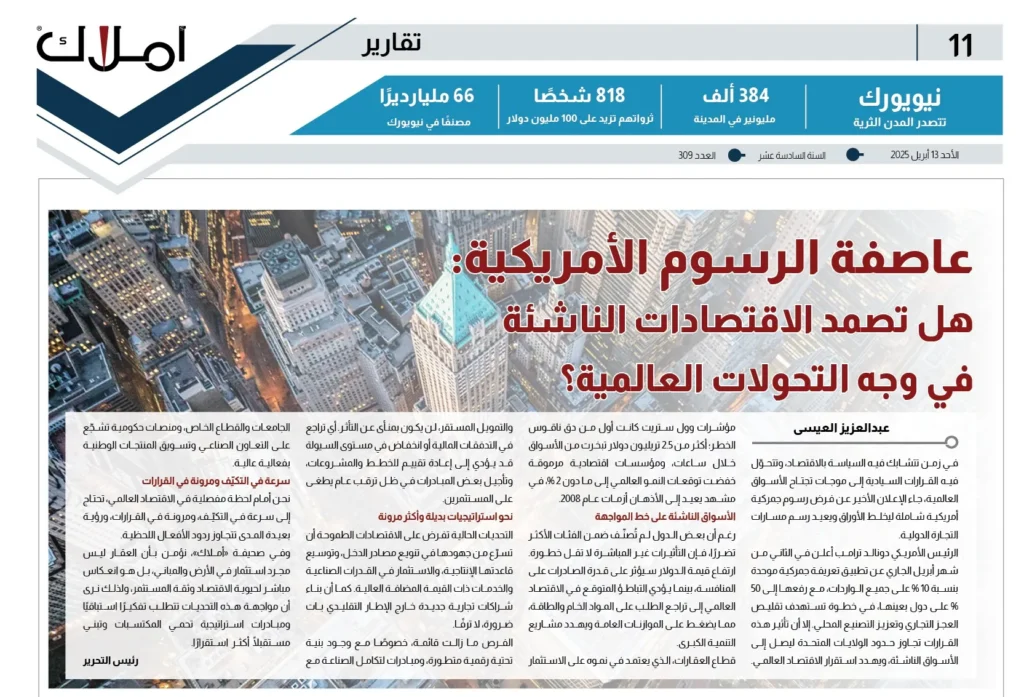
In a time when politics and economics are intertwined and sovereign decisions become waves that sweep across global markets, the recent announcement of sweeping US tariffs comprehensive tariffs has shuffled the cards and redrawn the paths of international trade.
In a time when politics and economics are intertwined and sovereign decisions become waves that sweep across global markets, the recent announcement of the imposition of <On April 2, the U.S. president announced a unified tariff of 10% on all imports and 50% on certain countries, in a move aimed at reducing the trade deficit and boosting domestic manufacturing. However, the impact of these decisions has spread beyond the US to emerging markets and threatens the stability of the global economy.
Wall Street indicators were the first to sound the alarm; more than $2.5 trillion evaporated from the markets within hours, and prestigious economic institutions cut global growth forecasts to below 2%, in a scene reminiscent of the 2008 crises.
Wall Street indicators were the first to sound the alarm.
Emerging Markets on the Frontline
<Although some countries have not been categorized as hardest hit, the spillover effects are no less serious. A stronger dollar will affect the competitiveness of exports, while an expected slowdown in the global economy will reduce demand for raw materials and energy, putting pressure on public budgets and threatening major development projects.<The real estate sector, which relies on stable investment and financing for its growth, will not be unaffected. Any decline in financial flows or decrease in liquidity could lead to a reassessment of plans and projects, and postpone some initiatives in light of the general uncertainty that prevails among investors.
The real estate sector, whose growth depends on investment and stable financing, will not be unaffected.
Towards alternative and more flexible strategies
Current challenges require ambitious economies to accelerate their efforts to diversify income sources, expand their productive base, and invest in industrial capabilities and high value-added services. Building new business partnerships outside the traditional framework has become a necessity, not a luxury. Opportunities still exist, especially with advanced digital infrastructure, initiatives to integrate industry with universities and the private sector, and government platforms that encourage industrial cooperation and the effective commercialization of national products.
Adaptability and flexibility
We are at a pivotal moment in the global economy that requires speed of adaptation, flexibility in decisions, and a long-term vision that goes beyond momentary reactions.
At Amlak, we believe that real estate is not just an investment in land and buildings, but a direct reflection of the vitality of the economy and investor confidence, so we believe that facing these challenges requires proactive thinking and strategic initiatives that protect gains and build a more stable future.
We are facing a pivotal moment in the global economy that requires speed and adaptation, flexibility in decisions, and a long-term vision that goes beyond momentary reactions.