
Real Estate - The Cabinet's approval of the comprehensive strategy for the real estate sector found great satisfaction in real estate circles, as the decision reflects the leadership's interest in developing the real estate sector in the Kingdom as one of the pillars of the national economy, and its keenness to regulate it, develop it, improve its supervision mechanisms, raise its efficiency, encourage investment in it, and enable it to increase its contribution to the GDP.
Real Estate.
Improving the performance of real estate facilities
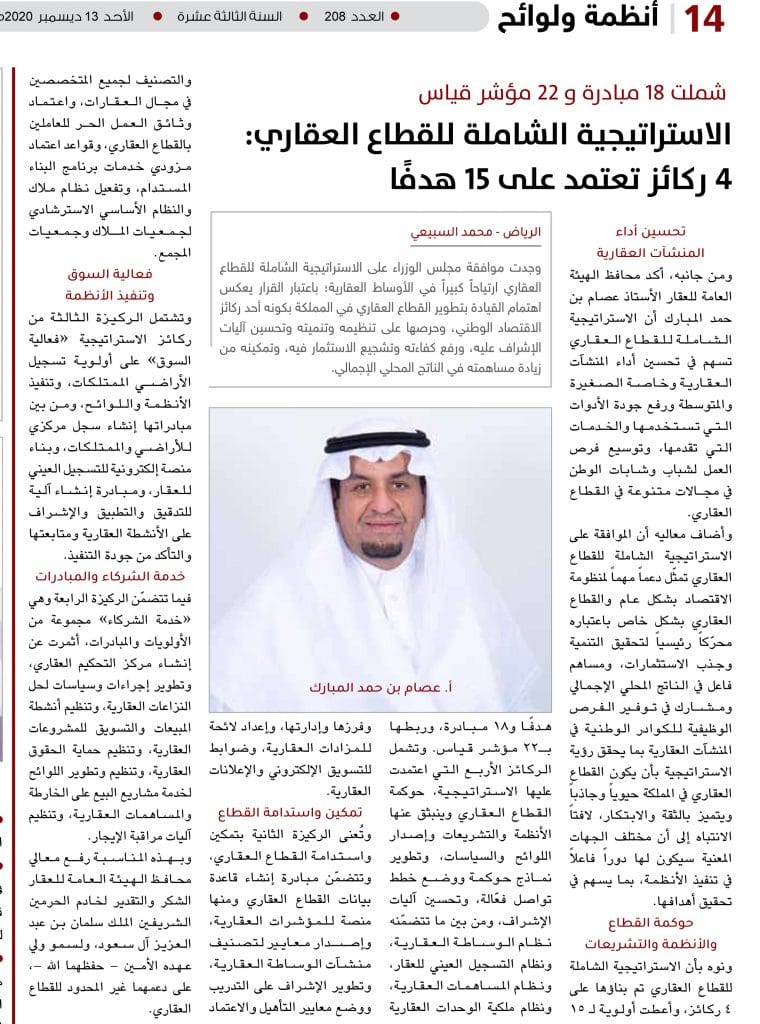
For his part, the Governor of the General Real Estate Authority, Mr. Essam bin Hamad Al Mubarak, confirmed that the comprehensive strategy for the real estate sector contributes to improving the performance of real estate establishments, especially small and medium-sized ones, raising the quality of the tools they use and the services they provide, and expanding job opportunities for young men and women in various fields in the real estate sector.
Al Mubarak added that the approval of the comprehensive strategy for the real estate sector represents an important support for the economic system in general and the real estate sector in particular as a major engine for achieving development and attracting investments, an effective contributor to the GDP and a participant in providing job opportunities for national cadres in real estate establishments, in order to achieve the vision of the strategy that the real estate sector in the Kingdom will be vital, attractive, characterized by confidence and innovation, pointing out that the various concerned authorities will have an active role in implementing the regulations, contributing to achieving its objectives.
<p class="wp-block-paragraph" style="font-weight: bold-face: bold-face: bold-face: bold-face: bold-face: bold-face: bold-face: bold-face: bold-face.Sector Governance, Regulations and Legislation
He noted that the comprehensive strategy for the real estate sector was built on 4 pillars, prioritized 15 objectives and 18 initiatives, and linked them to 22 measurement indicators, including the four pillars on which the strategy was based:
Governance of the real estate sector, which emanates from regulations and legislation, issuing regulations and policies, developing governance models, developing effective communication plans, and improving supervision mechanisms, including the real estate brokerage system, real estate registration system, real estate contributions system, real estate ownership, sorting and management system, real estate auctions regulation, electronic marketing and real estate advertising regulations.
Enabling and sustaining the sector
The second pillar is concerned with the empowerment and sustainability of the real estate sector, and includes the initiative of establishing a real estate sector database, including a platform for real estate indicators, issuing standards for the classification of real estate brokerage facilities, developing training supervision and setting qualification, accreditation and classification standards for all real estate professionals, approving self-employment documents for those working in the real estate sector, accreditation rules for sustainable building program service providers and activating the Malak system and the indicative statutes for owners" and community associations.
The second pillar is concerned with the empowerment and sustainability of the real estate sector, which includes the establishment of a real estate database, including a platform for real estate indicators.
Market Efficiency and Regulation Implementation
The third pillar of the strategy, Market Effectiveness, includes:
Market Effectiveness
Prioritizing land and property registration.
Implementation of laws and regulations.
Among its initiatives is the establishment of a centralized land and property registry.
Building an electronic platform for real estate registration.
And the initiative to establish a mechanism to audit, implement, supervise and follow up on real estate activities and ensure the quality of implementation.
Partner Services and Initiatives
While the fourth pillar, "Partner Service," includes a set of priorities and initiatives, which resulted in the establishment of the Real Estate Arbitration Center, the development of procedures and policies to resolve real estate disputes, the regulation of sales and marketing activities for real estate projects, the protection of real estate rights, the regulation and development of regulations to serve off-plan sales projects and real estate contributions, and the regulation of rent control mechanisms.
On this occasion, His Excellency the Governor of the General Real Estate Authority extended his thanks and appreciation to the Custodian of the Two Holy Mosques King Salman bin Abdulaziz Al Saud and His Royal Highness the Crown Prince for their unlimited support for the real estate sector.