
Remote work has become remote work an urgent necessity for many companies and organizations after the COVID-19 pandemic-19 pandemic has proven its success and yielded many benefits, prompting some employers to change their approach and shift toward hybrid work or hiring remote employees. They are now, for the first time, reaping the rewards of this transition.
Consequently, the commercial real estate sector has been affected by this shift as employees no longer require physical offices, which will lead in the future to a reliance on limited real estate for the management of large companies—by making maximum use of modern technologies to monitor and execute business operations. Statistics indicate that the number of remote workers has increased by 115%, and it is expected that over the next ten years, remote workers will account for more than 38% of all full-time employees; remote work may indeed be the future of employment.
The American Experience and Remote Work
Facing the commercial real estate sector in the United States a growing crisis, with mounting concerns over massive debts totaling $560 billion due in 2025, which have been exacerbated by the rise of remote work and higher U.S. interest rates.
As a result of concerns stemming from remote work, some banks, such as New York Community Bancorp and Japan’s Ozora, have warned of significant losses due to their investments in U.S. commercial real estate. Meanwhile, Deutsche Bank has more than quadrupled its provisions for real estate losses in the United States.
$560 billion in non-performing loans
This crisis has been exacerbated by the shift to remote work and rising interest rates, which are reducing demand for commercial real estate and making it harder to repay loans. $560 billion in commercial real estate debt is due, accounting for more than half of the sector’s total debt.
Increased Productivity: The Greatest Benefit
Organizations may implement a remote work policy for a number of practical reasons, including economic, social, and environmental factors. In general, employees who work from home save themselves a significant amount of time, and are able to recharge from time to time, which automatically improves their productivity compared to when working from an office; for this reason, remote work is commonplace in these sectors.
In some professions, particularly in technology-related sectors, employees are often required to work in ”blocks” and may need to concentrate for long periods, making a private space free from distractions essential, so remote work is common in these sectors.
Reduced Need for Office Space and Amenities
Remote work eases the burden on employers regarding the provision of employee benefits when managing remote teams or a number of independent contractors; companies are not required to offer retirement plans to their independent contractors; Consequently, they are likely to arrange their own health insurance and other benefits.
Employers will pay less—or nothing—for office space, one of the most obvious benefits of remote work. While renting or purchasing office space is expensive, renovating and maintaining an in-house office involves even greater costs.
And let’s not forget water and electricity bills, as well as Wi-Fi expenses. In other words, the savings on office expenses can amount to substantial figures. Naturally, any reduction in expenses increases the company’s revenue.
= = =
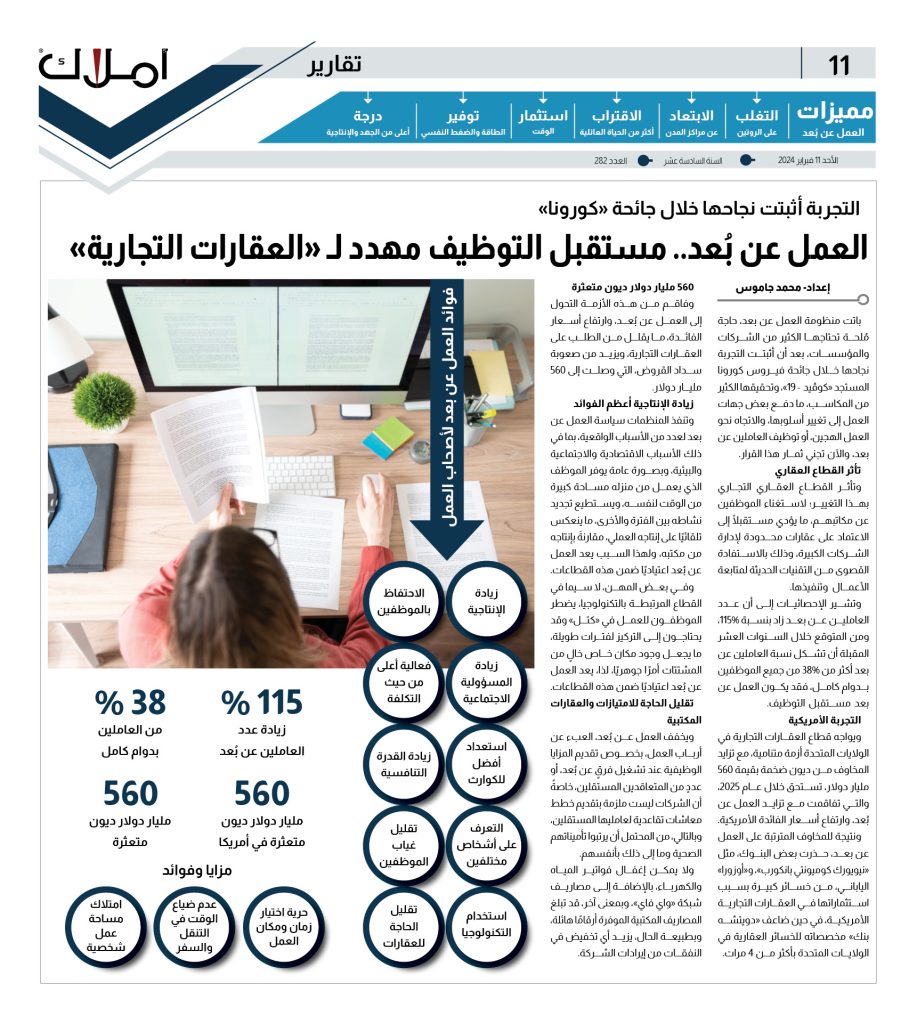
Benefits of Remote Work for Employers
Increased productivity.
Employee retention.
Increased social responsibility.
Greater cost-effectiveness.
Better disaster preparedness.
Increased competitiveness.
Meeting different people.
Reduced employee absenteeism.
Use of technology.
Reduced need for real estate.
Round-the-clock work.
= = =
115% increase in the number of remote workers
38% of full-time employees.
$560 billion in non-performing debt in the U.S.
$560 billion in delinquent debt
= = =
Advantages and Benefits
Freedom to choose when and where to work.
No time wasted on commuting and travel.
Having a personal workspace.