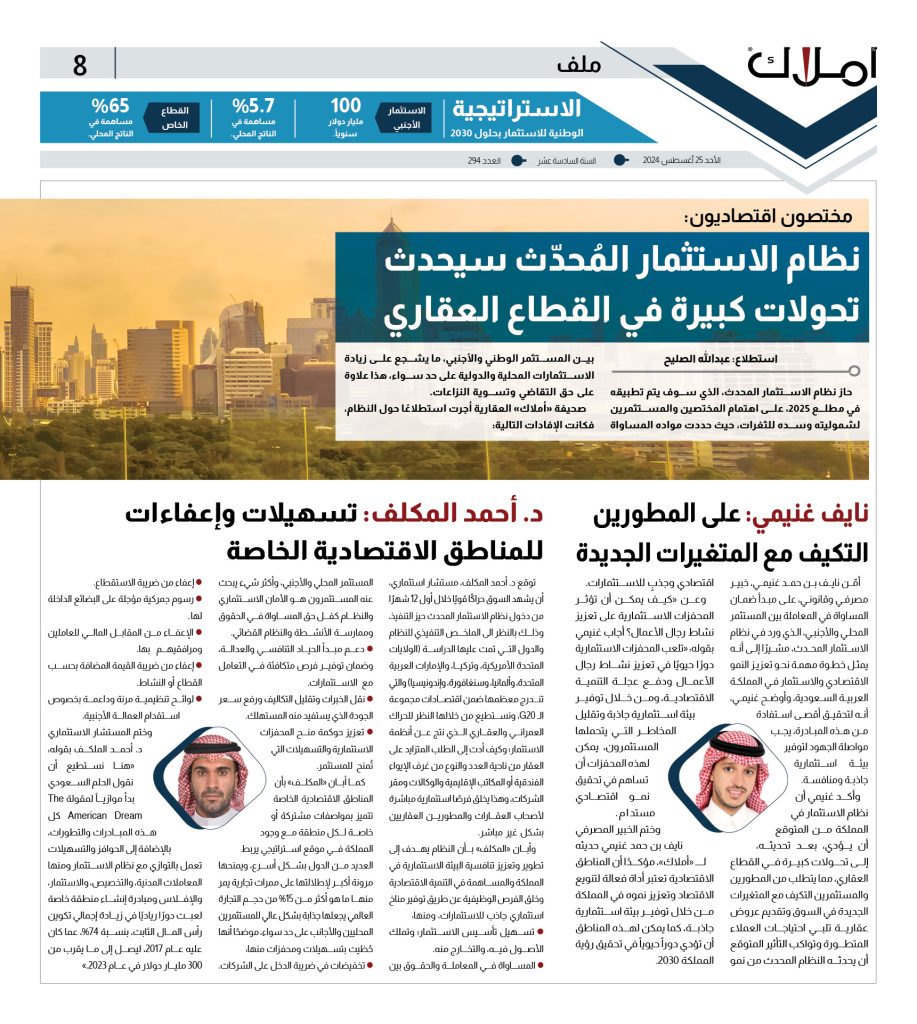

Survey: Abdullah Al-Saleh: the updated investment law, which will be implemented in early 2025, has attracted the attention of experts and investors for its comprehensiveness and its ability to close loopholes. Its provisions establish equality between domestic and foreign investors, which encourages an increase in both local and international investments, in addition to the right to litigation and dispute resolution.
The real estate newspaper “Amlak” conducted a survey on the law, yielding the following responses:
Naif Ghoneimi: Developers must adapt to the new changes

Naif bin Hamad Al-Ghunaimi, a banking and legal expert, affirmed the principle of ensuring equal treatment between local and foreign investors, as stipulated in the updated Investment Law, noting that it represents an important step toward promoting economic growth and investment in the Kingdom of Saudi Arabia. Al-Ghunaimi explained that to maximize the benefits of this initiative, efforts must continue to provide an attractive and competitive investment environment.
Ghanimi emphasized that the Kingdom’s investment law is expected to lead, following its update, bring about significant transformations in the real estate sector, requiring developers and investors to adapt to new market dynamics and offer real estate solutions that meet evolving customer needs and keep pace with the economic growth and investment attraction expected from the updated law.
When asked, “How can investment incentives help boost business activity?“ Ghoneimi replied: “Investment incentives play a vital role in boosting business activity and driving economic development. By providing an attractive investment environment and reducing the risks borne by investors, these incentives can contribute to achieving sustainable economic growth.
Banking expert Naif bin Hamad Ghoneimi concluded his remarks to ”Amlak," emphasizing that economic zones are an effective tool for diversifying the economy and promoting its growth in the Kingdom by providing an attractive investment environment, These zones can also play a vital role in achieving the Kingdom’s Vision 2030.
Dr. Ahmed Al-Mukallaf: Incentives and Exemptions for Special Economic Zones
Dr. Ahmed Al-Mukallaf, an investment advisor, expects the market to see strong activity during the first 12 months after the updated investment system takes effect, based on the system’s executive summary and the countries included in the study (the United States, Turkey, the United Arab Emirates, Germany, Singapore, and Indonesia)—most of which are part of the G20 economies. Through this, we can examine the urban and real estate developments resulting from these investment systems; and how they have led to increased demand for real estate in terms of the number and type of hotel rooms, regional offices, agencies, and corporate headquarters, thereby creating direct investment opportunities for property owners and, indirectly, for real estate developers.
The ”Minister“ explained that the system aims to develop and enhance the competitiveness of the Kingdom’s investment environment and contribute to economic development and job creation by providing an investment climate that attracts investment, including:
– Facilitating the establishment of investments; the ownership of assets within them; and the exit from them.
– Equal treatment and rights for local and foreign investors; what investors seek most is investment security, and the system guarantees equal rights, the freedom to conduct business activities, and a fair judicial system.
– Upholding the principles of competitive neutrality and fairness, and ensuring equal opportunities in the treatment of investments.
– Transferring expertise, reducing costs, and improving quality, which benefits consumers.
– Strengthening the governance of investment incentives and facilities granted to investors.
The ”Minister“ also noted that special economic zones share common characteristics or unique features specific to each region, with the Kingdom’s strategic location connecting numerous countries more efficiently, and granting them greater flexibility due to their proximity to trade routes through which more than 15% of global trade passes, making them highly attractive to both local and foreign investors alike. He explained that these zones have been granted incentives and facilities, including:
– Corporate income tax reductions.
– Exemption from withholding tax.
– Deferred customs duties on imported goods.
– Exemption from social security contributions for employees and their dependents.
– Exemption from value-added tax (VAT) depending on the sector or activity.
– Flexible and supportive regulations regarding the recruitment of foreign workers.
Investment Advisor Dr. Ahmed Al-Malik concluded by saying: ”Here we can say that the Saudi Dream has begun to parallel the ‘American Dream.’ All these initiatives and developments, in addition to incentives and facilitations, operate in tandem with the investment system—including civil transactions, privatization, investment, bankruptcy, and the initiative to establish a special economic zone—have played a leading role in increasing total fixed capital formation by 74% compared to 2017, reaching nearly $300 billion in 2023.”