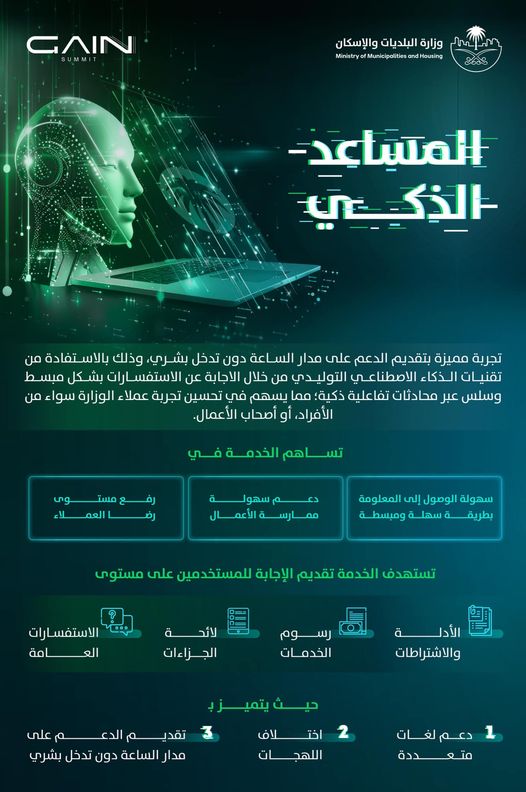
On September 11, 2023, the Ministry of Municipalities and Housing in Saudi Arabia launched the Smart Assistant service as part of its efforts to enhance digital services and improve citizen experience. This project aligns with the Kingdom's Vision 2030, which aims to achieve digital transformation and facilitate access to government services. This report will detail the Smart Assistant, its functionality, objectives, and how to use it.
What is a smart assistant?
The Smart Assistant is an advanced digital system that uses artificial intelligence technologies to enhance citizen interaction with the services of the Ministry of Municipalities and Housing. It aims to provide quick and efficient answers to inquiries related to a wide range of services, from housing services to municipal information.
The smart assistant service provides an intelligent experience that enables them to answer all their inquiries interactively and instantly by employing generative artificial intelligence technologies, and helps customers obtain clear and direct answers about the ministry’s services, regulations, and related requirements around the clock without human intervention.
How does a smart assistant work?
1. Artificial Intelligence Technologies
The smart assistant relies on natural language processing (NLP) and machine learning technologies to understand and analyze user queries. It can handle frequently asked questions and provide accurate, real-time answers.
2. Interaction across multiple channels
The smart assistant can be accessed through the Baladi app, the ministry's official website, smartphone applications, and social media. This allows users to benefit from services easily and conveniently.
3. Comprehensive database
The smart assistant has a comprehensive database containing accurate information about all services provided by the ministry. This information is updated regularly to ensure its accuracy and relevance.
Smart Assistant Goals
1. Improve user experience
The smart assistant aims to provide a convenient and fast user experience, making it easier for citizens to access the information and services they need without having to wait in queues.
2. Enhancing transparency
The assistant works to enhance transparency in the provision of government services, by providing clear information about procedures and regulations, thus reducing rumors and confusion.
3. Supporting digital transformation
The assistant is considered part of the ministry's efforts for digital transformation, which contributes to improving work efficiency and reducing administrative burdens.
How to use the smart assistant
1. Accessing the platform
Users can access the smart assistant via the “Baladi” application or the official website of the Ministry of Municipalities and Housing.
2. Asking questions
After logging into the platform, users can directly submit their inquiries. These inquiries can include questions about housing application procedures, information about housing projects, or any other questions related to the services provided.
3. Receiving responses
The smart assistant will analyze the question and provide an immediate answer. If an answer is unavailable, it can direct the user to appropriate resources or refer them to customer service.
In conclusion, the Smart Assistant initiative launched by the Ministry of Municipalities and Housing is a significant step towards achieving digital transformation in the Kingdom. By improving user experience and enhancing transparency, this system contributes to providing more efficient and effective government services. The use of artificial intelligence technologies opens new horizons for interaction between citizens and government entities, reflecting the Kingdom's commitment to improving the quality of life for its citizens and achieving the goals of Vision 2030.