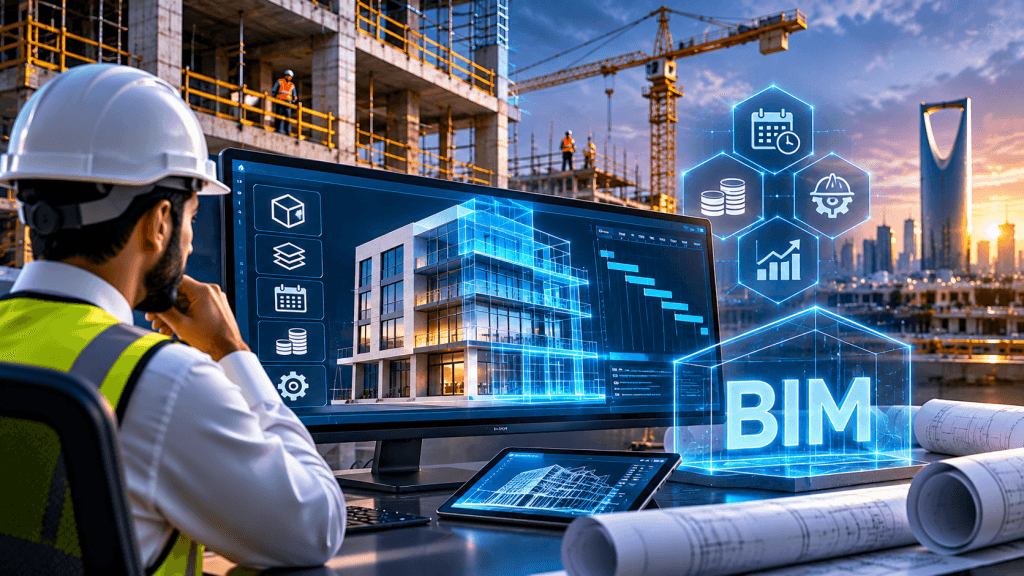

Real estate project management is witnessing a major boom, with the increasing complexity of buildings and the overlap of construction, electrical and mechanical works. It no longer relies on traditional engineering plans alone, but there is a greater need for tools that allow for the coordination of all project details before implementation begins, and limit errors that may cost developers additional time and money.
Building Information Modeling (BIM) technology is at the forefront of these tools, as it enables the creation of an integrated digital model of the building, combining architectural and structural design and technical systems into one image, and gives engineers, contractors and developers a clear view of the project details before its implementation on the ground.
How does BIM technology work?
Simply put, the technology is not limited to creating a three-dimensional model of the building, but rather it transforms the design into a database that includes information about its components, dimensions, materials, and quantities, and clarifies the relationship between its various elements.
For example, a conflict between air conditioning extensions and a structural element can be detected before work begins, rather than on-site after implementation, thus reducing the need for demolition and redoing of work and the resulting delays and additional costs.
The technology also allows linking the model to the project timeline, to monitor implementation phases and compare actual progress with the plan, and linking it to costs and quantities to estimate the impact of any modification in design or materials on the budget.
5 direct benefits of execution management
BIM technology contributes to improving the management of real estate projects by enabling engineering teams to detect conflicts between different disciplines before implementation begins, thus reducing errors and rework costs. It also helps to determine quantities more accurately, assess the impact of modifications on the budget, and link the design to the schedule to monitor the progress of work and track potential delays.
The technology also provides a unified database that allows for coordination of work between the designer, consultant and contractor, as well as maintaining detailed data on the building's components and systems, which can be used in operation and maintenance work after handover.
What about its implementation in Saudi Arabia?
There is increasing interest in standardizing information management standards in Saudi construction projects. One of the most prominent steps in this direction is the Saudi Standards, Metrology and Quality Organization’s proposal of the “Information Management using Building Information Modeling – Part Four: Information Exchange” standard, based on the international standard ISO 19650-4:2022.
These standards aim to regulate information exchange among project stakeholders and improve the quality of data used during the design, implementation, and delivery phases. Further project details can be found on the Saudi Standards, Metrology and Quality Organization (SASO) website .
A study published in the journal Frontiers in Built Environment also addressed the reality of applying technology in construction projects in Saudi Arabia, and highlighted the importance of design coordination, identifying conflicts, and improving communication between project stakeholders in reducing implementation-related problems.
Does the technology guarantee a reduction in construction costs?
Despite its advantages, using BIM does not necessarily mean an automatic decrease in project costs, as the return depends on the efficiency of its application, the quality of the data, the training of workers, and the extent to which the developer, consultant, and contractor are committed to using and updating the model throughout the implementation phases.
Companies face challenges related to the cost of programs and training, a shortage of specialized personnel, and the difficulty of standardizing information exchange mechanisms among participating entities. Therefore, successful implementation requires a clear plan that defines each party's responsibilities, the data to be updated, and a mechanism for adopting the model as a common reference for the project.
What does it mean for a real estate buyer?
The use of technology may positively impact the quality of property execution by reducing conflicts and errors, improving coordination between work teams, and providing more organized information about the building's components upon delivery.
However, the developer's use of BIM technology does not constitute an independent guarantee that the property is free of defects, nor does it replace engineering supervision, quality tests, and technical inspection before handover.
In conclusion, Building Information Modeling (BIM) represents a transformation in the way real estate projects are managed. Instead of discovering problems after they occur, it allows the engineering team to anticipate and address them early, which supports time and cost control and improves the quality of execution, and makes data an essential part of project management from design to operation.
Read also:
Don't wait for the first leak... 8 points to check in your home before the rainy season
How do companies measure resident satisfaction after units are handed over?