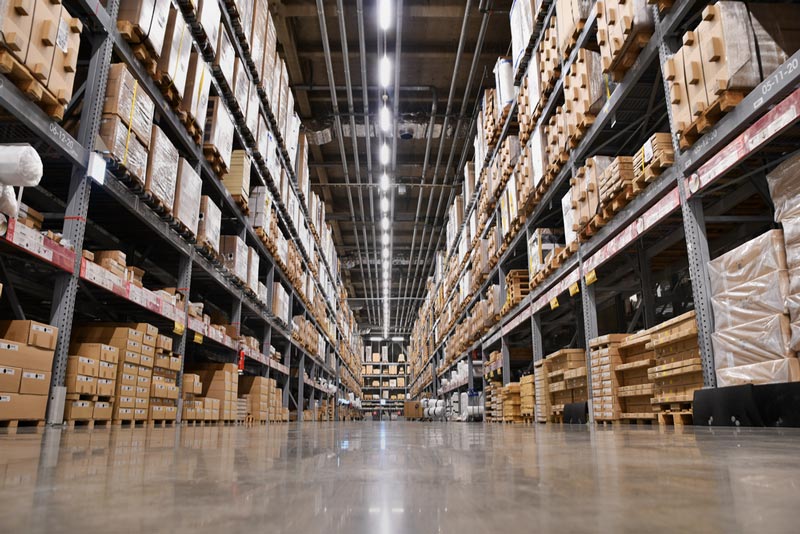

Warehouse rents in the capital have increased by 16%. In its report on Saudi Arabia's industrial and logistics market, the firm noted that the Kingdom is on track to become the leading industrial center in the Middle East, driven by the growth of e-commerce, government incentive packages, increased local and foreign investments, as well as significant infrastructure expansion.
According to the report, Saudi Arabia's industrial and logistics market is on track to become the leading industrial center in the Middle East. <According to Knight Frank, the Saudi industrial sector recorded remarkable growth in 2024, with 1,346 new industrial licenses issued, with capital investments of about 50 billion riyals. However, the shortage of warehousing and logistics space has put upward pressure on rents, especially in Riyadh. <Average warehouse rents in the capital rose to 208 riyals per square meter, while rents for prime locations exceeded 250 riyals. In areas such as Masanah, Al Bariya, Al Farouq and Al Manakh, rents jumped by more than 20% as a result of strong demand, while the total inventory of warehouses and logistics in Riyadh reached about 28 million square meters.
In Jeddah, the average rents for warehouses in the capital jumped to Riyal 108 per square meter. <In Jeddah, average rents recorded around 238 riyals per square meter with an occupancy rate of 97%. The city continues to expand at a steady pace, with inventory reaching 19.8 million square meters and is expected to grow by 15.5% by 2030.
<Al Khumra is the beating heart of Jeddah's logistics, accounting for 82% of the total inventory alone. The area has benefited from small warehouse development projects through 2024 to strengthen its position as a strategic logistics corridor linking industrial areas to ports.
Government support through entities such as MODON and PIF-linked organizations continues to drive the expansion of industrial zones. Although no major projects will be delivered in 2024, the market has witnessed the signing of huge agreements that point to a wave of expansion over the next four years.
Knight Frank explained that the trend in the industrial sector is moving towards custom-built projects to meet the needs of advanced industries, reflecting a qualitative shift in the Kingdom's industrial planning.
Night Frank explained that the industrial sector is moving towards custom-built projects to meet the needs of advanced industries, reflecting a qualitative shift in the Kingdom's industrial planning. 2024 saw a number of major deals signed in the sector, most notably Saudi real estate developer Caden's partnership with Germany's DB Schenker to expand logistics capabilities, GFH Group's collaboration with Panattoni Saudi Arabia to develop 500,000 square meters of modern facilities, and a joint venture between Arcapita and Rakaz to establish an advanced logistics complex in Riyadh.
The report identifies sustainability as a key driver for the industrial sector in the Kingdom. <The report identifies sustainability as one of the key drivers of the market, noting that major companies such as Maersk and Agility are leading the development of green infrastructure through the use of solar energy and energy-efficient storage solutions, furthering the Kingdom's environmental goals. <The establishment of special economic zones such as the King Salman Automotive Park in King Abdullah Economic City and the Integrated Economic Zone in Riyadh are playing a key role in accelerating the growth of logistics and supply chains. These zones operate under public-private partnerships, making them attractive to global investments and companies.
The report noted. The report noted that foreign direct investment (FDI) reforms have created a more open and competitive market, prompting multinational companies to enter into strategic partnerships with local entities to set up their logistics businesses within the Kingdom.
Adam Wynne, partner, said. <Adam Wynne, Partner and Head of Commercial Agency at Knight Frank, said Saudi Arabia remains a pivotal center for global business expansion. The sector is undergoing a remarkable transformation driven by technological advances, a focus on sustainability, and increased international collaboration.“
Adam Wynne, Partner and Head of Commercial Agency at Knight Frank, said. "The Kingdom continues to implement the Vision 2030 agenda and is witnessing emerging trends such as build-to-rent projects, automation and cross-border investments that are reshaping the sector and opening the door for tremendous growth in the coming years."
He added: ”Saudi Arabia continues to be a pivotal center for global business expansion.