

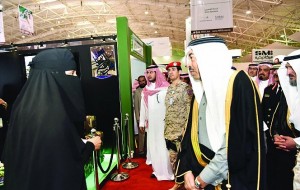
Under the patronage of the Custodian of the Two Holy Mosques, King Salman bin Abdulaziz Al Saud, the largest industrial event in the Middle East was launched, following the inauguration by the Ministry of Defense of the Armed Forces Exhibition for Supporting the Localization of Spare Parts Manufacturing (AFED), at the Riyadh International Convention and Exhibition Center. The opening ceremony was graced by Assistant Minister of Defense, Lieutenant General Mohammed Al-Ayesh, who affirmed that the Crown Prince's directives were evident in opening the door for the Saudi private sector to support the armed forces' systems by including in the Ministry of Defense's contracts with international companies a requirement for the localization of spare parts manufacturing at a rate of 101 TP3 T for the total number of spare parts.
Securing the needs and requirements of the armed forces
The exhibition is located across 4 halls within the center, covering an area of 15,000 square meters. It is an investment opportunity for the private sector to showcase its products and manufacture various needs of the armed forces and major participating companies for spare parts and equipment, with the presence of major companies in the field of manufacturing equipment and spare parts, in the context of growing investment incentives in the Kingdom and the development of its environment in general.
The Ministry of Defense aims, through holding the exhibition and its accompanying scientific programs, to support the localization of the spare parts industry and to inform the private sector of the needs and requirements of the armed forces for materials and spare parts, in addition to establishing communication channels for planning and follow-up between the beneficiaries, the armed forces, local and international factories and companies, and research bodies, in addition to creating a long-term strategic relationship with the private sector in the field of local manufacturing. The exhibition reflects the direction of the state supporting the national initiative and highlighting the strategic objectives of the exhibition to manufacture most of the spare parts for military systems and others.
Localization of 70% spare parts manufacturing
Assistant Minister of Defense, Lieutenant General Mohammed Al-Ayesh, explained that the General Administration for Supporting Local Manufacturing aims to localize 70% of the manufacturing of spare parts for the armed forces in the long term. For this purpose, it has put in place a mechanism to facilitate cooperation between international companies and the Saudi private sector, in partnership with the Contracts and Agreements Department.
Al-Ayesh stressed that the exhibition is a valuable opportunity for the private sector to learn about the needs and requirements of the armed forces for materials and spare parts that can be manufactured locally, in addition to establishing communication channels for planning and follow-up between the armed forces and local factories, companies and research bodies to promote local manufacturing. Al-Ayesh emphasized that the benefit of the exhibition is to have continuous readiness of the military capabilities of the armed forces in their operations, in addition to reducing the cost of some materials by between 2 and 3 times their imported value.
Achievements of the General Administration for Local Manufacturing
For his part, Abdulrahman Al-Zamil, Chairman of the Council of Saudi Chambers, explained that the General Administration for Local Manufacturing has achieved remarkable accomplishments for the private sector since it began. The first of these was transforming the committee into a general administration to support the localization of local manufacturing, directly linked to His Highness the Minister of Defense, with the membership of military leaders and a representative of the private sector. The second was obligating all foreign spare parts suppliers to supply ten percent of any contract locally.
Al-Zamil added that the third achievement is the ability of the administration to form specialized committees to communicate with local factories, qualify their products, and facilitate procedures for purchasing them by various military agencies, as well as encouraging and directing foreign companies to local manufacturing in some devices, whether due to routine procedures or financial procedures. Al-Zamil praised the administration’s role in opening the field for the private sector to cooperate with military procurement and its specialized management.
Great results and outcomes for the exhibition
The numbers tell us that preparations for this major industrial event were made early, accompanied by a revolution in the rehabilitation of factories, where 600 existing factories were maintained and equipped, and more than 250 factories were contracted and more than 550 local contracts were concluded.
In terms of numbers, the exhibition also represents the largest economic event of its kind in the Middle East, as the “AFED” exhibition provides more than 40,000 new investment opportunities in the spare parts manufacturing sector, and more than 1,300 investment opportunities in specialized support items in the medical sector, in addition to showcasing a range of innovations and inventions that have contributed to solving technical problems.


