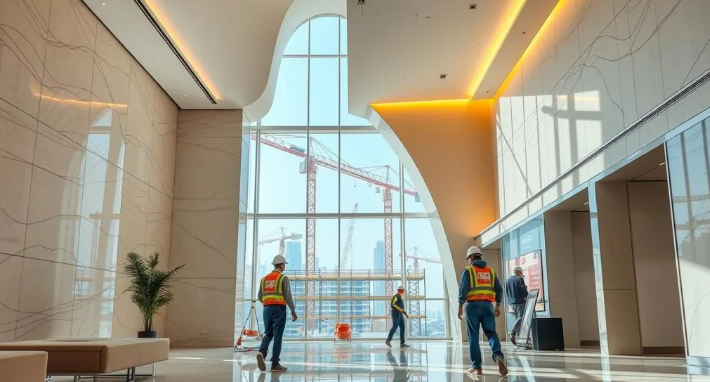
The real estate sector is witnessing a remarkable shift in the concept of “service-based real estate”, where the value of a project no longer depends on the unit itself, but rather on the surrounding service system. This globally growing trend is redefining the relationship between housing and services, turning “service space” into a key element guiding purchasing and investment decisions.
The real estate industry is witnessing a remarkable shift.
Why are services coming to the forefront? <Users are increasingly interested in services that enhance the quality of daily life, such as co-working spaces, health clubs, shaded recreation areas, walking trails, meeting rooms, and smart energy management facilities. With this shift, services have become not just an add-on, but a key attraction that differentiates a project in a highly competitive market.
Service spaces as a standalone product
In this new model, services become a separate economic unit within the project, with an independent operating and revenue strategy, and their value is sold to users and investors alike.The main features of this trend include:
Service spaces as a standalone product
Service spaces as a standalone product
- Integrating services at the heart of the urban design rather than on the periphery.
- Growing shared spaces that are used by all residents or visitors.
- Professional management of services that makes them a direct source of financial return.
- Adopt smart technologies to optimize the user experience and monitor operation.
Impact on the developer and investor: This model offers clear advantages:
- Raising the market value of projects with advanced services.
- Increased occupancy due to higher user satisfaction.
- Diversify revenue streams through paid services or memberships.
- Enhance the identity of the project by offering an integrated experience, not just a residential or commercial unit.
How does this reflect on the Arab market? <Some projects in the Arab region - especially in the Gulf - are beginning to embrace this vision with centralized community spaces, health clubs, and small business centers within residential complexes. As cities expand and customer expectations rise, it is expected that services will shift from an “add-on” to a standalone element on which the entire project is built.
The Conclusion
The rise of service space as a standalone real estate product signals a reshaping of market priorities; value is no longer measured by the number of meters, but by how well a project can deliver an integrated living experience.Developers who grasp this shift early will have a clear competitive advantage in a market that is steadily moving toward more diverse and richer real estate models.
Developers who grasp this shift early will have a clear competitive advantage in a market that is steadily moving toward more diverse and richer real estate models.