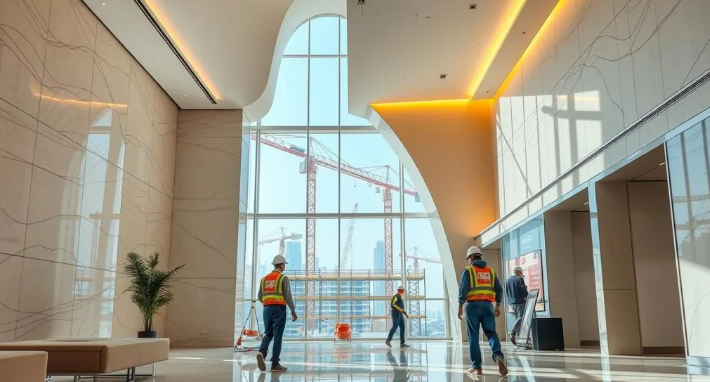
While giant cranes were towering over Riyadh and Muscat in 2025, a different kind of movement was taking place in the corridors of decision makers; a movement that did not just pour concrete and build complexes, but focused on drafting a new «real estate legislation». Today, as the sun rises in 2026, the real estate scene in the region's major markets seems to be emerging from the cocoon of traditionalism into the realm of regulation and transparency.
«Price Justice» and tearing down the walls of monopoly
<In Riyadh, the narrative is no longer limited to the number of housing units pumped into the market, but to «curbing inflation». 2025 was the year of confrontation with speculation; the General Real Estate Authority became a «digital censor» that monitors price movements in real time.
The year 2025 was the year of confrontation with speculation. <The story in the Kingdom began to take a dramatic turn when white land was put under the microscope of strict fees, forcing «silent spaces» within cities to speak the language of development or concession. By the last quarter of last year, the fruits of this policy began to show in the slowdown in price growth, which registered 4.3% at the beginning of the year, giving a glimmer of hope to the generation of aspiring homeowners within the targets of Vision 2030. The curtain did not close at this point, but the doors were opened to global capital through «real estate residency», which turned luxury villas into transit tickets to settle in the heart of the largest economy in the region.
Oman's legislative renaissance and the sound of billion-dollar numbers
<On the other side of the Gulf, the Sultanate of Oman was writing a new chapter in its real estate narrative, with Royal Decree No. 79 of 2025 as its protagonist. This law was not just a regulatory text, but a «declaration of confidence» for local and foreign investors alike. This legislative maturity was immediately reflected in the language of numbers; while global markets were waiting in anticipation, the value traded in Oman jumped past the RO928 million mark. In Muscat, the story was not just about space, but quality; residential real estate prices rose by 7.3%, driven by the emergence of model cities such as Sultan Haitham City, which is taking shape as an icon of smart cities. Foreign investment in Oman is no longer a matter of buying square meters, but a partnership in a tourism and development vision that gives the investor the right of residence and a sense of belonging.2026The year of «maturity», not «bubble»
Today, at the beginning of 2026, observers agree that the scene in Saudi Arabia and Oman is no longer a market for rapid speculation, but has become a «safe haven» governed by legislation, Saudi Arabia has succeeded in turning real estate into a tool for social and economic balance, and Oman has succeeded in turning it into a global attraction sector par excellence.
Today, at the beginning of 2026, observers agree that the scene in Saudi Arabia and Oman is no longer a market for rapid speculation. It is a success story that goes beyond buying and selling real estate; it is a story of building nations that put sustainability and transparency above all else, so that real estate remains the «righteous son» of the economy in both countries.
@OMARALKENDI