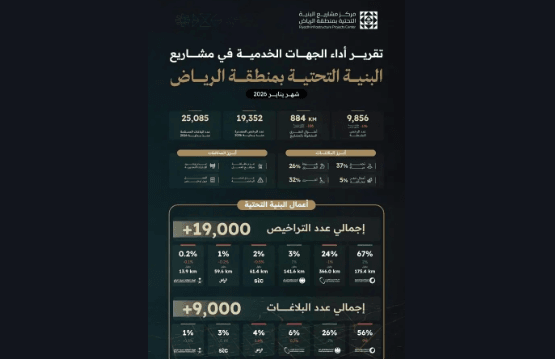
The Riyadh Region Infrastructure Projects Center a report on the performance of service providers for January 2026; as part of its ongoing approach to making operational data available and measuring the efficiency of implementing infrastructure projects, thereby supporting improvements in the quality of fieldwork and enhancing the level of commitment and coordination among relevant agencies.
The report revealed that the total number of permits issued since the beginning of the year reached 19,352, while the number of active permits stood at 9,856; reflecting the continued pace of work on infrastructure projects and the expansion of implementation across multiple sites within the region. The report noted that the total length of roads under construction reached 884 kilometers during the same period, an indicator that reflects the scale of field activity and the distribution of work across various service sectors, including critical infrastructure and utility networks.
Regarding reports, the center clarified that the total number of reports received since the beginning of the year reached 25,085, with the most prominent being reports of gatherings (37%), sinkholes (26%), and “other” reports at 32%, in addition to 5% regarding unauthorized excavation work; this underscores the importance of continuous monitoring and improving the speed of field response.
The report also reviewed the most notable violations observed at project sites, which included: unsanitary work sites, working without a permit, and failure to renew permits; this is part of efforts to raise the level of compliance and improve the quality of execution at infrastructure sites.
The Center emphasized that the periodic publication of performance reports supports the principles of transparency, enhances coordination efficiency, and provides accurate indicators that help improve the urban landscape and raise the quality of infrastructure projects in the Riyadh region.

19,352 licenses issued for infrastructure projects in Riyadh region since the beginning of 2026
Report monitors 19,352 licenses, 884 kilometers of occupied roads and 25,085 reports, with a focus on compliance, improved coordination and transparency