
The countdown has begun for the implementation of the Riyadh Municipality’s decision prohibiting the use of properties as furnished apartments on streets 30–36, The Secretariat has given owners of furnished apartments until next Ramadan to vacate them and convert them into residential apartments, in light of recent measures taken by the Riyadh Region Secretariat to regulate the real estate and housing sectors, in order to align with future aspirations and vision.
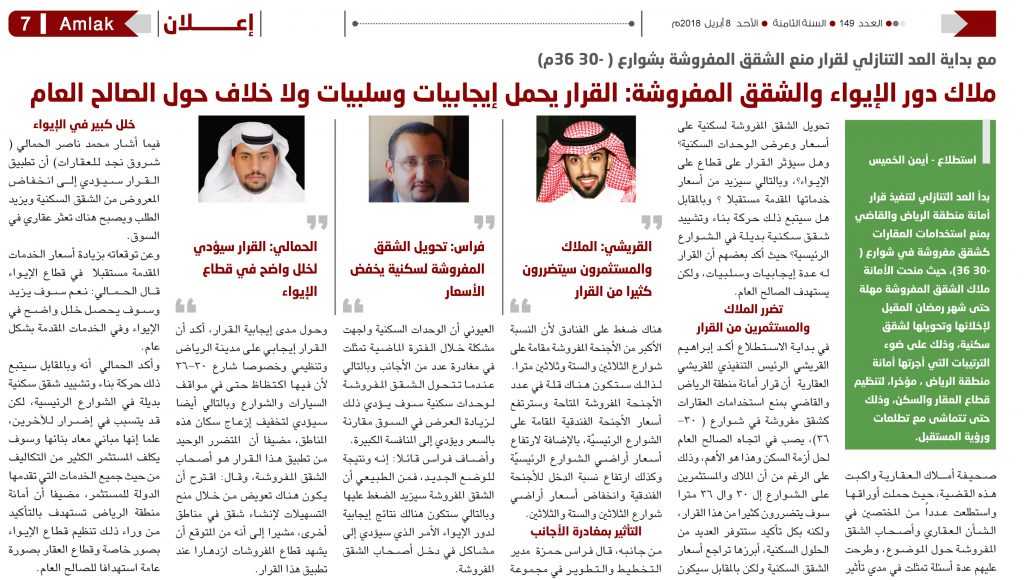
The Amlak Real Estate newspaper covered this issue, conducting interviews with a number of real estate experts and owners of furnished apartments on the subject, and posed several questions to them, such as: To what extent will converting furnished apartments into residential units affect prices and the supply of housing units? Will the decision impact the accommodation sector, and consequently lead to higher prices for its services in the future? Conversely, will this lead to the construction of alternative residential apartments on main streets? Some of them confirmed that the decision has several pros and cons, but it aims to serve the public interest.
Landlords and investors are affected by the decision
At the beginning of the survey, Ibrahim Al-Quraishi, CEO of Al-Quraishi Real Estate stated that the decision by the Riyadh Municipality to prohibit the use of properties as furnished apartments on streets (30–36), is in the public interest to resolve the housing crisis, and that is what matters most. This is despite the fact that property owners and investors on streets 30 and 36 meters wide will be significantly affected by this decision, but there will certainly be many housing solutions available, most notably a decline in apartment prices; however, in return, there will be pressure on hotels because the majority of furnished suites are located on 30- and 36-meter streets.
Consequently, there will be a shortage of available furnished apartments, and prices for hotel suites on the main streets will rise, in addition to rising land prices on main streets, as well as higher revenue for hotel suites and lower land prices on 30th and 36th Streets.
The impact of foreigners leaving
For his part, Firas Hamza , Director of Planning and Development at Al-Ayuni Group, that residential units have faced a problem in recent times due to the departure of a number of foreigners; consequently, when furnished apartments are converted into residential units, this will lead to an increase in market supply relative to price, resulting in significant competition.
Firas added: "As a result of the new situation, it is natural that pressure on furnished apartments will increase, and consequently, there will be positive outcomes for the accommodation sector, which will lead to problems for the income of furnished apartment owners."
Regarding the extent to which the decision is positive, he emphasized that the decision is positive for the city of Riyadh and for urban planning, especially on 30th Street-36, as these areas are overcrowded even in parking lots and on the streets, and consequently, it will also alleviate the inconvenience faced by residents of these areas. He added that the only party affected by the implementation of this decision is the owners of furnished apartments, and he said: "I propose that compensation be provided by offering incentives to build apartments in other areas," noting that the furnished apartment sector is expected to flourish once this decision is implemented.
A major imbalance in housing
Meanwhile, Mohammed Nasser Al-Hamali (Shurooq Najd Real Estate) noted that implementing the decision will lead to a decrease in the supply of residential apartments, increase demand, and cause a real estate slump in the market.
Regarding his expectations for future price increases for services in the housing sector, Al-Hamali said: Yes, they will increase, and there will be a clear imbalance in housing and in services provided in general.
Al-Hamali emphasized that, conversely, this will be followed by a surge in the construction of replacement residential apartments on main streets, but it may cause harm to others, noting that these are rebuilt buildings and will incur significant costs for the investor in terms of all the services the state provides to the investor. He added that the Riyadh Municipality certainly aims, through this, to regulate the housing sector specifically and the real estate sector in general for the public good.