
The financial indicators of the performance of the state's general budget for the second quarter of the fiscal year 1439/1440 AH (2018) were as follows:
Total revenues for the second quarter amounted to SAR 273.588 billion, registering an increase of (67%) from the same quarter last year.
Non-oil revenues for the second quarter amounted to SAR 89.423 billion, an increase of (42%) compared to the same quarter last year.
Oil revenues for the second quarter amounted to SAR 184.165 billion, a growth rate of (82%) compared to the same quarter last year, driven by the improvement in oil prices in the global markets.
Oil revenues for the second quarter amounted to SAR 184.165 billion, a growth rate of (82%) compared to the same quarter last year. Total expenses during the second quarter amounted to SAR 280.950 billion, registering an increase of (34%) compared to the same quarter last year.
The deficit for the second quarter amounted to SAR 280.950 billion, an increase of (34%) compared to the same quarter last year. The deficit in the second quarter amounted to SAR 7.361 billion, as the deficit rate decreased as a result of positive growth in revenues.
Public debt increased from SAR 443.253 billion at the beginning of 2018 to reach SAR 536.954 billion at the end of the second quarter.
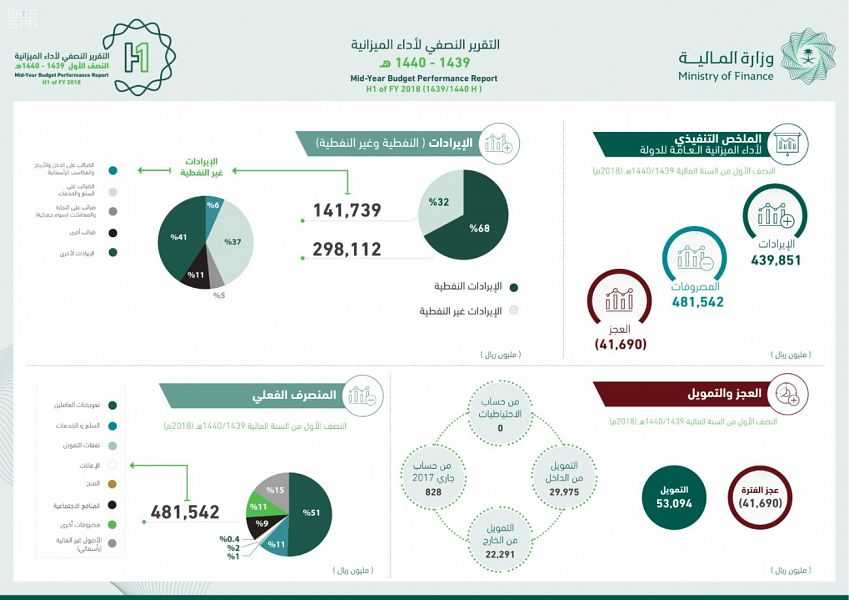
Public debt increased from SAR 443.253 billion at the beginning of 2018 to reach SAR 536.954 billion at the end of the second quarter. The financial indicators of the performance of the state's general budget for the first half of the fiscal year 1439/1440 AH (2018) were as follows:
<Total revenues for the first half amounted to SAR 439.851 billion, registering an increase of (43%) compared to the similar period last year. Total expenses for the first half amounted to SAR 481.542 billion, an increase of (26%) compared to the same period last year.
Actual disbursements at the end of the second quarter (first half of the year) amounted to about (49%) of the total estimated budget during the year.
The deficit in the first half of the year amounted to SAR 481.542 billion. <The deficit in the first half amounted to SAR 41.690 billion. Sectors of social importance such as education, health, social development, and municipal services received the largest share of expenditures in the first half, amounting to (42%) of the total expenditures.
The deficit in the first half amounted to SAR 41.690 billion. <Commenting on the financial results for the second quarter, His Excellency the Minister of Finance, Mr. Mohammed bin Abdullah Al-Jadaan, said: “The announced financial figures on the budget performance for the second quarter of this year reflect the improvement in the performance of public finances, and the continued efforts to implement our reform plans.”
<and economic reforms aimed at economic diversification and achieving financial sustainability." His Excellency stressed that the Ministry of Finance works together with other government agencies through continuous coordination of efforts to harmonize policies and measures to support the Kingdom's macroeconomic stimulation and to achieve the objectives of the fiscal balance program.
His Excellency stressed that the Ministry of Finance works together with other government agencies through continuous coordination of efforts. His Excellency pointed out that the improvement in fiscal performance was also accompanied by an improvement in economic performance, as real GDP grew by (1.2%) during the first quarter of this year, and the growth of the non-oil sector was (1.6%).
The preliminary economic indicators show that the Kingdom's macroeconomic indicators are in line with the Kingdom's macroeconomic growth rate, and the objectives of the fiscal balance program. <Preliminary economic indicators show that economic activity continued to improve in the second quarter of this year, especially private consumption. Point-of-sale operations and cash withdrawals increased during the period, as well as for private investment, the PMI performance saw progress, and private credit in the second quarter recorded positive growth for the first time since the first quarter of 2017. These indicators give a positive outlook that reinforces optimism that the GDP performance will continue to improve in the second quarter, supported by improved levels of government operational and investment spending, as well as the recovery of global oil markets.
In this context, he welcomed the improvement in the monetary policy for the period, as well as private investment. <In the same context, Minister Al-Jadaan welcomed the contents of the IMF report following the Article IV consultations for 2018, which are largely consistent with the budget performance indicators, in terms of the significant improvement in public finance conditions that contributed to reducing the fiscal deficit, growth in non-oil revenues, increasing spending efficiency, progress in strengthening the medium-term fiscal framework, increasing transparency, and developing macro-fiscal analysis. Also, the progress made in implementing the reform programs within Vision 2030 and their positive repercussions on the Kingdom's economic situation, which led to raising the economic growth forecast for the current year and the positive economic outlook.