The International Monetary Fund’s Article IV Consultation Report on the Saudi housing sector projected continued strong growth in residential mortgage lending in the Kingdom, driven by government programs designed to boost demand and expand supply in the sector.
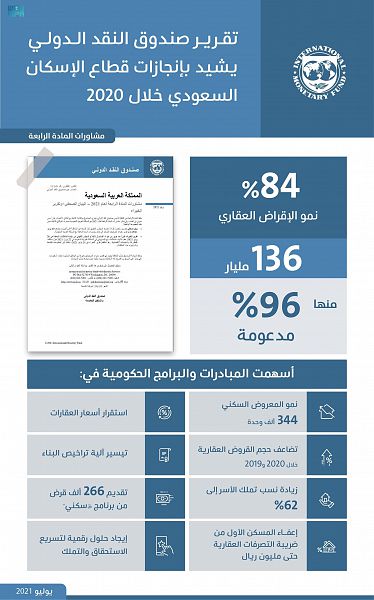
The report commended the role of government programs and regulations in improving the regulatory environment, increasing the homeownership rate to 62% and boosting the housing supply to 334 thousand housing units in 2020, and developing digital solutions to expedite the housing eligibility process.
The Fund’s report highlighted the efforts of the “Sakani” program in increasing the number of housing options and diverse financing solutions, as well as providing 266,000 housing loans and free land plots during 2020, noting that the program enabled beneficiary Saudi families to obtain subsidized mortgage loans of up to 500,000 Saudi riyals, with support for interest payments due to the lender, and that “Sakani” determines the level of support based on income and family size, in addition to providing a mortgage guarantee program for lower-income families. The report can be viewed by visiting the link https://www.imf.org/ar/Whats-New-Archive.
The report noted that the value of residential mortgage financing rose to 136 billion riyals in 2020, highlighting that loans subsidized by government housing programs accounted for 96% of this amount, Mortgage lending continues to grow rapidly amid government programs supporting both demand and supply in the housing sector, and the volume of mortgage loans has doubled over the past two years to approximately 18% of total bank credit.
The report highlighted the stabilization of real estate prices in 2020 following their sharp decline between 2015 and 2019, and the improvement of the regulatory environment for the housing market through the streamlining of various procedures, including the building permit process and the exemption of first homes from real estate transaction tax effective October 2020, provided the purchase price does not exceed one million Saudi riyals, which contributed to an increase in the home ownership rate among Saudi households from 47% in 2016 to over 62% by the end of 2020.
The report highlighted the growth in the supply of residential real estate and the availability of approximately 344,000 new residential units provided by real estate development companies during 2020, representing a 4.1% increase compared to 2019, of which 30% were provided through the government’s “Sharakat” program in collaboration with the private sector, and the “Etmam” platform for real estate developers.
The report also addressed the role of digital solutions provided by the “Sakani” smartphone app in enhancing the efficiency of the residential real estate market by streamlining the process of verifying eligibility and submitting applications, and facilitating access to appropriate financing solutions. It also highlighted the implementation of the “Ijar” program and the digital solutions it provides in the rental market to increase transparency and efficiency by standardizing electronic lease agreements, establishing a regulatory framework for real estate brokerage firms, and connecting landlords with tenants through a digital platform.

IMF: Saudi Arabia's housing efforts have boosted ownership, lending and real estate supply