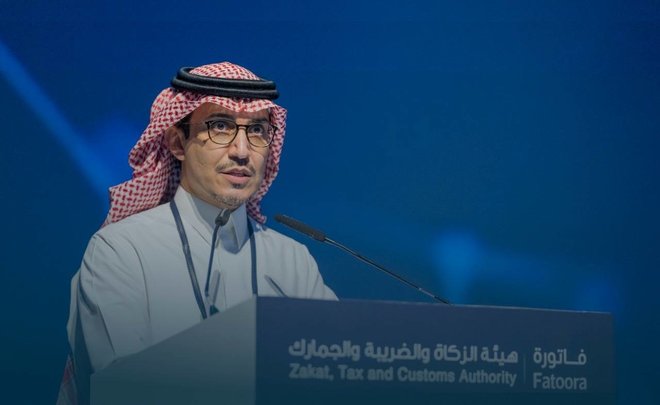
Yesterday, Tuesday, the Zakat, Tax, and Customs Authority launched the e-invoicing project “Fatura” in Riyadh, in the presence of Engineer Suhail Abanmi, Governor of the Authority; Engineer Ahmed Al-Suwaiyan, Governor of the Digital Government Authority; Engineer Saleh Al-Rashid, Governor of the General Authority for Small and Medium Enterprises (Monsha’at); Ahmed Al-Suwailem, CEO of the Program to Combat Front Companies; Ajlan Al-Ajlan, President of the Council of Saudi Chambers and Chairman of the Riyadh Chamber of Commerce; and Eng. Yusuf Al-Harqan, CEO of the National Center for Government Resource Systems.
For his part, Abdullah Al-Fantookh, Director of the “Fatura” at the Zakat, Tax, and Customs Authority, said that the project requires all taxable entities to comply with it and begin issuing their invoices via the electronic invoicing system on the specified dates, noting that the project contributes to combating fronting and the shadow economy.
In a speech, the Governor of the Zakat, Tax, and Customs Authority stated that the electronic invoicing project “Fatura” is one of the most prominent and ambitious national projects led by the Zakat, Tax, and Customs Authority, building on a variety of digital initiatives the Authority has launched in recent years in line with the Kingdom’s vision and ambitious goals for achieving the desired digital transformation.
Abanmi noted that the “Fatura” project aligns with the latest advancements in leading global economies and will have a tangible impact on the national economy. He said: “The project will help curb the shadow economy and promote fair competition, while also contributing significantly to the efforts of various government agencies to combat front companies. It will also play a fundamental role in enriching the consumer experience.”
He expressed his gratitude to all parties collaborating on the implementation of the “Fatura” project, including providers of electronic invoicing services and systems, while also acknowledging the enthusiasm and willingness of business owners and those responsible for implementing electronic invoicing requirements, whose feedback and suggestions helped the Authority achieve this integrated system.
For his part, Saleh Al-Rashid, Governor of the General Authority for Small and Medium Enterprises, that the Authority has worked to refine a number of initiatives that have enabled it to help correct market distortions. One of these is electronic invoicing, which offers several benefits to businesses, including the creation of a fair and attractive environment for growth and prosperity, as well as its contribution to eliminating front companies, facilitating access to financing and banking services, as electronic invoicing ensures highly accurate financial records.
He added that the Enterprise Bank has contributed to increasing the percentage of financing for small and medium-sized enterprises in Saudi Arabia from 2 percent in 2016 to 8 percent this year, noting that the bank is helping to bridge the financing gap for small and medium-sized enterprises.
The first phase will take effect for taxpayers subject to the electronic invoicing regulations starting December 4, 2021, which requires the issuance and retention of tax invoices and related debit and credit notices electronically.
The second phase will be implemented in stages starting January 1, 2023, and will focus on consolidating integration between taxpayers“ electronic systems and those of the Zakat, Tax, and Customs Authority.
The ceremony featured the signing of agreements and the launch of a list of electronic invoicing solution providers who have expressed their readiness to offer electronic invoicing solutions, in preparation for the mandatory implementation of the first phase (the issuance and retention phase) on December 4 of this year.
In this regard, the Authority emphasized that the list of electronic invoicing solution providers launched during the ceremony is a non-binding, indicative list intended to help taxpayers select the technical solution best suited to the size of their business and the type of sector, and the list should not be interpreted as limiting the provision of electronic invoicing solutions to those providers; rather, a taxpayer is considered compliant as long as they meet the requirements for electronic invoicing.
It is worth noting that the Authority has launched intensive campaigns during the past phase that will continue until the end of the year, with the aim of raising awareness about electronic invoicing, its implementation phases, and the necessary requirements for its adoption, and to highlight the expected benefits of electronic invoicing, as part of the Authority’s commitment to streamlining procedures for taxpayers.

Coinciding with its official launch ... Zakat”: Electronic invoicing limits hidden economy transactions and promotes fair competition