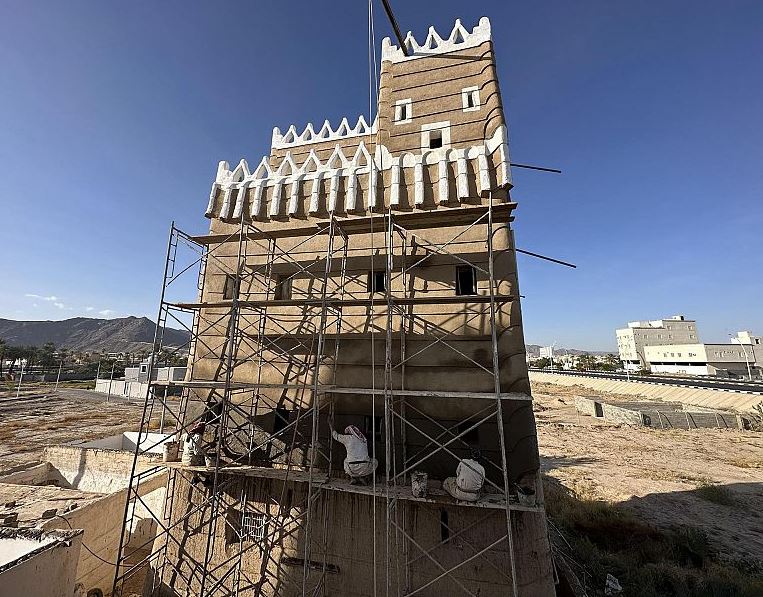
The Najran region is unique with many monuments, civilizational landmarks, and urban heritage, which is considered an essential component of rural tourism in the region, as about 33 mud villages are spread on both sides of the Najran Valley extending from west to east, north and south.
<In order to preserve them from extinction, due to their unique architectural style intertwined with the beauty of the surrounding environment with its green areas, rich gardens and palm trees on both banks of Wadi Najran, the owners of the heritage mud palaces and houses in Najran have taken the initiative to restore and rehabilitate them in a national gesture. A national initiative stemming from their awareness of the importance of the national historical heritage and the importance of preserving it as an identity and history, and the origin of an ancient past, a prosperous present, and a promising future, to be a tourist attraction and a legacy for future generations, and a witness to the cultural heritage and urban heritage of the region and the country.
<The models of mud buildings differ in names, shape and method of construction, while the components of their construction are united from stone, clay, wood and hay, and the "darb" is characterized by geometric images with striking architectural and aesthetic art consisting of seven to nine floors, and a single room is built on its surface called the outside that reveals the entire outer perimeter of the darb and is intended for the head of the family There is a well called “Al-Hasi” in the vicinity of the darb, while the “Al-Mashuliq” building, a U-shaped building, consists of two to three floors and all its rooms overlook the main entrance, while the “Al-Muqaddam” building consists of three floors and monsters, the ground floor of which is used as a council and storage rooms, as well as the “square” building, which is characterized by the equality of its sides.
The aesthetics of the urban construction of palaces and mud houses in Najran, with its smallest details in the divergent oblique corners, and the proximity of the roof in the “Mashuluq” building, while the “square” and “kasbah” are built in a circular shape, the base is large, and the circle narrows as it rises upwards and the building is usually located in the corners of the village for protection.
What follows is the model of the palace and mud houses in Najran, with three floors.
<The model of castles or fortresses or the so-called ”Kasbah”, which is usually in the wall that is built on some buildings or on the village, is built in a circular shape where the base is larger and the circle narrows as the building rises and usually at the top of the wall surrounding a group of buildings. Usually at the top of the wall surrounding a group of buildings is the placement of “brambles” or what is called “zarb” to surround the height of the wall for the purpose of protection and to prevent climbing, and the wall has a door made of solid “cans” wood and has keys called the key or key, and Sidr wood is also used in the manufacture of interior doors and windows “Baja”.
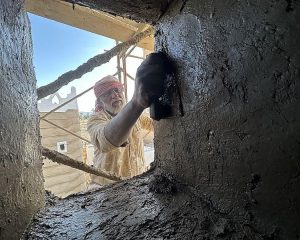
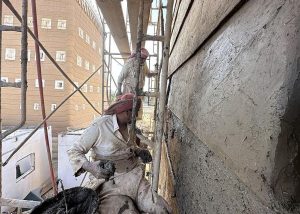
<The construction of mud houses begins by using mud, hay, palm trunks and palm fronds, starting with laying the foundation called "Wathar", which is made of stones and mud, then starts laying the first pillar and after completion it is left for a day to dry, in summer, while in winter it is left for two or three days and then the second pillar is erected, and so on until the construction is completed, and after completion. After 15 days, the so-called “gadadad” of white lime is started, then the “ta'asif” process is done, which is the process of staircasing and smoothing with mud, after which the additional aesthetic operations of the buildings inside and outside are started, after that comes the additional aesthetic operations of the buildings from the inside and outside.
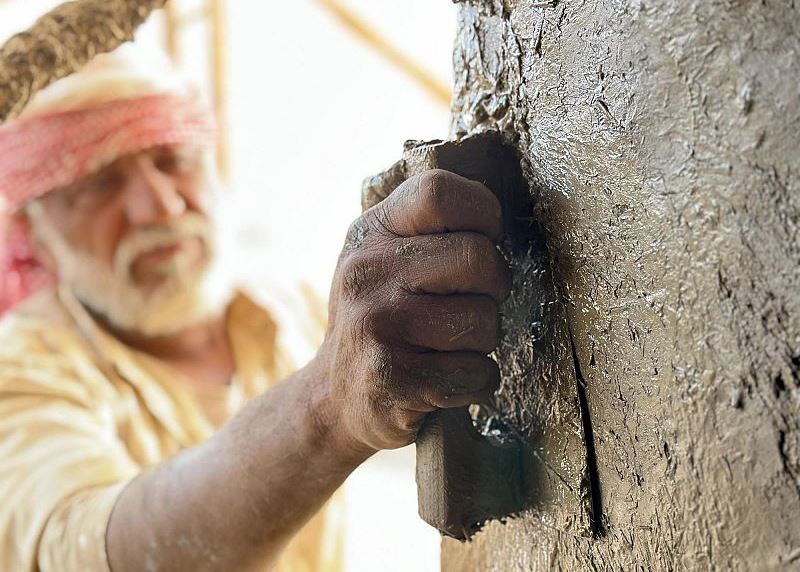
<The Saudi Press Agency (SPA) visited the restoration of a number of heritage mud houses and palaces in the region, where Nasser Mubarak Al-Suqour, a specialist in cultural and urban heritage in Najrani, explained how to build and restore mud houses, starting with their components of mud, hay, wood and stone. So that the stone is the basis of the building from the bottom and a height of at least 10 cm to preserve the texture of the mud and protect it from decomposition and corrosion “eaten by salt”, and the work with mud and hay is in three stages, namely building two stages and “Malaj” or taliyas one stage.
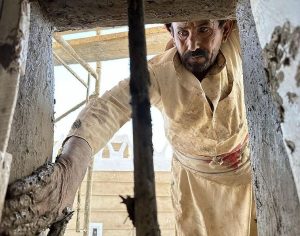
<It consists of clay that is left for two to three days after mixing with hay, until it becomes dry, hard and cohesive, the first stage of construction begins with the use of milk by placing it in a monolithic form, and then the second stage in construction, which is the Madamek stage, which is the fermentation of clay for two or three days and then mixed with hay in a beating method, collected and then beaten on the wall It is the most important step in the construction or restoration process to fill the cracks, cohesion, durability and appearance of the building, during which the hay is mixed with clay from ten days or more, by mixing it one day and leaving it one day and adding hay and water to the clay when mixing until its smell becomes pungent, which means its stability and quality, and good clay free of sand is chosen to make ceilings, sharifs and dye.