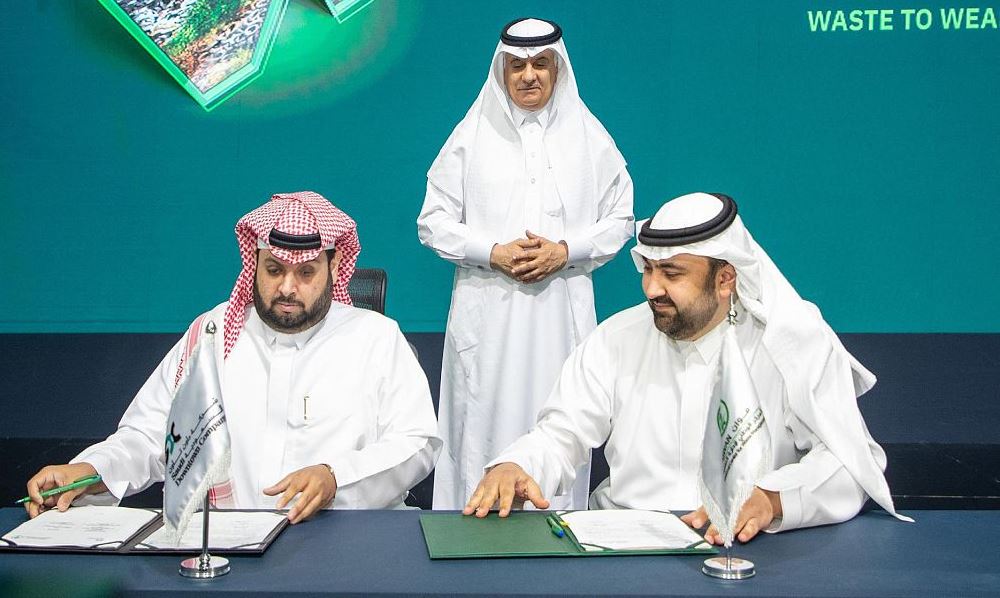
<a style="color: #993300;" href="https://www.saudidowntown.com., a wholly-owned subsidiary of the Public Investment Fund, signed a memorandum of understanding with the National Waste Management Center (MWAN) on the sidelines of the "Waste Management Investment Forum“ held in Riyadh, in the presence of His Excellency the Minister of Environment, Water and Agriculture Engineer Abdulrahman bin Abdulmohsen Al Fadhli.
The company was represented by Nayef Al-Hamdan, Board Member and Acting CEO, and Dr. Abdullah Al-Sebai, CEO of Mowan, during the signing.
Through this memorandum, the two parties seek to cooperate in terms of waste management programs and initiatives, training, raising the performance level of technical staff, ensuring compliance with waste management legislation and controls, and enhancing joint work to improve the services provided to residents and visitors of Downtown Saudi projects in 12 cities in the Kingdom.
<”Downtown Saudi aims through this cooperation with the National Waste Management Center to explore ways of cooperation in developing integrated plans and programs to contribute to achieving sustainability, optimal use of resources and enhancing the quality of life through the company's projects in 12 cities."
This cooperation comes within the framework of the strategy of <a style="color: #993300;" href=”https://amlak.net. Downtown Saudi Arabia's ESG objectives include achieving sustainability, enhancing community participation and interaction, and achieving resource efficiency. The company will work to achieve these targets by adopting best governance practices, effective cooperation with all relevant parties, formulating policies, using modern technologies and spreading awareness.
Downtown Saudi will develop and create destinations and urban centers with sustainable economic and social impact in 12 cities in the Kingdom, namely: Medina, Al Ahsa, Al Khobar, Buraida, Taif, Arar, Hail, Tabuk, Dumat Al Jandal, Jizan, Najran and Al Baha. The projects will be built on a total area of more than 10 million square meters and will stimulate economic activity and improve the quality of life in these cities, in addition to creating new options and opportunities in various sectors including: Shopping, entertainment, hospitality, tourism, office space, residential, and more.