
Ceramic and porcelain. Advantages and differences
What is ceramic
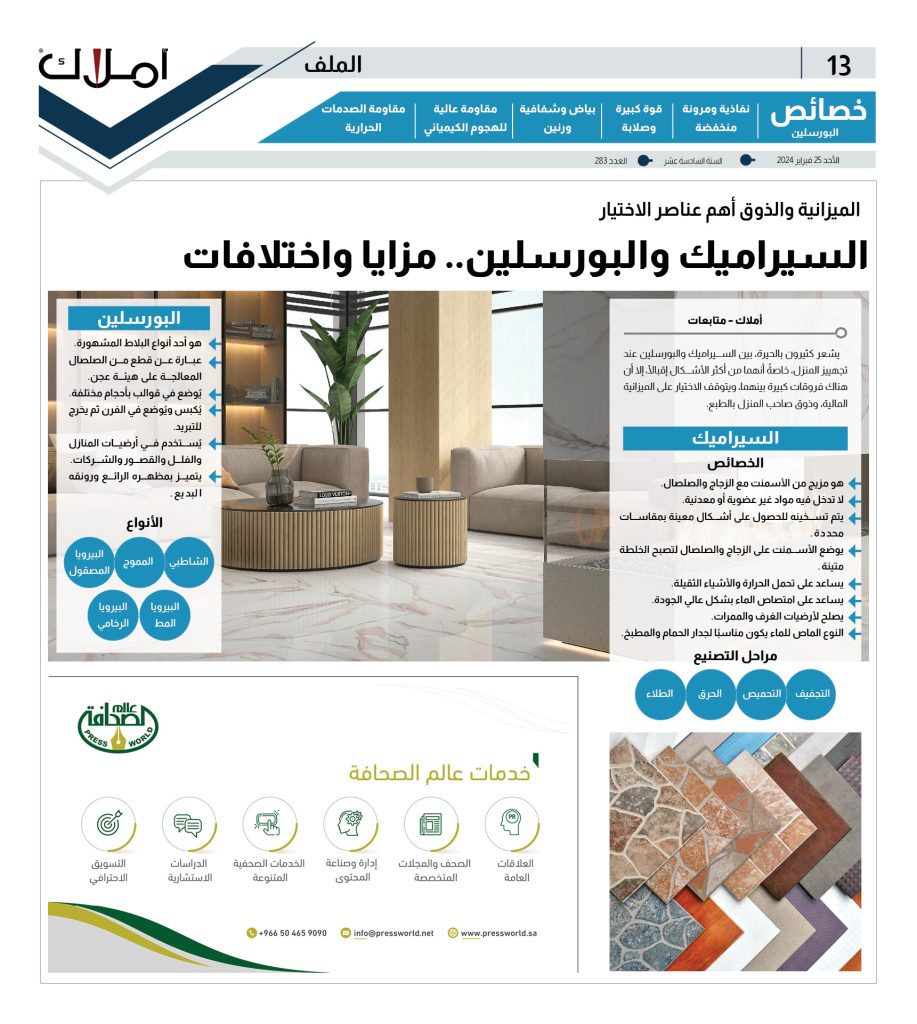
Ceramic is a combination of cement with glass and clay, and no inorganic or mineral substances are involved.
Ceramics.
These materials are heated like pottery in order to create specific shapes in specific sizes. Cement is placed on the glass and clay in order to make the mixture durable and not easily breakable, and it also helps ceramics withstand heat and heavy objects, and ceramics during its manufacture goes through several stages, which are: Drying.
<Drying.
<Roasting.
<Firing.
<Painting.
Ceramic tiles are highly water-absorbent and have open pores. This is suitable for the floors of rooms and corridors, and there is a type of ceramic that absorbs water slightly and this is suitable for the wall of the bathroom and kitchen.
Porcelain is a popular type of tile, which are pieces of clay that are processed into a paste.
They are placed in molds of different sizes, then pressed and placed in a high-temperature kiln and taken out for cooling. Porcelain is a popular type of tile.
Porcelain is used in the floors of houses, villas, palaces, palaces and companies, as it is characterized by its wonderful appearance and magnificent luster.
There are many types of porcelain, including beach porcelain, corrugated porcelain, polished Piruya porcelain, polished Piruya porcelain, rubberized Piruya porcelain, and marble Piruya porcelain. There are many types of porcelain.
What is porcelain?