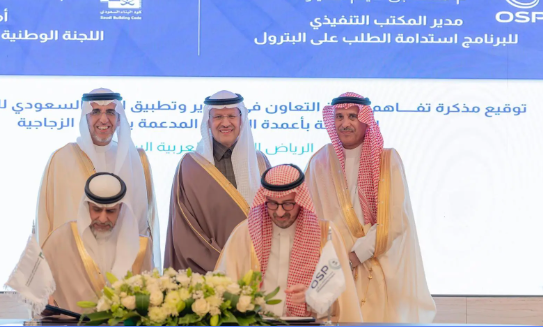

The signing was attended by His Royal Highness Prince Abdulaziz bin Salman, Minister of Energy and Chairman of the Supervisory Committee of the Saudi Building Code Program. The signing was attended by HRH Prince Abdulaziz bin Salman bin Abdulaziz, Minister of Energy, Chairman of the Supervisory Committee of the Petroleum Demand Sustainability Program, His Excellency the Governor of the Saudi Standards, Metrology and Quality Organization (SASO), Chairman of the National Committee for the Saudi Building Code, Dr. Saad bin Othman Al-Qasabi, and the CEO of Saudi Basic Industries Corporation (SABIC), Engineer Abdulrahman Al-Faqih.
The Petroleum Demand Sustainability Program was represented during the signing by the Director of the Executive Office, Engineer Mohammed bin Haitham Al-Tayyar, while the National Saudi Building Code Committee was represented by the Secretary General of the Committee, Engineer Saad bin Saleh bin Sha'il.
According to the memorandum, the Petroleum Demand Sustainability Program will study, prepare and develop the Saudi Code for Structural Concrete Reinforced with Glass Fiber Reinforced Polymer Bars according to the scientific references and methodologies approved by the National Committee for Saudi Building Code.
Development of building materials standards
The Secretary General of the National Committee stressed the importance of the memorandum and its role in cooperation and coordination between the sectors interested in developing standards for materials used in the construction and building sector to raise the quality of buildings by targeting new and innovative materials in the fields of building design to enhance the role and objectives of the National Committee for Saudi Building Codes and the Sustainable Oil Demand Program by preparing and adopting standards for the safe use of structural concrete reinforced with glass fiber reinforced polymer rods.
For his part, the Director of the Office of the Director General of the National Committee for the Saudi Building Code and the Sustainable Petroleum Demand Program. <Mohammed Al-Tayyar, Director of the Executive Office of the Program, explained that the memorandum aims to enable the two parties to implement joint plans and initiatives for hydrocarbons, and seek to develop the Saudi Code for Glass Fiber Reinforced Polymer Reinforced Structural Concrete (GFRP Rebars Code) according to the methodology of the American Concrete Institute (ACI). The American Concrete Institute (ACI), address challenges and develop possible recommendations to achieve the objectives of the program in the application of the code by contributing to training for the fields of design and implementation, thus contributing to the alignment of strategic directions on the application of the code for the construction sector, and supporting and empowering local content in the sector.
National Committee for Saudi Building Code
The <a href="https://sbc.gov.sa/ar/ContactUS/Pages/Faq.The National Committee for Saudi Building Code was formed according to the Council of Ministers Decision No. (7B/3230) dated (09/03/1421H), and the National Committee consists of sixteen government agencies, and the National Committee had an effective and important role in adopting and setting the foundations and conditions for the building and construction sector by preparing unified building codes in the Kingdom to ensure public safety and preserve the national economy and mandatory professional work practice compatible with the environment and conditions of the Kingdom through the public and private sector for the benefit of the public interest.
National Committee for Saudi Building Code The Petroleum Demand Sustainability Program was established with the participation of seventeen governmental and non-governmental entities under the umbrella of the Supreme Committee for Hydrocarbon Affairs. The program aims to develop a sustainable energy mix taking into account the use of hydrocarbons, through sustainable methods that encourage the integration of multiple industries at the local and international levels, and support Saudi Arabia's ongoing efforts towards addressing and supporting climate pledges and the United Nations Sustainable Development Goals (SDGs).