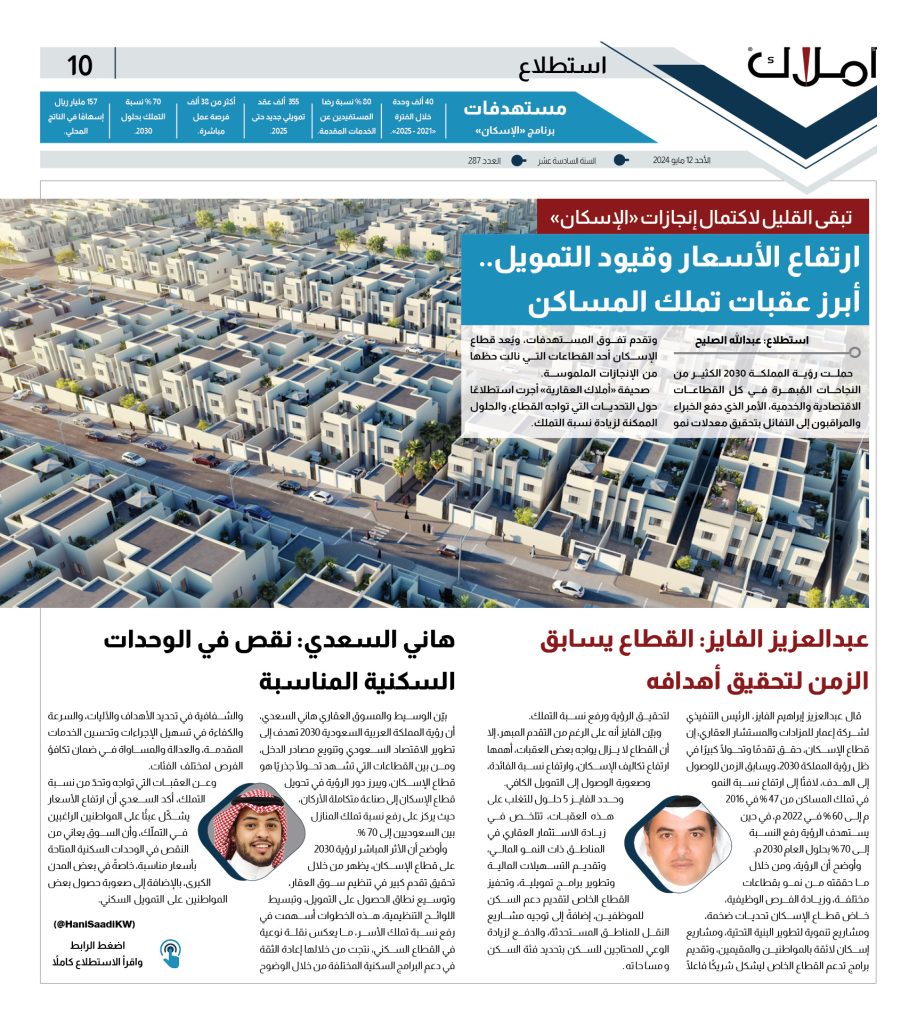

Survey by Abdullah Al-Saleh : The Kingdom's Vision has brought many impressive successes across all economic and service sectors, leading experts and observers to be optimistic about achieving growth and progress rates exceeding targets. The housing sector is one of the sectors that has benefited from tangible achievements. Amlak Real Estate newspaper conducted a survey on the challenges facing the sector and possible solutions to increase homeownership rates and ensure reasonable residential property prices.
= = = = =
Abdulaziz Al-Omar: Investing in various housing projects

Abdulaziz Al-Omar, an expert and trainer in real estate, affirmed that Saudi Vision 2030 aimed to comprehensively improve the housing sector in the Kingdom by providing affordable, high-quality housing for citizens and increasing homeownership rates. It also worked to boost investment in urban infrastructure and create job opportunities for citizens in the real estate development, construction, and building sectors.
Al-Omar explained that the vision has been largely successful in restoring confidence in supporting various housing programs by relying on clear strategic plans and a realistic methodology to improve the housing sector, and has provided comprehensive and integrated solutions that include developing infrastructure, diversifying and expanding real estate financing options, and stimulating and supporting the private sector and real estate developers to contribute to providing suitable housing for citizens.
Al-Omar identified a number of points through which the private sector can contribute to raising the rate of homeownership to achieve the targeted rates each year, ultimately reaching the strategic goal of 70% of citizens owning a home by 2030. These points are as follows:
- Investing in social, middle-income and luxury housing projects to provide diverse and affordable housing options.
- Developing innovative financing programs with easy terms and reasonable interest rates.
- Partnering with the government in developing large housing projects and building the necessary infrastructure.
- Providing educational programs for citizens about the importance of investing in real estate and how to take advantage of available real estate opportunities.
- Providing additional services such as maintenance and property management.
6. Establishing local and global partnerships with major companies to raise the level of quality, standards, and competitiveness in real estate development and economic construction.
Al-Omar explained that the high prices of real estate and property, and the restrictions on real estate financing, are among the most important obstacles that limit the rate of homeownership among citizens, in addition to the cost of various administrative procedures.
To overcome these obstacles, Abdulaziz Al-Omar suggested the following steps:
- Studying the current and future status of the housing strategy in the Kingdom to reduce rising real estate prices and provide affordable housing.
- Developing accessible financing programs and providing loans at low interest rates to citizens.
- Pushing and strengthening the authorities to expedite the implementation of infrastructure and provide complete basic services in residential areas in order to approve the largest number of residential plans to control prices.
= = = = =
Abdulaziz Al-Fayez: Supporting the private sector to be a partner in the vision
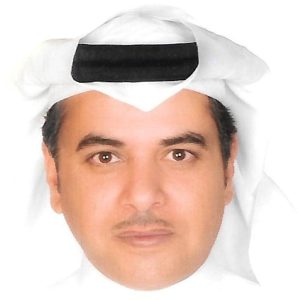
Abdulaziz Ibrahim Al-Fayez, CEO of Emaar Auctions, stated that the housing sector, under the Kingdom's Vision 2030, has made significant progress and undergone a transformation that is rapidly approaching its goals. The growth rate in homeownership increased from 471 TP3T in 2016 to 601 TP3T in 2022, while the Vision aims to raise this rate to 701 TP3T by 2030.
Al-Fayez explained that the vision, through the growth it has achieved in various sectors and the increase in job opportunities, has led the housing sector to face huge challenges, development projects to develop infrastructure and decent housing projects for citizens and residents, and the provision of programs that support the private sector to form an active partner to achieve the vision and raise the rate of homeownership.
Al-Fayez explained that despite the impressive progress, the sector still faces some obstacles. The most significant of these are high housing costs, high interest rates, and difficulty in accessing sufficient financing. He identified five solutions to overcome these obstacles, which are summarized as follows:
- Increased real estate investment in areas with financial growth.
- Providing financial facilities and developing financing programs.
- Encouraging the private sector to provide housing support for employees.
- Directing transportation projects to newly developed areas.
- Paying to raise awareness among those in need of housing by identifying housing categories and sizes.
= = = =
Hani Al-Saadi: The shortage of available housing units at reasonable prices

Hani Al-Saadi, a real estate broker and marketer, confirmed that the Kingdom of Saudi Arabia’s Vision 2030 aims to develop the Saudi economy and diversify sources of income. Among the sectors that are witnessing a radical transformation is the housing sector. The Vision’s role is highlighted in transforming the housing sector into a fully integrated industry, as it focuses on raising the rate of home ownership among Saudis to 70%.
Al-Saadi explained that the direct impact of Vision 2030 on the housing sector is evident through the significant progress made in regulating the real estate market, expanding access to financing, and simplifying regulatory frameworks. These steps have contributed to raising the rate of homeownership among families, reflecting a qualitative shift in the housing sector. This has resulted in restoring confidence in supporting various housing programs through clarity and transparency in defining objectives and mechanisms, speed and efficiency in facilitating procedures and improving services provided, and fairness and equality in ensuring equal opportunities for different groups.
Al-Saadi said: “The private sector can contribute to raising the ownership rate by enacting clear regulations and laws that govern the construction and investment process in housing projects, partnering with the government in implementing housing initiatives and programs, and encouraging real estate financing by providing and developing real estate financing programs with low interest rates for citizens, to encourage them to buy homes. This can create an attractive environment for local and foreign investments and raise the ownership rate.”
Regarding the obstacles hindering homeownership rates, Al-Saadi explained that high prices place a burden on citizens wishing to own property, and the market suffers from a shortage of affordable housing units, especially in some major cities. He added that some citizens also face difficulties in obtaining housing finance.
Al-Saadi called for the development of programs that ensure stability and prevent excessive inflation in prices, and promote mass housing by increasing investment in social housing programs to provide affordable housing units for low- and middle-income groups.
(@HaniSaadiKW)
= = = = =
Khaled Al-Amroudi: The vision achieved its goals and provided solutions.

Khaled Al-Amroudi, Chairman of the Board of Directors of Azmat Management Consulting and Business Development Company, affirmed that the various initiatives and projects led by the Kingdom’s Vision 2030 seek to bring about a radical transformation in the housing sector to achieve the aspirations of Saudi families to own suitable housing and to support sustainable economic development, which contributes to achieving quality of life and stimulating economic growth and sustainable development in the Kingdom.
Al-Amroudi praised the achievements of the Vision in a few years, achieving high rankings according to global indicators, under the leadership of the inspiring His Royal Highness Crown Prince Mohammed bin Salman, and Their Excellencies the Ministers and the creative work teams who wrote the most beautiful success stories despite the challenges the world is witnessing.
Al-Amroudi explained that the vision played a vital role in transforming the housing sector in Saudi Arabia, through several key pillars:
- Homeownership: One of the key objectives of Vision 2030 is to increase homeownership rates among citizens. The vision aims to raise the homeownership rate to 701,000,000 by 2030, reflecting a strong focus on improving the social and economic stability of individuals.
- Stimulating the private sector: Encouraging private investment in the housing sector by providing incentives to developers and investors, as well as facilitating procedures and regulations to enable the private sector to contribute more effectively to providing housing units.
- Affordable housing programs: Developing initiatives such as the “Sakani” program, which aims to provide affordable housing solutions for citizens. Providing financial support and low-income loans to middle- and low-income families.
- Infrastructure development: Improving housing-related infrastructure, such as roads, public facilities, and services, to enhance quality of life.
- Use of technology: Adopting modern technologies in the construction of housing units to increase efficiency and reduce costs, as well as in the management of real estate and housing services to improve the beneficiaries' experience.
- Sustainability and Environment: Encouraging the construction of sustainable and environmentally friendly housing to reduce the environmental impacts of the housing sector and promote environmental sustainability.
- Developing the legislative and regulatory environment: This involves improving transparency and trust between investors, financing entities, and buyers, and facilitating and simplifying procedures, which has contributed to enhancing the sector's growth and making it more attractive to investors, developers, and beneficiaries.
- Developing integrated communities: with new and attractive residential projects that include development in infrastructure and basic services such as schools, health centers, and recreational areas, which enhances the quality of life for residents and is an attraction to improve the beneficiaries' experience and contribute to raising the ownership rate.
Al-Amroudi said, “Vision 2030 has had direct impacts and provided housing solutions for a tangible, vibrant environment in the housing sector in the Kingdom of Saudi Arabia. The most prominent of these tangible impacts can be summarized in the following points:
- Increased availability of housing: Thanks to government incentives and facilities, and initiatives to enable the private sector to increase supply in the housing market, which has helped to reduce the gap between supply and demand.
- Improving homeownership: Through subsidized and accessible financing programs such as the Real Estate Development Fund and the Sakani program, it has become easier for citizens to own homes, which has contributed to raising the homeownership rate.
- Lower property prices: Competition resulting from increased supply has led to adjustments in market prices, allowing access to more diverse housing options for wider segments of society.
- Accelerating construction and licensing procedures: Regulatory reforms and streamlining of procedures have reduced the time and cost of construction operations, enabling projects to be delivered in less time.
- Investing in technology and innovation: Investments in new technologies to build homes in more efficient and sustainable ways, supporting conservation efforts and reducing costs in the long run.
Al-Amroudi explained that since the launch of the Kingdom’s Vision 2030, our confidence is greater in our hopes than in our fears because the leader is inspiring and the projects are exceptional (we are living them and seeing them) and we are living in their gains, thanks be to God, and we are moving forward in achieving more in all sectors with confident steps with pride and honor, explaining the effective role that the private sector can play in raising the rate of homeownership by developing integrated communities represented by new and attractive residential projects that include development in infrastructure and basic services such as schools, health centers, and recreational areas, which enhances the quality of life for residents and is an attraction to improve the experience of beneficiaries and contribute to raising the rate of homeownership.
Al-Amroudi identified the obstacles limiting homeownership rates, summarizing them as the high cost of real estate, limited income coupled with a lack of suitable financing options, and stringent mortgage requirements that prevent many families from acquiring suitable housing. He explained that the proposed solutions are evident today in the objectives of Saudi Vision 2030, and they include:
- By providing diverse and accessible financing solutions.
- Increase the range of real estate options and encourage investment.
- Improving infrastructure and developing attractive residential environments.
- Simplifying procedures and developing laws and regulations.
- Various government support programs
= = = = =
Dr. Fawaz Al-Za'bari: Financial support and facilities have strengthened citizens' confidence.

Dr. Fawaz Al-Zaabari, a professor at the College of Engineering at Najran University, affirmed that Vision 2030 directly targeted the housing sector through the launch of programs such as the “Sakani” program, which aims to increase homeownership rates among citizens. This was achieved by facilitating access to residential villas and providing land at subsidized prices. These steps have contributed to increasing homeownership rates and improving the quality of life for citizens.
Al-Zaabari attributed the restoration of confidence in housing programs to transparency, continuous monitoring, the provision of regular progress reports, and the establishment of mechanisms for cooperation between the public and private sectors. He added that financial facilities and ongoing government support have also strengthened citizens' trust in the state's commitment to improving the housing sector.
Al-Zaabari said: “The private sector can contribute by investing in residential construction and real estate development projects. Cooperation with the government on infrastructure projects can reduce construction costs and allow for the provision of affordable housing units. The private sector can also provide innovative financing solutions that help citizens own homes on easy terms.”
He indicated that among the most significant obstacles to homeownership are the high costs of construction and land in urban areas, along with the financing challenges faced by individuals. He explained that suitable solutions could include providing government support for land and construction costs, strengthening public-private partnerships, and offering incentives to developers to build affordable housing units. Furthermore, mortgage financing mechanisms could be improved to facilitate access to housing loans.
@Falzabari
= = = =
The dream of owning a lifelong home is no longer a dream.

Khaled Al-Humaid
The Kingdom's Vision 2030 has brought about a qualitative leap and an unprecedented transformation in the development of the housing sector. This is achieved by setting strategic and developmental targets to facilitate homeownership for citizens. It has worked to create diverse housing products and programs, reduce the waiting period for obtaining housing, and find subsidized and accessible financing solutions that meet the needs of different segments of society. This has undoubtedly restored confidence in housing programs, as the percentage of families owning their homes has risen to approximately 631 TP3 T percent. We also note an increase in the real estate supply with the participation of the private sector, which is an important partner in the economic and developmental movement. It contributes to providing many housing projects, diversifying products, and increasing the ownership rate. The dream of families to own a home for life is no longer a dream, but has become a reality thanks to God and then thanks to the Kingdom's Vision 2030, which is moving forward with confident steps and a clear vision.
Although the housing sector is making great efforts to overcome difficulties and facilitate ownership, there are still some obstacles that have limited this. Perhaps the most prominent obstacle limiting the ownership rate is the “high interest rates,” which have greatly affected individuals’ willingness to obtain real estate financing. Therefore, perhaps the most appropriate solutions are to find suitable financing options with low interest rates or to provide discounted housing products. Also, the high prices of land and real estate, especially in major cities, have led to a decrease in demand. Therefore, it is necessary to monitor the real estate market to control prices in a way that contributes to encouraging individuals to own property.
General Manager of Maalem Al-Maskan Real Estate Investments