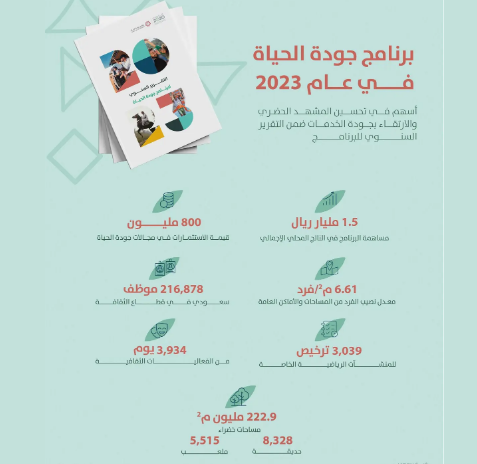

The Quality of Life Program issued its annual report for 2023, which included the achievements of the quality of life sectors included under the scope of the program to achieve the goals of the Kingdom’s Vision 2030 related to the urban landscape, the security sector, the culture and heritage sectors, sports, tourism, entertainment and hobbies. The Quality of Life Program continued to achieve tangible positive results on the level of its strategic indicators, as last year it achieved 22 indicators with completion rates of 100% and more. The program also contributed 1.5 billion riyals to the GDP in 2023, in addition to the progress of the program in implementing 127 diverse initiatives in close cooperation with 17 executive bodies.
The report revealed its key indicators and actual figures achieved in 2023, highlighting the scale of efforts made to improve quality of life and livability. The program focuses on providing options, developing systems, enhancing human capital, and building and developing infrastructure. Furthermore, it contributes to empowering and supporting various sectors related to quality of life. Through agreements and partnerships with government entities, the private sector, and the non-profit sector, the program has facilitated the marketing and implementation of several investment opportunities worth 800 million riyals in diverse projects that contribute to achieving quality of life objectives.
Regarding the program’s indicators and targets, it has made remarkable progress in a number of indicators. In the field of urban design, the per capita share of public spaces and places increased by 132%, reaching 6.61 (square meters/person). The number of parks reached 8328 parks, 5515 playgrounds, and 222.9 million square meters of green spaces, reflecting a strong interest in improving the urban landscape and raising the quality of services, in addition to the interest in humanizing cities, addressing visual distortions, developing roads, and promoting digital transformation in the municipal sector.
In the sports sector, 2023 saw an increase in the percentage of people engaging in weekly sports and physical activities to 371,000 TP3T, exceeding the target rate by 1,031,000 TP3T. The number of licenses issued for private sports facilities also rose to 3,039, and the number of venues hosting sports events and programs reached 2,793.
In the entertainment sector, global events were supported, and human resources were developed through a range of training and educational programs. These included a program that led to employment for 600 beneficiaries and the training of 90 entertainment leaders. To support and stimulate investment, entertainment accelerators were launched, encompassing a range of activities, including the incubation of 28 startups. Regarding performance indicators, the number of entertainment venues increased to 584, exceeding the target by 1691 TP3T. The "Mall Area Per Capita" indicator achieved a significant increase of 0.68 square meters per capita, surpassing the target by 1831 TP3T. The number of amateur clubs reached 569, exceeding the target by 1421 TP3T.
As for the vital tourism sector, it witnessed significant qualitative leaps during the past year - as more than 100 million tourist visits to the Kingdom were recorded from inside and outside the country by the end of 2023, which is seven years before the period previously set to achieve this goal, thus achieving the strategic goal assigned to the Quality of Life Program (developing the tourism sector) to raise the 2030 target to 150 million tourist visits. The volume of tourist spending reached more than 250 billion riyals, of which 135 billion riyals were for incoming tourists.
Many innovative solutions and electronic applications have also been developed, and these initiatives have achieved many accomplishments within the project to develop the tourism data system, in addition to providing training and qualification opportunities in the sector for young Saudi men and women.
The cultural sector witnessed significant progress in construction projects and training and qualification programs in support of the cultural sector, as the number of Saudi employees in the cultural sector increased to 216,878 employees, a percentage of 201% above the target, and the number of completed cultural facilities increased to 45 facilities, and the number of days of cultural events increased to 3934 days, and a number of museums were opened, and rehabilitation and restoration work was completed for a number of historical sites, including the Qishla Palace in Hail, the King Abdulaziz Palace, and the Jarash site, in addition to operating craft centers in Madinah, Tabuk, and Al-Ahsa, and registering the Bani Ma'arid Reserve site on the UNESCO World Heritage List.
The year 2023 witnessed significant support for the development and qualification of Saudi cultural personnel through a number of educational, qualification and training programs. The Royal Institute of Arts also established a number of educational and training programs and initiatives that benefited more than 4,000 beneficiaries. It also announced the launch of the Saudi Crafts Company, which aspires to provide job opportunities for craftsmen.