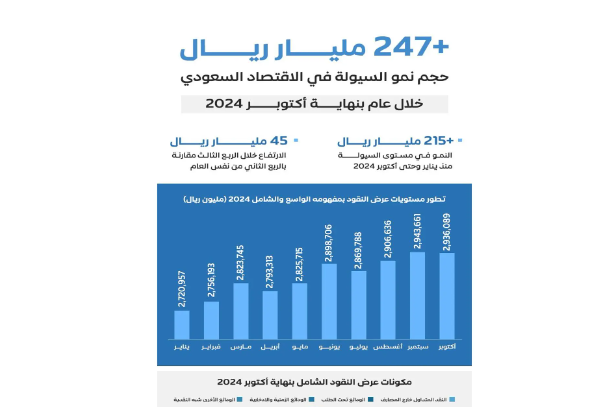

Levels of liquidity “available cash” in the Saudi economy grew by more than 247,647 billion riyals on a year-over-year basis, at a rate of 9.2%, reaching 2,936,089 million riyals by the end of October of this year, compared to 2,688,442 million riyals during the same period last year. These levels reflect the money supply in its broad and comprehensive sense (N3), as explained in the data from the monthly statistical bulletin of the Saudi Central Bank for October 2024.
Comparing liquidity levels on a quarterly basis, they recorded growth of 1.5%, an increase of nearly 45 billion riyals, reaching 2,943,661 million riyals by the end of the third quarter of this year, compared to 2,898,706 million riyals at the end of the second quarter of the same year.
Liquidity levels grew by 8%, an increase of more than 215 billion riyals, compared to January 2024 levels, which stood at 2,720,957 million riyals.
These strong liquidity levels serve as a driver for the economic and commercial system and contribute to achieving positive rates of economic development.
A review of the four components of the broad money supply (M3) in its broad and comprehensive sense shows that “demand deposits,” which account for the largest share of the total at 49%, amounting to 1,425,489 million riyals at the end of October 2024, while “time and savings deposits” stood at 971,103 billion riyals, making them the second-largest contributor to the total money supply (N3) at 33%
“Other quasi-monetary deposits” reached 312,506 billion riyals, accounting for 11% of the total money supply (N3), making them the third-largest contributor.
Fourth was “cash in circulation outside banks,” valued at 226,991 billion riyals, accounting for approximately 8% of the total money supply (M3).
It should be noted that quasi-monetary deposits consist of residents’ foreign currency deposits, deposits against documentary credits, outstanding transfers, and repurchase agreements (repos) executed by banks with the private sector.
Domestic liquidity also includes (n1), which comprises cash in circulation outside banks, in addition to demand deposits only, and (M2), which includes (M1) plus time and savings deposits; and the broad definition (M3), which includes (M2) plus other quasi-monetary deposits.