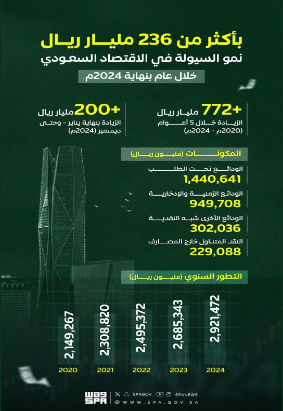

The levels of “available cash” in the Saudi economy system achieved an annual growth of 236,129 million riyals, representing a 9 %% increase, to reach a level of 2,921,472 million riyals by the end of 2024, compared to 2,685,343 million riyals in 2023. These levels reflect the availability of cash in its broad and comprehensive sense (n3), as indicated by the data from the Saudi Central Bank’s (SAMA) monthly statistical bulletin for December.
The liquidity level has seen growth since the beginning of 2024 until the end of December of the same year, with a value exceeding 236,129 million riyals and a rate of 7.4 %%.
The liquidity levels witnessed a positive development, registering growth over 5 years, specifically from the period (2020-2024), by 36 %%, with an increase estimated at 772,205 million riyals.
These levels of liquidity are considered a driving force for the economic and trade system and contribute to achieving positive rates in the economic development journey.
By reviewing the four components of the cash display (N3), in its broad and comprehensive sense, “Demand Deposits,” which is the largest contributor to the total, recorded a contribution of 49.3 %%, with a value of 1,440,641 million riyals at the end of 2024, while “Time and Savings Deposits” recorded 949,708 million riyals, which is the second largest contributor to the total cash display at 32.5 %%.
Other quasi-cash deposits reached 302,036 million riyals, accounting for 10.3 % percent of the total cash supply, making them the third largest contributor, while the fourth largest contributor was “cash held outside banks” with a value of 229,088 million riyals, accounting for about 7.8 percent % of the total cash supply.
It is noted that quasi-cash deposits consist of deposits by residents in foreign currencies, deposits against documentary credits, current transfers, and repurchase transactions (repo) carried out by banks with the private sector; local liquidity also includes (n1), which includes cash circulating outside banks, in addition to deposits under demand only; (n2), which includes (n1) in addition to time deposits and savings deposits; and the broad definition (n3), which includes (n2) in addition to other quasi-cash deposits.