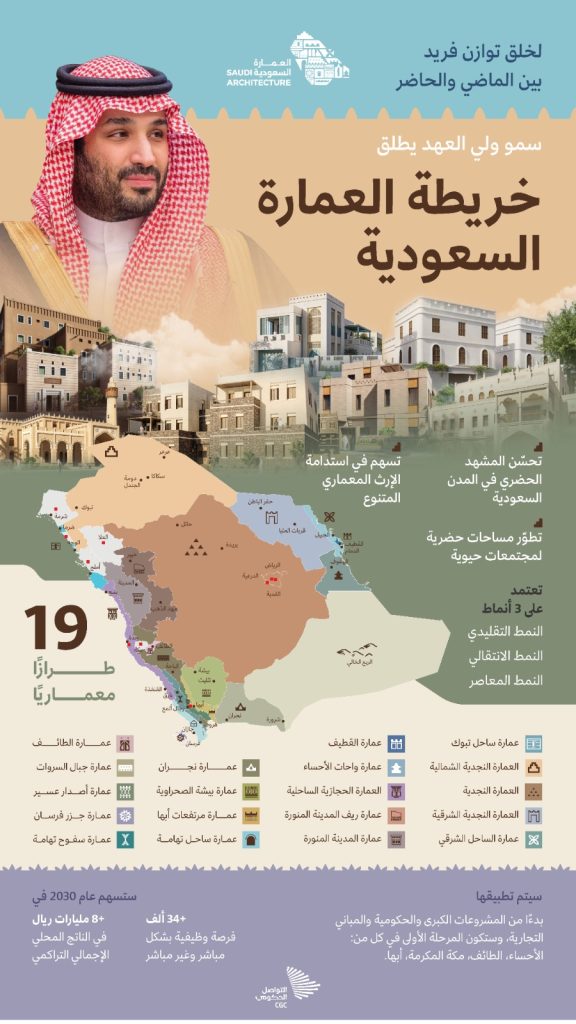

In a move that reflects the growing interest in preserving urban identity and enhancing the quality of life, His Royal Highness Prince Mohammed bin Salman bin Abdulaziz Al Saud, Crown Prince, Prime Minister, has launched Saudi Architecture Map, featuring 19 architectural styles inspired by the Kingdom's geographical and cultural characteristics. This initiative comes as part of His Highness's efforts to revive the urban heritage and develop the urban landscape in Saudi cities, in line with the objectives of the Kingdom's Vision 2030.
Sustainable urban identity
<His Highness the Crown Prince, Chairman of the Higher Committee for Design Guidelines for Saudi Architecture, stressed that the Saudi Architecture Map reflects the unique cultural and geographical diversity of the Kingdom, as it aims to develop sustainable urban cities that harmonize with the local environment and employ traditional architectural style with modern touches. His Highness said: “Saudi architecture is an integrated blend of heritage and contemporary design, through which we work to improve the urban landscape and enhance the quality of life, achieving a balance between the past and the present and becoming a global source of inspiration in the field of architectural design.” <pHis Highness pointed out that this initiative not only enhances urban identity, but also contributes to economic development by increasing the attractiveness of cities, which is reflected in the growth of the tourism, hospitality and construction sectors, and contributes to building a prosperous future for Saudi cities and communities.
His Highness pointed out that this initiative not only enhances urban identity, but also contributes to driving economic development.
Economic impact and career opportunities
Saudi Architecture is expected to contribute more than 8 billion Riyals to the cumulative GDP and create more than 34,000 jobs in the engineering, construction and urban development sectors by 2030. The initiative is also based on flexible design guidelines that allow the use of local building materials without imposing additional financial burdens on developers or owners, with a focus on three main architectural styles:
- Traditional style: Inspired by heritage architectural styles.
- Transitional style: The one that blends originality and modernity.
- Contemporary style: Reflecting urban development in a modern and renewed style.
19 architectural styles reflecting the spirit of each region
The map of Saudi architecture includes 19 architectural styles, identified based on extensive architectural and historical studies that reflect building patterns handed down through generations. These include:
- Najdi architecture, northern Najdi architecture, Tabuk coastal architecture, Medina architecture, Medina countryside architecture, Hejazi coastal architecture, Taif architecture, Sarawat Mountains architecture, Asir desert architecture, Tihama foothills architecture, Tihama coastal architecture, Abha highlands architecture, Farsan Islands architecture, Bisha desert architecture, Najran architecture, Al-Ahsa oasis architecture, Qatif architecture, East Coast architecture, Eastern Najdi architecture.
These architectural styles will be applied gradually, starting with major projects and government and commercial buildings, with the first phase of application in Al-Ahsa, Taif, Makkah, and Abha.
Effective partnership to support urban identity
The implementation of Saudi Architecture is integrated through close cooperation between government agencies, engineering offices, and real estate developers to ensure the highest standards of quality and sustainability. Engineering design studios will be provided to support engineers and designers, in addition to organizing training workshops and qualifying local competencies, to ensure that projects are implemented according to a vision that is in line with the Kingdom's urban identity.
Towards more attractive cities. And an inspiring architectural future
The Saudi Architecture Map reflects the balance between heritage and modernity, contributing to building a sustainable urban environment that respects the Kingdom's history and celebrates its rich heritage, while adding modern creative touches that make Saudi cities a global destination for urban design inspiration.
Saudi Arabia's architecture map reflects the balance between heritage and modernity, contributing to a sustainable urban environment that respects the Kingdom's history and celebrates its rich heritage, while adding modern creative touches to the Kingdom's cities.