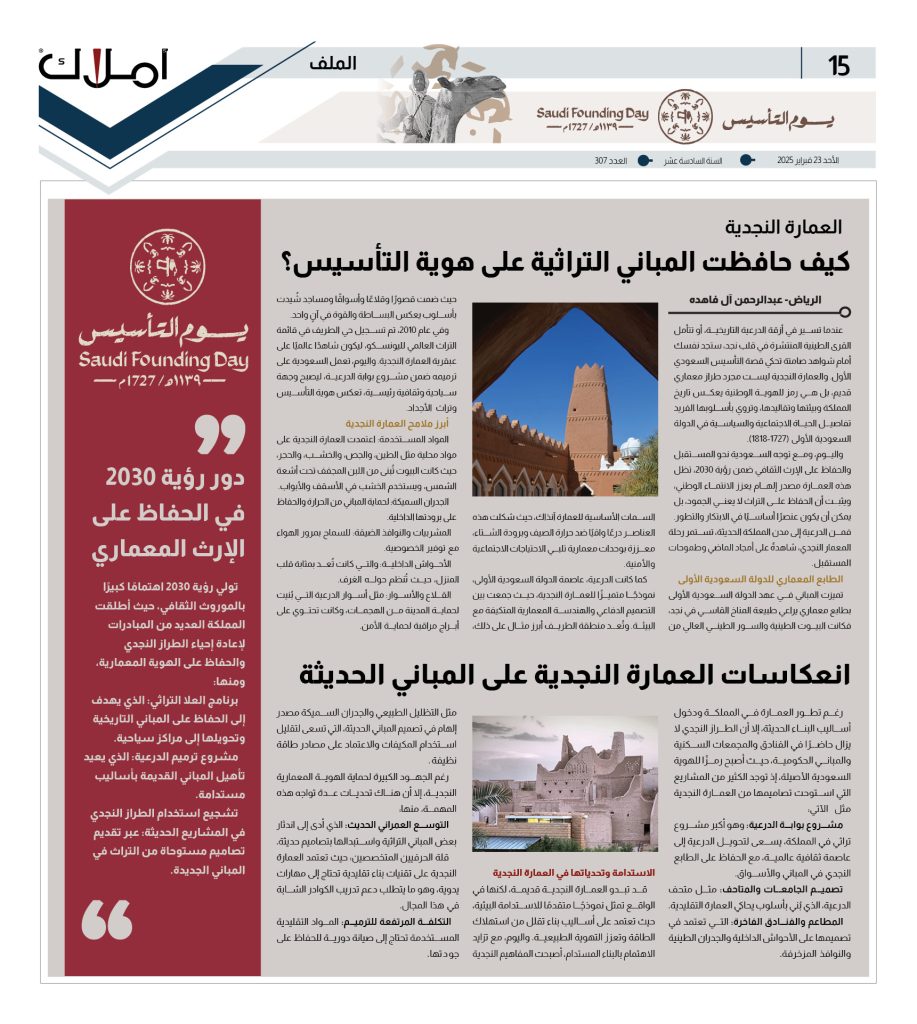

Najdi architecture. How have heritage buildings preserved the founding identity?
A
Riyadh- Abdulrahman Al-Fahdeh - When you walk through the alleys of Historic Diriyah, or contemplate the mud villages scattered in the heart of Najd, you will find yourself in front of silent witnesses that tell the story of the first Saudi founding. Najd architecture is not just an ancient architectural style, but a symbol of national identity that reflects the Kingdom's history, environment and traditions, and in its own unique style, tells the details of social and political life in the first Saudi state (1727-1818).
Today, as Saudi Arabia is moving towards a more modern approach to architecture, it has become a symbol of the Kingdom's national identity. <Today, as Saudi Arabia looks to the future and preserves its cultural heritage as part of Vision 2030, this architecture remains a source of inspiration that reinforces national belonging and proves that heritage preservation does not mean stagnation, but can be a key element in innovation and development. From Diriyah to the Kingdom's modern cities, the journey of Najdi architecture continues, bearing witness to the glories of the past and the ambitions of the future.
The architectural character of the first Saudi state
Mud houses and high mud walls were the main features of the architecture at the time, as these elements formed a protective shield against the heat of summer and the cold of winter, reinforced by architectural units that met social and security needs.The first Saudi state buildings were characterized by an architectural character that took into account the harsh climate of the Najd. <Diriyah, the capital of the first Saudi state, was also an outstanding example of Najdi architecture, combining defensive design with architecture adapted to the environment. Al-Turaif is the most prominent example of this, with palaces, castles, souks and mosques built in a style that reflects both simplicity and strength.
In 2010, Diriyah, the capital of the first Saudi state, was a prime example of Najdi architecture, combining defensive design with architecture adapted to the environment. <In 2010, Al-Turaif was inscribed on the UNESCO World Heritage List, a global testament to the genius of Najdi architecture. Today, Saudi Arabia is restoring it as part of the Diriyah Gate project to become a major tourist and cultural destination, reflecting the founding identity and ancestral heritage.
The most prominent features of Najdi architecture
Materials used: Najdi architecture relied on local materials such as mud, plaster, wood, and stone, as houses were built of sun-dried mud, and wood was used for roofs and doors.
Thick walls: to protect buildings from heat and keep the interior cool.
Tight shutters and windows: To allow air to pass through while providing privacy.
Interior courtyards: which were considered the heart of the house, around which the rooms were organized.
Castles and walls: Such as the walls of Diriyah, which were built to protect the city from attacks and contained watchtowers to protect security.
Despite the development of architecture in the Kingdom and the introduction of modern construction methods, the Najdi style is still present in hotels, residential complexes and government buildings, as it has become a symbol of authentic Saudi identity, as there are many projects whose designs are inspired by Najdi architecture, such as the following:
<Diriyah Gate Project: It is the largest heritage project in the Kingdom, which seeks to transform Diriyah into a global cultural capital, while preserving the Najdi character in buildings and markets.
Designing universities and museums: Such as the Diriyah Museum, which is built in a style that mimics traditional architecture.
Restaurants and luxury hotels: The design is based on interior courtyards, mud walls and decorative windows. Restaurants and luxury hotels.
Reflections of Najdi architecture on modern buildings
Sustainability and its challenges in Najdi architecture
<Najdi architecture may seem ancient, but it actually represents an advanced model of environmental sustainability, relying on building methods that minimize energy consumption and promote natural ventilation. Today, as interest in sustainable construction grows, Najdi concepts such as natural shading and thick walls are inspiring the design of modern buildings, which seek to minimize the use of air conditioning and rely on clean energy sources.
Although efforts have been made to preserve the Najdi identity, it is actually an advanced model of environmental sustainability, relying on building methods that minimize energy consumption and promote natural ventilation.
Despite great efforts to protect the Najdi architectural identity, there are several challenges facing this task, including:
Modern urbanization. <Modern urbanization: This has led to the disappearance of some heritage buildings and their replacement with modern designs.
The lack of specialized craftsmen. <Lack of specialized craftsmen: Najdi architecture relies on traditional building techniques that require manual skills, which requires supporting the training of young cadres in this field.
<High cost of restoration: The traditional materials used need regular maintenance to maintain their quality.
The role of Vision 2030 in preserving architectural heritage
Vision 2030 pays great attention to cultural heritage, as the Kingdom has launched several initiatives to revitalize the Najdi style and preserve the architectural identity, including:
The AlUla Heritage Program: It aims to preserve historic buildings and transform them into tourist centers.
Diriyah Restoration Project: which rehabilitates old buildings in a sustainable manner.
<Encouraging the use of Najdi style in modern projects: By introducing heritage-inspired designs in new buildings.