
From squares lined with bicycles to sparkling canals, the Danish capital, Copenhagen, has stolen the spotlight this year, topping the list of the world’s most livable cities compiled by The Economist Intelligence Unit (EIU). The change at the top was no accident; the Scandinavian city scored highly in stability, infrastructure, and education, while its rival, Vienna, stumbled due to security concerns that ended its three-year reign at the top.
Why did Copenhagen rise to the top?
Stability and subtle differences: The Danish capital scored nearly perfectly in the stability category, with low crime rates and an effective security system.
Green and smart infrastructure: Reliable public transportation, an abundance of bike lanes, and an eco-friendly road network bolstered its leading position.
Schools and universities meeting international standards: Heavy investment in the education system bolstered its standing in the index.
Vienna Slips… But Remains on the Podium
With a slight drop in stability scores—following the cancellation of Taylor Swift’s summer 2024 concert for security reasons—Vienna slipped to second place, tying with Zurich, Switzerland. Nevertheless, the Austrian capital maintains its global reputation thanks to a seamless transportation network and high-quality healthcare.
The Index
Methodology The Economist evaluates 173 cities across five main categories: stability, healthcare, culture and environment, education, and infrastructure. This study is typically used by companies to assess incentives for their employees when relocating abroad.
Europe Dominates, Australia Breaks the Monopoly
Four European cities made the top five, while Melbourne was the only city from the Southern Hemisphere to join the elite group. Here are the top ten cities for 2025:
Copenhagen – Denmark
Vienna – Austria
Zurich – Switzerland
Melbourne – Australia
Geneva – Switzerland
Sydney – Australia
Osaka – Japan
Auckland – New Zealand
Adelaide – Australia
Vancouver – Canada
London drops out of the top 50… and Honolulu leads the U.S.
The British capital slipped from 45th to 54th place due to a decline in stability, though it remains the top-ranked city in the United Kingdom.
Honolulu, in the state of Hawaii, took 23rd place, becoming the most attractive U.S. city to live in this year.
Canadian and Global Setbacks
Calgary fell from fifth to 18th place due to a decline in its healthcare rating.
Toronto fell four spots, settling at No. 16.
Damascus continues to suffer
The Syrian capital continues to suffer the effects of a long war, ranking at the bottom of the list as the least livable city despite the ouster of the former regime and the change in power; the legacy of the conflict will take additional years to heal.
Parsali Patacharia, Deputy Industry Director at *The Economist*, commented: "Global livability has stabilized over the past year, but stability scores have declined slightly. In the United States, small and medium-sized cities outperformed their larger counterparts, such as New York, amid pressure on infrastructure and services."
The Arab World on the Map: Al-Khobar Jumps 13 Places
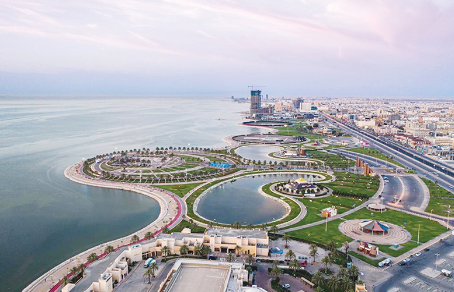
Saudi Arabia has invested heavily in health and education as part of Vision 2030, propelling Al-Khobar from 148th to 135th place—the largest improvement among Arab cities in the report. Abu Dhabi and Dubai also recorded slight improvements, confirming that improving quality of life has become a key part of economic diversification strategies in the Gulf.
The biggest leaps over the past year