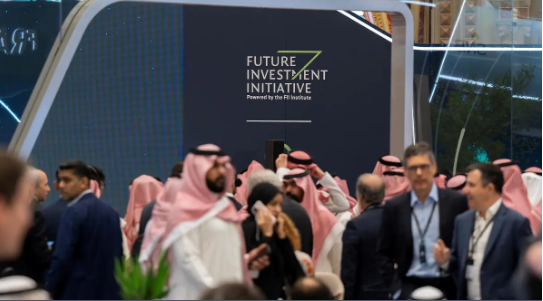

His Excellency the Governor of the Public Investment Fund, Chairman of Saudi Aramco, and Chairman of the Board of Trustees of the Future Investment Initiative Foundation. His Excellency the Governor of the Public Investment Fund, Chairman of the Board of Directors of Saudi Aramco, and Chairman of the Board of Trustees of the Future Investment Initiative Foundation, Mr. Yasser bin Othman Al-Rumayyan, delivered the opening speech, welcoming the attendees, noting that this conference is the most important gathering in the world for those who have the vision to transform ideas and investments into a tangible global impact. More than 250 billion US dollars worth of deals have been made through this platform since the forum was launched less than a decade ago, and we have come a long way together, but this year we must raise our impact to higher heights.
A great opportunity to shape the future of the global economy
His Excellency said:” The power of capital represented by the decision makers present today imposes a great responsibility on us, and at the same time gives us a greater opportunity to shape the future of the global economy, and we must assume this responsibility and seize this opportunity without delay. The world has changed since we last met twelve months ago, investors and companies are now facing a new economic reality and accelerating technological transformations. The old models that brought us to this point are no longer able to keep pace with the future, governments cannot correct the course alone, nor can the private sector bear the burden alone, and the solution lies in the unity of efforts between governments and the private sector as true partners, and we need a new model, and global cooperation that can keep pace with a new era of shared prosperity.”
And we need a new paradigm, and global cooperation that can keep pace with a new era of shared prosperity.
<His Excellency emphasized that the Future of Investment is the ideal platform as it brings together world leaders, investors and decision makers from various sectors, pointing out that the global GDP exceeded (111) trillion US dollars and is expected to grow by (2.While 66% of people feel positive about their lives, only 37% are optimistic about the future of the world, and 69% of people are worried about losing their jobs due to foreign competition, this gap between individual hope and collective doubt is an alarm.
Technology can bridge the gaps
Three out of four people fear that artificial intelligence will widen the educational gap between societies that have access to education and those that lack it, and we cannot allow this to happen. We must confront the inequalities that have hindered progress, he said, noting that in 2025, approximately 10% of the world's population, equivalent to about 808 million people, live in extreme poverty, emphasizing that with every challenge comes an opportunity to find solutions that serve all humanity.With every challenge comes an opportunity to find solutions that serve all of humanity.
He noted the importance of governments and the private sector working together to harness global capital to achieve security and stability, create opportunities and promote optimism, and that governments must intensify their efforts, given the need for open, not restricted, markets, and smart regulation, not over-regulation.
H.
H.
H.
H.
H.
H. <H.E. Mr. Al-Rumayyan said:” Under the leadership of His Royal Highness Prince Mohammed bin Salman bin Abdulaziz Al Saud, Crown Prince and Prime Minister, the Kingdom has set a new global benchmark in economic transformation through Vision 2030, which has opened wide horizons for future generations, nine years have passed since the launch of the vision, and the results are evident everywhere: New cities, new industries, integrated ecosystems, innovative supply chains, and just last year, foreign investment grew by 24% to reach 31.7 billion US dollars. We have introduced the Kingdom to the world, and now the world is coming to the Kingdom, to the Future Investment Initiative every year, to Expo 2030, to the FIFA World Cup 2034.
He emphasized that the Kingdom's wealth is a global benchmark for economic transformation through Vision 2030, which opened horizons for generations, nine years ago. He emphasized that wealth in the Kingdom is not measured by numbers, but by human prosperity, and in Riyadh this week, there are opportunities to forge cross-border partnerships that create real impact and embody the true power of global cooperation, adding that the Future Investment Initiative will continue its pioneering role, and this edition will conclude with a declaration that unites world leaders in a common pursuit of progress for all.
The Chairman of the Future Investment Initiative (FII) Committee delivered the keynote speech. For his part, Richard Attias, Chairman of the Executive Committee and Acting CEO of the Future Investment Initiative Foundation, welcomed global leaders and international guests to the ninth edition of the Future Investment Initiative, expressing his pride in what the Future Investment Initiative has achieved in building a passionate community that aspires to change the world.
For his part, Chairman of the Executive Committee and Acting CEO of the Future Investment Initiative Foundation Richard Attias delivered a speech during which he welcomed global leaders and international guests.
FII gathers to collaborate, not compete
The dream was to bring the world's decision makers together not to compete but to collaborate, not just to talk about the future but to shape it, noting that this year's edition reached 9,000 delegates including 2,000 members and media groups from all over the world.Richard emphasized the importance of bringing together the world's decision makers to collaborate, not compete. Richard Attias emphasized that what has been achieved today is a historic record and a launch of the main theme of “the key to prosperity” that shapes the world, noting that this year the initiative is more inclusive with ideas moving forward to support the bold movement in health, artificial intelligence and human development.
The Future Investment Initiative belongs to everyone, a strength that comes from collective action and succeeds if each of us are members of this movement and its ideas are co-creators of transformation, pointing out that in the coming days, new paths of financing, creativity and courage will be revealed, and this is what the initiative stands for.
FDI doubled
H.E. Khalid bin Abdulaziz Al-Falih, Minister of Investment, revealed that foreign direct investment in the Kingdom has doubled (4) times, exceeding the set targets, adding that the Kingdom's Vision 2030 has proven over the years that it is a reality and not a dream.
This came during the participation of the Ministry of Investment in the Kingdom of Saudi Arabia. <During his participation in the panel discussion titled “Leaders of Public-Private Alliances” within the 9th edition of the Future Investment Initiative Conference, His Excellency pointed out that the Kingdom's economy is no longer based on oil, and (40%) of the Kingdom's budget and expenditures are funded by non-oil revenues, and (90%) of foreign direct investment in the Kingdom is non-oil, indicating that the Kingdom has achieved more progress and transformation in new and interesting sectors, such as: advanced manufacturing, technology and tourism: Advanced Manufacturing, Technology, Tourism, Entrepreneurship, Deep Tech, and Venture Capital.
He emphasized that the Kingdom has been able to overcome many obstacles such as: Corona pandemic, oil declines, and regional tensions, thanks to large reserves and high stability, which is a strength of the Kingdom, pointing out that the non-oil economy increased to (5%), indicating that the past two years have witnessed more new and promising investment opportunities in the Kingdom, including artificial intelligence and acceleration in digital transformation, noting that major national projects continue their work and some are preparing to open their doors.
H.
H.
H.
H.
H.
H.
H.
H. <His Excellency concluded by emphasizing that the Kingdom strongly believes in a strong partnership between the private sector and the government sector that stands behind the private sector and even with partnerships with the foreign investor, noting the Kingdom's commitment to minimizing barriers to trade. The panelists pointed out that the energy-related sectors are promising and full of innovation that will build a better future for humanity, noting that partnerships between the public and private sectors will contribute to reaching the goals in a shorter period of time.
High flexibility increases investment opportunities
Participants highlighted the importance of harmonization between the public and private sectors to face challenges and shocks, indicating that high flexibility and operational flexibility would achieve many promising investment opportunities that provide balance in the market in general, noting that governments should work to establish clear frameworks for the work of the public and private sectors, which will pave the way for more investment opportunities between all countries.Participants stressed the importance of harmonizing the public and private sectors to face challenges and shocks, indicating that high flexibility and operational flexibility would achieve many promising investment opportunities that provide balance in the market in general. Dr. Ngozi Okonjo-Iweala, Director-General of the World Trade Organization (WTO), stressed that the international trade system is going through a phase of pressures and challenges, but it is still effective and influential in stabilizing global trade, noting that more than (70%) of global trade passes through the WTO system.
In turn, the Director-General of the WTO Dr. Ngozi Okonjo-Iweala stressed that the international trade system is undergoing a period of pressure and challenges.
This came during her participation in a panel discussion entitled “Will the world shift from free trade to strategy”, within the sessions of the ninth edition of the Future Investment Initiative Conference, addressing the future of global trade and the most prominent shifts in the international trade system.
Dr. Iwui said that the WTO is still effective and influential in stabilizing global trade, pointing out that (10%) of trade globally passes through the WTO system. Dr. Iweala explained that the international trade system needs reforms and updates in line with the rapid economic and technological changes, considering that the current stage represents an opportunity to rebuild the global trade system on a more flexible and fair basis, in light of the rapid growth of the global economy by (4%), and the increase in trade in the digital sector by (8%), with e-commerce volume reaching levels close to one trillion dollars.
Dr. Iweala stressed that intelligence is the key to the future of global trade and the most important changes in the international trade system. She stressed that artificial intelligence, digital trade and green trade represent major pillars in the future of global trade, and that studies conducted by the organization showed that technologies related to artificial intelligence contributed to achieving growth of about (5%) in international trade, and related sectors led growth of more than (40%), noting that there are ongoing negotiations between member states on setting clear standards for data exchange and regulating digital trade, explaining that trade in this area reached about (3) trillion dollars, including products such as computers and connectors.
Iwoye concluded that the value of trade exchange in this area reached about (3) trillion dollars including products such as computers and connectors. Iweala concluded her speech by emphasizing that international cooperation is the best way to overcome the current challenges, and that continued dialogue and joint action among member states enhances the stability of the global trading system and provides greater opportunities for development and sustainable growth.“
Participants in the session emphasized the importance of developing clear standards for data exchange and regulating digital trade. Participants in the ”Sovereignty vs. Globalization" session at the 9th edition of the Future Investment Initiative Conference stressed that the world needs diversified supply chains, more energy self-sufficiency, investment in data centers, technology and artificial intelligence, and more joint trade between allied and friendly countries.
Participants in the ”Sovereignty vs. Globalization" session at the 9th edition of the Future Investment Initiative Conference, stressed the need for diversification of supply chains. H.E. Ali bin Ahmed Al-Kuwari, Qatar's Minister of Finance, H.E. Rachel Reeves, UK Treasury Secretary, and Mehmet Şimşek, Turkish Treasury Secretary, discussed the importance of globalization, trade, artificial intelligence, cooperation between countries, signing technical agreements and direct partnerships to find solutions to economic crises and the importance of working to strengthen the work of multilateral organizations, especially after working hard for years to build a system based on rules, participation and mutual cooperation.
The panel discussion was moderated by H.E. Ali bin Ahmed Al-Kuwari, Qatar's Minister of Finance, and H.E. Rachel Reeves, UK Treasury Secretary. <The British Chancellor of the Exchequer said: "One of the government's priorities in the United Kingdom is to grow the economy; to do so requires a solid foundation of stability to do so, as well as building relationships with important allies." She reviewed the trade deals that the United Kingdom has concluded with a number of countries, and trade agreements that confirm competitiveness. <Qatar is open to direct foreign investment, citing the 2022 World Cup, which gave great impetus to building infrastructure and Qatar's identity, looking forward to capitalizing on this while continuing to attract international investment, especially as Qatar is one of the largest LNG producers in the world, noting the importance of cooperation with the whole world towards building partnerships and direct investments such as economic cooperation and trade agreements: Economic cooperation and trade agreements.
He said that artificial intelligence and technology are part of the strategies in his country's plan to diversify the economy, and that investing in artificial intelligence and energy is important and logical, and Qatar has distinguished national capacities in data, innovation and aviation.
In turn, he noted that Qatar is a large producer of liquefied natural gas in the world. <For his part, the Turkish Treasury Minister noted the importance of countries investing in international and regional integration, as it has benefits in strengthening risk-bearing aspects such as: Energy and production security, stressing the importance of technology, health, security, artificial intelligence, data and cybersecurity that need more investments in them, noting the importance of working to minimize risks before they occur.