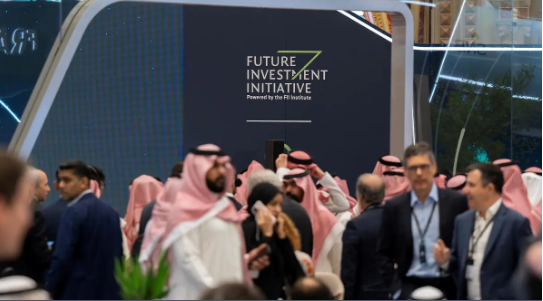

The sessions of the Future Investment Initiative Conference featured discussions on humanity within the right system, the tax system, spending efficiency, the importance of attracting long-term foreign investment in achieving sustainable development, and the characteristics of leaders and their ability to deliver and achieve tangible results that meet the aspirations of the people.
This came during a panel discussion titled “Is Humanity Heading in the Right Direction,” as part of the sessions of the ninth edition of the Future Investment Initiative Conference, in which His Excellency Shahbaz Sharif, Prime Minister of the Islamic Republic of Pakistan, President of the Republic of Rwanda Paul Kagame, President of the Cooperative Republic of Guyana Mohamed Irfan Ali, Prime Minister of the Republic of Albania Edi Rama, and FIFA President Gianni Infantino.
The Prime Minister of the Islamic Republic of Pakistan congratulated His Royal Highness Prince Mohammed bin Salman bin Abdulaziz Al Saud, Crown Prince and Prime Minister – may God protect him – on organizing the ninth edition of the Future Investment Initiative conference, praising the conference for representing a global leadership vision that embodies the transformation led by the Kingdom at the economic and developmental levels.
He explained that Pakistan is continuing to implement radical economic reforms, including measures to diversify revenue sources, the digitization of the tax system, the fight against corruption, and the enhancement of spending efficiency, emphasizing that these steps are part of building a productive economy capable of attracting long-term investments and achieving sustainable development.
He noted that youth account for approximately 60% of Pakistan’s population, making them a cornerstone of training, skills development, and employment plans aimed at boosting productivity and economic growth, highlighting the importance of international cooperation to support developing countries in the fields of technology and green investment, and outlining the challenges his country faces as a result of climate change, He noted that Pakistan is among the ten countries most affected by natural disasters despite its carbon emissions being less than (0.1%), as it suffered devastating floods in 2022 that caused losses exceeding $130 billion, calling for strengthened international cooperation to address climate impacts and support countries affected by natural disasters through equitable partnerships in financing and technology.
The Pakistani Prime Minister emphasized that artificial intelligence is a key pillar of Pakistan’s technological transformation, explaining that his country is investing in building human capacity and establishing the data centers necessary to develop AI applications in agriculture and industry, thereby contributing to increased productivity and economic integration between the Global North and South.
For his part, Rwandan President Paul Kagame emphasized that the most important leadership qualities the world needs today are the ability to deliver and achieve tangible results that meet the aspirations of the people, stressing that trust between leaders and citizens is not granted, but is built through actual performance and commitment to what is said and implemented on the ground.
He explained that true leadership is measured by the extent to which promises are fulfilled and plans are translated into achievements that people feel in their daily lives, noting that the process of building trust depends on a balance between what leaders offer and the experiences citizens live through, so that achievements are tangible and measurable.
He noted that the Rwandan experience serves as a practical model in this regard, as the country, despite its small geographical size, has managed to foster a strong national spirit and an open-minded approach that matches the ambitions of larger nations, emphasizing that true change is not linked to the size of nations or their resources, but rather to the ability of peoples to shoulder their responsibilities and make decisions to rise again.
Mohammed Irfan Ali, President of the Cooperative Republic of Guyana, affirmed that investing in human capital, developing infrastructure, and promoting sustainable economies are fundamental pillars for ensuring continued development and global competitiveness, noting that the world faces multiple challenges related to climate, energy, food, and migration, and pointing out that his country serves as a unique model for preserving ecological diversity, as it maintains the highest rates of forest cover and the lowest levels of desertification in the world.
The President of Guyana noted that his country, despite its small size, has one of the fastest-growing economies in the world thanks to recent oil discoveries; this has enabled it to launch extensive investment programs in education, technology, artificial intelligence, and digitalization; with the aim of building a competitive economy based on innovation. He emphasized that small and medium-sized countries are capable of making a global impact through flexibility, innovation, and investment in people, calling for a reorientation of development priorities to be more inclusive and equitable among nations.
The Prime Minister of the Republic of Albania, Edi Rama, explained that culture, creativity, and the arts are essential elements in inspiring people and driving development, noting that the transformation the Kingdom is undergoing embodies the link between beauty and prosperity, and serves as an inspiring model for the world. He emphasized that the Kingdom has become a living example of the possibility of transforming the desert into a vibrant environment that rivals the beauty of major historic cities, and that urban development and attention to the urban landscape reflect an advanced awareness of the importance of beauty in improving quality of life.
He emphasized that the world today is witnessing a growing need for inspiration and positive change, and the Saudi experience proves that renaissance is not exclusive to a specific region, but can emerge from any place that possesses the will and vision to achieve it.
For his part, FIFA President Gianni Infantino affirmed that soccer possesses a magical power capable of bringing happiness and joy into people’s lives, expressing his delight at the success of the World Cup in Qatar, noting that soccer promotes education and peace, and brings together fundamental values such as understanding and cooperation.
He noted that soccer is not merely a sport but a global symbol of connection between communities, as it brings together people from different cultures, thereby contributing to the spirit of unity and understanding among nations. He emphasized the importance of education through sports, and the role of clubs and schools in teaching children positive values, such as cooperation and respect. He expressed his desire to promote equality and justice in society through soccer, noting the need to use this sport as a platform to provide equal opportunities for all.