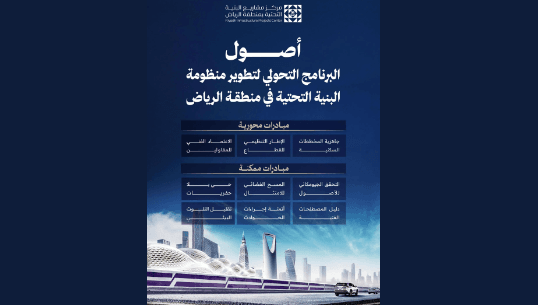

Riyadh Infrastructure Projects Center launched “Ossul”, the transformational program to develop the infrastructure system in the Riyadh region, including (9) initiatives that include organizational, technical and technical aspects, in light of the rapid growth witnessed by Infrastructure sector, where the center recorded a growth of (29%) by 2025.
Increased regulation and governance
The launch of the program comes in response to the expansion of the sector and the increase in the level of regulation and governance, with more than 600 contractors and implementers and more than 110 stakeholders from the public and private sectors working in the energy, water, telecommunications and roads sectors.
The Center explained that the Ossul program includes nine integrated initiatives aimed at regulating the sector and raising its efficiency, including: The readiness of residential plans, the regulatory framework for the sector, technical accreditation for contractors, geospatial verification of assets, satellite survey for compliance, excavation-free neighborhoods, technical terminology guide, automation of procedures for accidents resulting from infrastructure works, and reducing environmental pollution associated with project works, in order to enhance the quality of implementation, increase data reliability and improve the efficiency of coordination between the relevant authorities.
The Ossol program includes nine integrated initiatives aimed at regulating the sector and raising its efficiency.
Raising the efficiency of planning and implementation
Osol is part of its objectives to govern the implementation of infrastructure projects, increase the efficiency of planning and implementation, enhance coordination between government and service agencies, reduce duplicate digging and duplication of work, and achieve spending efficiency, thus contributing to building a sustainable infrastructure system that supports economic growth and improves the quality of life in the Riyadh region.
The center pointed out that its efforts during the past period contributed to achieving a number of achievements, most notably the launch of the comprehensive detailed plan for infrastructure projects and the resulting harmonization of projects and reducing conflicts, contributing to reducing the duration of infrastructure works from 34 days to 26 days during 2025, in addition to the governance of resphalting works, automating the issuance of licenses, and enhancing field monitoring, in order to enhance transparency, raise the level of compliance, improve the urban landscape, and the experience of residents and visitors to the city of Riyadh.
The center pointed out that its efforts during the past period contributed to the achievement of some achievements, including the launch of the comprehensive detailed outline for infrastructure work and the resulting harmonization of projects and reducing conflicts.