
The Riyadh Economic Forum will conclude its sessions today and issue its recommendations made by specialists, participants and experts in five main axes, including the human resources axis, the study of future jobs in the Kingdom, financial reforms and their impact on economic development, the study of environmental issues and their impact on economic and social development in the Kingdom, in addition to studying the role of balanced development in encouraging reverse migration and achieving sustainable and comprehensive development in the infrastructure axis, and the fifth axis discusses the role of the non-profit sector in economic and social development.
The role of the non-profit sector in economic and social development will be discussed in the fifth axis.
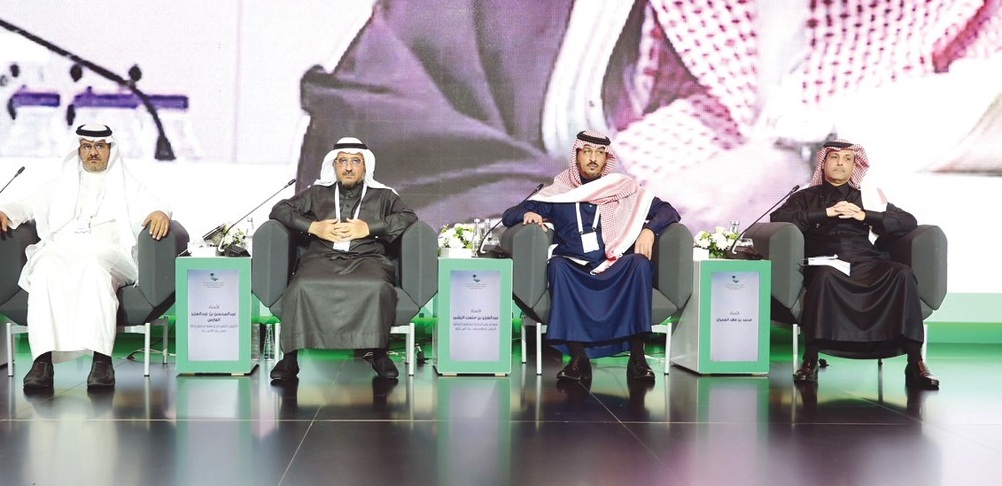
Stopping Financial Waste in Government Agencies During the second session, which dealt with the business sector and the study of fiscal reforms and their impact on economic development in the Kingdom, the CEO of Alinma Bank, Abdulmohsen Al-Fares, stressed the need to stimulate the public sector and support it to the private sector, pointing out that doubling salaries in 2020 means an issue with one resource, oil, indicating that there was financial waste before the establishment of "Absher", calling for the establishment of another model for the program to eliminate financial waste in government agencies. The role of the non-profit sector in the economic and social development.
Al-Fares demanded, during the session, to stop financial waste and we must look at financial reform for fifty years, noting that the study has great intersections and the future in the private sector will contribute to the local product.
3.7% of GDP supports establishments For his part, economic analyst Mohammed Al-Omran said that the state provided energy subsidies worth 330 billion riyals and other services provided to citizens, pointing out that the non-oil sector achieved growth rates. Al-Omran pointed out that the study did not address the employment of Saudis and the study should have focused on localization, stressing that 3.7 % of GDP goes to support small and medium enterprises, and the GDP contribution of small and medium enterprises should be raised from 20 % to 35 %.
Praise the non-profit sector On the same topic, Assistant Minister of Finance for International Financial Affairs Abdulaziz Al-Rasheed called for the sustainability of public finance, pointing out that the non-oil sector grew by 4.2%, and Al-Rasheed addressed that industrialization depends on local demand and must be built on diversification in products and export outside the Kingdom, and praised the government work during the past three years in terms of huge transformations, especially in terms of joint teamwork, between the public and private sectors, international organizations and the non-profit sector. These are the most important reform priorities, stressing that economic growth is linked to government spending and the stability of investment spending is what brings strength to the private sector.
Al-Rasheed said that the spending policy linked to the size of revenues is a policy that amplifies the positive effects if revenues increase and also amplifies the negative effects if public revenues decrease. He added that the Kingdom has sought over long periods of time to reduce this correlation between increased spending, but the dumping in the event of increased revenues overcame the issue of control and stabilization of government spending through the economic cycle. Rasheed said.
Al-Rasheed emphasized that, with this fluctuation in spending historically, current spending increases, a large part of which is workers' compensation. He pointed out that the stability of investment spending in the budget is very important even if growth is weak, which is what achieves the highest efficiency in the private sector. Rasheed stressed that the stability of investment spending in the budget is very important even if growth is weak.
The study stressed the need to rationalize unproductive current spending, such as spending on public administration and subsidies, and follow up the existing gap between actual and budgeted spending to identify the causes and means of treatment, and disclose this in a transparent framework, in addition to developing non-oil revenues, by reforming the tax and customs duties system and addressing the imbalances affecting the private investment environment. The study emphasized the need to rationalize non-productive current spending, such as spending on public administration and subsidies.
Compliance with the specific rules for government spending Compliance with the specific rules for government spending The Riyadh Economic Forum study emphasized reviewing ways to reduce the budget deficit by relying on real savings in financing and reducing recourse to internal public borrowing when crowding out the private sector, and external borrowing, especially short-term loans, in addition to reviewing medium-term spending frameworks of three and five years in terms of the bases for estimating budget tools in light of actual indicators and data and estimates of the Saudi Arabian Monetary Agency, and adherence to the financial rules specified for the size of government spending in normal times to increase the fiscal space, with some flexibility in applying these rules, and overcoming this
In the area of consistency of fiscal policy objectives and the targets of the Kingdom's Vision 2030, the study emphasized the presentation of different scenarios for fiscal policies whose outputs are balanced with the quantitative targets for the economic variables concerned in the Kingdom's Vision 2030, and alternative scenarios for fiscal policy instruments and the targeted growth or employment rates in 2023, or the contribution rates of SMEs, foreign direct investment, or non-oil commodity exports to GDP in the target year. Examining these scenarios and their quantitative impacts would move fiscal policy from focusing solely on fiscal discipline in the medium term 2023 to a broader and more comprehensive scope for the quantitative impact of fiscal policy in the long term 2030 and beyond.