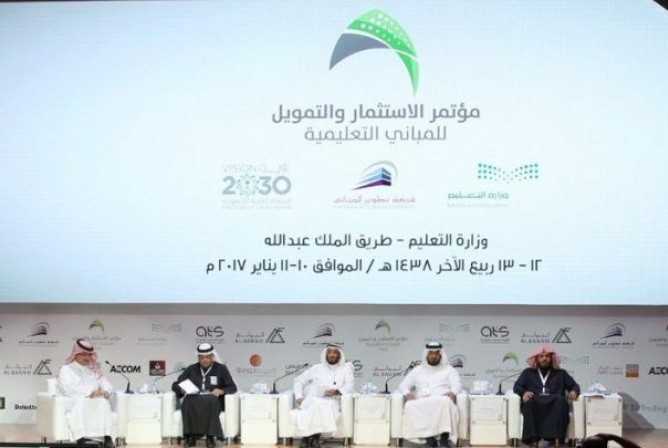

At the Investment and Financing Conference for Educational Buildings, which was opened today, Tuesday, by Minister of Education Dr. Ahmed Al-Issa, investment and education experts emphasized that endowments play a vital role in the education development strategy to ensure intergenerational equity and to provide a sustainable financial source, so that educational institutions are not affected by any economic fluctuations.
This came during the second session of the conference, titled “Endowments to Support and Finance Investment in Education,” chaired by His Excellency Dr. Ismail bin Mohammed Al-Bashri, President of Al-Jouf University, and attended by Dr. Ziad bin Othman Al-Hagil, CEO of Sulaiman Al-Rajhi Endowments Company, Dr. Abdullah bin Abdulrahman Al-Shuwaier, Secretary of the Education Fund; Dr. Khalid bin Saeed Al-Dhafir Al-Qahtani, Secretary-General of King Saud University Endowments; and Dr. Ahmed bin Abdullah Bakrman, former member of the National Real Estate Committee and CEO of Rasel Holding Company.
Dr. Othman reviewed the projects of the Sulaiman Al-Rajhi Endowments, which include numerous initiatives such as the Al-Rajhi Educational City project and the Sulaiman Al-Rajhi Hospital, explaining that the Sulaiman Al Rajhi Endowments is a legal entity with several committees and councils under its umbrella, including the Audit Committee, the Investment Committee, and others, with these committees employing external auditors and analysts to ensure governance and protect rights, and has been established in accordance with international standards to achieve the principles of sustainability and community development.
For his part, Dr. Al-Shuwaier considered endowments to be particularly important when they relate to strategic matters such as education, as the goal of endowments is to establish intergenerational equity and provide a sustainable financial source, ensuring that educational institutions are not affected by economic fluctuations. He explained that the optimal model for endowments involves diverse revenue streams managed by a professional and specialized team.
Al-Shuwaier praised the Education Fund as a model and a unique experience in this field, noting that at its inception it managed seven universities and has since evolved to become the investment arm of 26 universities today; the fund has financed more than 500 university projects.
He noted that the assets of educational endowments in the United States amount to $200 billion, which are used to sustainably support scientific research without being affected by the economic cycle, which sometimes experiences recessions and slowdowns in growth. He explained that the challenges facing endowments in Saudi Arabia lie in the lack of diversification and the focus on a single type of asset.
For his part, Dr. Al-Qahtani emphasized the importance of endowments in the development and advancement of global universities, considering them a vital tool for the transformation from a traditional university to an advanced one, noting that King Saud University’s investments in the endowment sector include real estate investments in tower leasing, long-term land investments, financial investments in tourism and hotels, and medical investments, and noting that the university has a partnership with the private sector through Riyadh Tech Valley via the establishment of the SABIC Research Center.
Al-Qahtani discussed universities with large endowments, citing Harvard University, which has endowments worth $36 billion, and Stanford University, which has endowments worth more than $21 billion, explaining that universities with massive endowments were not affected by the recession that hit the U.S. economy in 2009 and were able to continue their research activities.
For his part, Dr. Bakermann noted that most endowments focus their investments on real estate, calling on endowment administrators to focus on the health and education sectors, as they are promising sectors.
He explained that the PPP system provides strong guarantees for investors, calling for the adoption of the Turkish model, which relies 40% on this system in partnership with the private sector, as it ensures sustainable cash flows.