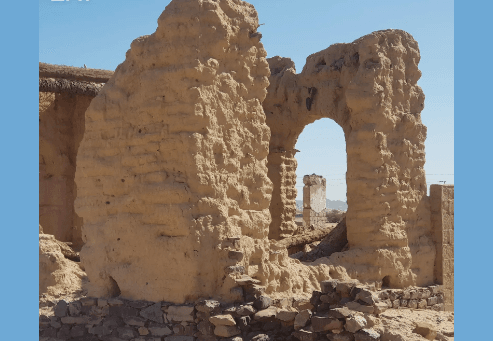
Woven the ancient mud-brick houses in the center of Thul, north of Jeddah Province, with their brown walls and roofs supported by acacia and palm trunks, form an architectural epic that transcends the boundaries of time and space, standing as a silent witness to centuries of maritime life and carrying within its details the memories of generations who lived to the rhythm of the waves, and who, using mud, stone, and wood, forged an architectural legacy that embodies humanity’s authenticity and its ability to harmonize with the environment and create beauty from its simplest resources.
And stretching along the alleys of the old town, these mud-brick houses stand tall despite the cracks left on their walls by the passing years, as if refusing to bow to the passage of time, preserving the features crafted by the hands of skilled builders, remaining an open record that tells the history of a village linked to the Red Sea, which adopted fishing, trade, and seafaring as a way of life, according to the Saudi Press Agency (SPA).
Walls of rammed earth
The components of these buildings reveal a genius traditional architecture on the Kingdom’s western coast, where the walls were constructed from rammed earth mixed with sea gravel, while the roofs were supported by tree trunks and palm fronds, in a design that combines simplicity and efficiency, provides natural insulation suited to the coastal environment, and reflects a deep understanding of the climate prior to the emergence of modern construction techniques.
The mud-brick houses in Thul reflect an important aspect of the architectural identity of the Kingdom’s coastal communities, where dwellings were not merely structures for living but social spaces that embraced the details of daily life, and formed part of the village’s cultural and economic fabric during a time when Thul flourished as one of the coastal ports on the Red Sea.
Historical and Architectural Value
The ancient mud-brick houses in Thul embody an authentic example of traditional coastal architecture, where mud walls harmonize with tree trunks and palm-frond roofs, creating a scene that preserves the memory of an ancient coastal village and embodies humanity’s connection to its environment across centuries of history.
The ancient mud-brick houses in Thul continue to retain their historical and architectural value as a living testament to an important phase in the region’s history and as a cultural resource worthy of documentation and protection, thereby contributing to the promotion of cultural tourism and the preservation of architectural heritage, in line with the objectives of the Kingdom’s Vision 2030, which aims to preserve national identity and invest in historical sites.

The Mud-Brick Houses of Thul: The Memory of a Place Woven Over Centuries on the Red Sea Coast
These buildings serve as a living record of traditional coastal architecture and document the connection between the people of Thul and the sea and their environment over the centuries.