
The completion of the preparation of the Master Plan for Northeast Riyadh marks a pivotal milestone in the urban development journey of the Saudi capital, as its role is not limited to regulating land use but also lays the foundation for a new phase of long-term planning aimed at guiding urban and investment growth in one of the Kingdom’s largest future expansion areas. Although the Royal Commission for Riyadh City has emphasized that the plan does not represent the launch of an implementation project, its implications extend to the real estate market by providing greater clarity for investors and developers and creating a more stable environment for future investments.
A plan that charts the future of 456 square kilometers
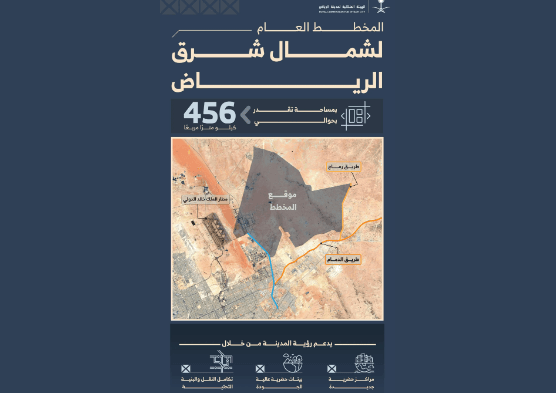
the Royal Commission for Riyadh City that it has completed the preliminary master plan for the area located northeast of the capital, covering an area of approximately 456 square kilometers, in a strategic location connected to King Khalid International Airport, Wadi Al-Sali, and the Dammam and Janadriyah highways.
The plan outlines a general vision for land use, ensuring that urban expansion is organized in accordance with a long-term vision, while taking into account the needs of Riyadh’s population and economic growth.
4 Principles Guiding Future Development
The plan is based on four main pillars aimed at building a more sustainable city, including:
Establishing a long-term urban model that allows for phased expansion.
Developing integrated communities that combine housing with daily services.
Achieving a balance between residential, economic, recreational, and natural land uses.
Improving quality of life, enhancing green spaces, and preserving natural wadis.
These principles reflect a shift toward developing integrated neighborhoods, rather than traditional urban sprawl, thereby increasing land-use efficiency and enhancing the appeal of real estate investment.
Why is the plan significant for the real estate market?
Although the Authority has emphasized that the plan represents an initial planning phase rather than an implementation project, the announcement carries positive signals for the real estate market.
A clear vision for land use provides real estate developers and investors with a more accurate picture of future expansion trends, which helps in preparing investment plans and reducing the risks associated with investing in new areas.
Furthermore, a clear planning vision helps boost market confidence, as investment decisions are based on clear regulatory foundations rather than mere expectations.
A Strategic Location That Boosts Investment Attractiveness
The area derives particular importance from its location, which connects several of the capital’s most vital hubs, foremost among them King Khalid International Airport, the Dammam and Janadriyah highways, and Wadi Al-Sali.
This location is expected to boost future demand for residential, commercial, and service projects, especially as Riyadh continues to expand northward and northeastward, transforming these areas into one of the most important hubs of urban development.
Long-Term Planning Supports Market Stability
The preparation of the plan is part of the Royal Commission for Riyadh City’s strategy to guide urban growth in the capital, which is experiencing rapid population and economic expansion.
This type of planning is a key factor in stabilizing the real estate market, as it defines future development trends, and helps government agencies and the private sector align their projects with urban plans, thereby reducing haphazard development and enhancing development efficiency.
New Opportunities for Real Estate Developers
The completion of the plan provides real estate development companies with a clearer vision of the areas poised for growth in the coming years, which helps them prepare feasibility studies, set investment priorities, and plan projects that align with the capital’s future direction.
The planning framework also supports financing decisions and gives investors greater ability to evaluate investment opportunities before the implementation phases begin.
Will Land Prices Fall?
The completion of the plan does not mean immediate declines in land prices, especially since the Authority has emphasized that the announcement does not represent the launch of a new development project, and that the plan will be followed by detailed planning phases before implementation begins.
However, the announcement may increase investor interest in areas within the plan’s scope and neighboring areas, given the clarity of future growth trends, while the actual impact on prices will remain linked to the launch of infrastructure projects, the approval of detailed plans, and the announcement of implementation phases.
Why did the Authority emphasize that the plan is not an implementation project?
The Royal Commission for Riyadh City was keen to clarify that what was announced represents only an initial planning phase, not an implementation project, in order to avoid any interpretations that might lead to real estate speculation or inaccurate expectations regarding the timing of development.
It explained that the next phase will involve the preparation of detailed plans for the various areas by the relevant authorities, with any future updates to be announced through official channels.
Impacts Extending to Vision 2030
The plan aligns with the objectives of the Kingdom’s Vision 2030, which aims to build more sustainable cities with a higher quality of life by providing integrated communities, promoting green spaces, and striking a balance between urban development and the preservation of the natural environment.
It also contributes to Riyadh’s status as one of the fastest-growing capitals in the region and establishes the planning infrastructure to accommodate population growth and future investments.
What happens after the plan is finalized?
The completion of the preliminary master plan marks the beginning of a new phase, not the end of the project, as the relevant authorities will move on to preparing detailed plans, determining land uses, road networks, and the locations of public services and facilities, in preparation for the implementation phases.
Thus, the plan’s most significant impact at present is to enhance clarity for the real estate market, regulate urban expansion, and create a more stable investment environment, thereby supporting the capital’s long-term growth, and laying the foundation for a new development roadmap that will reshape the future of real estate investment in northeast Riyadh.