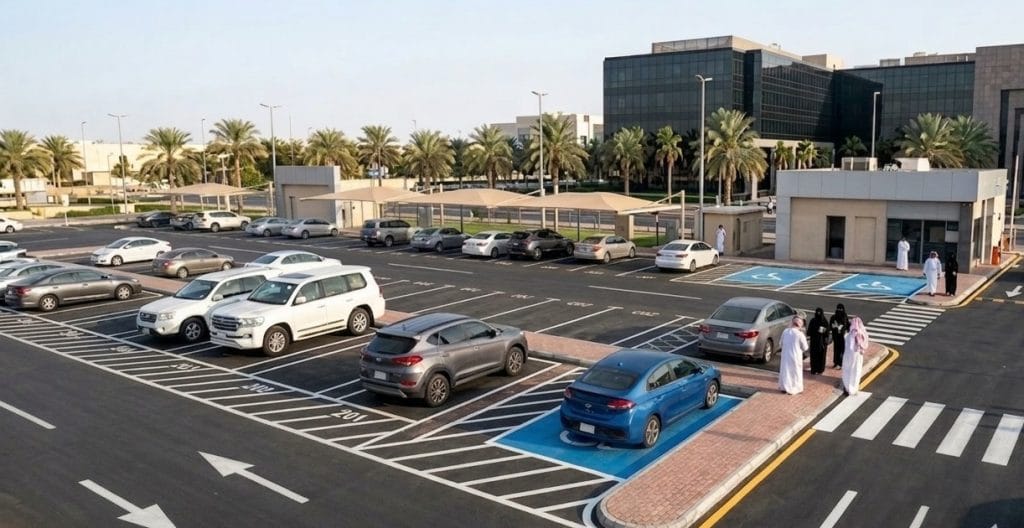

public parking lots are an essential part of the facilities that residents of residential neighborhoods rely on every day, however, some neighborhoods are witnessing irregular practices such as reserving parking spaces with rocks, cones, chains, and other objects, thereby turning a public facility into a space appropriated by individuals, which in some cases leads to disputes among neighbors, residents, and visitors. In addition, it contributes to visual pollution.
From a social perspective, respecting a neighbor’s rights and safeguarding the rights of others are deeply rooted values in our society. The Messenger of Allah ﷺ said: «Gabriel kept advising me regarding the neighbor until I thought he would be made an heir.» Thus, regulating the use of public parking spaces is not merely a municipal measure; it also contributes to enhancing social stability and quality of life within neighborhoods.
This raises an idea worth exploring: incorporating public parking spaces within residential neighborhoods—including those located on local, non-commercial roads—into the parking management system operated by municipal authorities, and linking them to official digital applications and platforms, similar to existing parking management apps in some cities.
This does not necessarily mean imposing high fees; rather, nominal rates or reduced residential rates could be adopted, with the option to reserve, pay, and manage parking electronically, thereby ensuring equitable use and limiting the phenomenon of parking monopolization, especially in neighborhoods suffering from a shortage of private parking spaces.
This system would provide municipal authorities with accurate data on parking demand, peak times, and congestion hotspots, helping them make more informed decisions regarding the creation of parking spaces, road development, and the redistribution of space.
The model may also help protect public property, reduce disputes, and increase the efficiency of available space utilization, while providing a financial resource that can be directed toward developing transportation and parking services and improving the urban landscape.
Transforming public parking spaces in neighborhoods from open areas subject to individual occupation into digitally managed facilities governed by clear and fair rules may represent a practical step toward better-organized neighborhoods, and reflects the Kingdom’s commitment to smart cities, improving quality of life, and achieving the goals of Saudi Vision 2030.
Ahmed Al-Diyasti
[email protected]