Integrated transportation network
The booklet issued by the Supreme Authority for the Development of Riyadh to explain the implementation of the King Abdulaziz Public Transport Project in the city of Riyadh explained that the origin and destination of trips and the volume of traffic on the roads and streets of Riyadh were investigated, and in light of this, the public transport routes in the city and serving high traffic attraction areas such as universities, schools, hospitals, employment centers, activities and commercial complexes, and the expected passenger volume, and reducing the impact of traffic volume on the road network “congestion.“
The electric train network ”Metro" includes 6 tracks with a total length of (176) kilometers and 85 stations and a multi-level network of buses that includes 24 tracks with a total length of 1.083 kilometers and 776 stations.
The tracks of the Riyadh Metro project consist of the first track: Al Olaya - Al Batha axis, the second track is the King Abdullah Road axis with a length of 25.3 kilometers, the third track is the Medina Road axis - Prince Saad bin Abdulrahman I Road with a length of 40.7 kilometers, and the fourth track: King Khalid International Airport Road axis with a length of 29.6 kilometers, the fifth track is King Abdulaziz Road axis with a length of 12.9 kilometers, and the sixth track is Abdul Rahman bin Ouf Road - Sheikh Hassan bin Hussein bin Ali Road with a length of 30 kilometers.
Some stations will include shops and parking lots, and the design of the stations will be based on the use of solar cell technology that will contribute to saving 20% of electrical energy consumption needed for air conditioning and lighting.
The train project
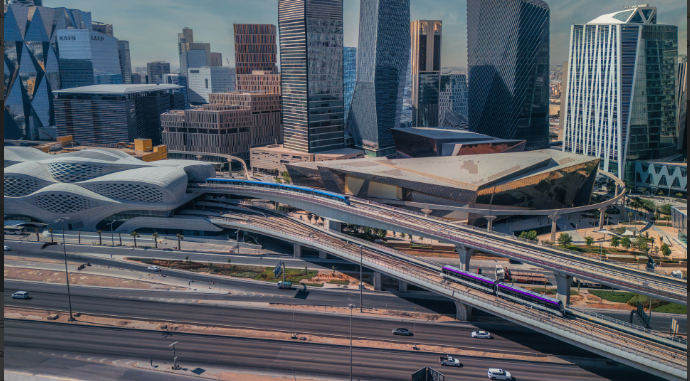
The report added that the electric train project includes (4) main stations at the intersection of the train tracks. The main stations are one of the most important factors for the success of the public transportation system in the city and a major factor to attract passengers because they are located in high-density areas and at the intersection of metro and bus tracks, while these stations are concerned with providing various services supporting the public transportation system, including public parking lots, ticket outlets, shops and customer service offices.
These stations are an added value to the public transportation project and a factor to improve the urban environment in the city. The project includes (5) stations to transfer between different train tracks and integrate with the bus network to facilitate the transfer of passengers between the levels of the public transportation network in Riyadh.
The Supreme Commission for the Development of Riyadh City organized an architectural competition in which it invited the most prominent architectural offices and companies specialized in the design of major public transport stations to submit innovative and advanced architectural and engineering designs for the four main stations of the electric train project.
Parking lots
The Authority has also provided (21) parking lots, each with a capacity of between 200 and 600 parking spaces to facilitate the use of the train network and the distribution of these sites at the level of the city in an appropriate manner that facilitates the transition from the private car to the train, in addition to the security and safety system by providing its requirements for passengers and facilities by providing the project facilities (cars and stations) with advanced surveillance systems that include surveillance cameras and early warning systems.
New Projects
The Supreme Authority for the Development of Riyadh explained that the work procedures for the Riyadh Metro project include the first group, which is track No. (1) the Al Olaya - Al Batha axis, track No. (2) the King Abdullah Road axis, the length of the tracks: 63.3 km and the number of stations 42 stations, while the second group includes track No. (3) axis of Medina Road - Prince Saad bin Abdulrahman Road, the length of the tracks 40.7 km and the number of stations 21 stations, and the third group for track No. (4) axis of King Khalid International Airport Road, then track No. (5) axis of King Abdulaziz Road, track No. (6) axis of Abdulrahman bin Ouf Road - Sheikh Hassan bin Hussein Road, the length of tracks 72.5 km, and the number of stations 32 stations.
The qualified consortium was invited to implement the electric train project on 13 Ramadan 1433 AH, and the Supreme Authority for the Development of Riyadh organized a meeting between the working team supervising the design and implementation of the electric train project and the competing consortiums to implement the project, during which the six train routes and their various elements and the requirements for submitting technical and financial bids were reviewed, and two field trips were organized to see the axes through which the train lines will pass.
Competition in the project
The report indicated that the project competition documents and documents included that the competitors submitted a clause related to the maintenance tasks of transportation systems for ten years, including train systems and control systems, maintenance of control and operation center systems, railway maintenance, passenger platform gate systems, security monitoring systems, access control systems, trip information systems, as well as electric power supply systems for trains, fiber optic network systems and information transmission.
Thus, the Riyadh Metro project consists of a total length of 176.1 kilometers with a total of 85 stations, the number of trains at the opening of the project is 202 trains (expandable in the future to 338 trains), and the capacity is estimated at 1.16 million passengers per day, which can be increased to 3.6 million per day in the future by increasing the number of trains and reducing transit times.
The bus network is designed to provide service at several levels: A high-level axial network, the second: Supporting circular network, the third: Secondary arterial network, and the fourth: A local network within residential neighborhoods. Accordingly, the network of bus lines was divided into four levels.
The bus project includes 4 categories of stations that match in their design, spaces and functions with the multiple levels of the network and will include the main stations.