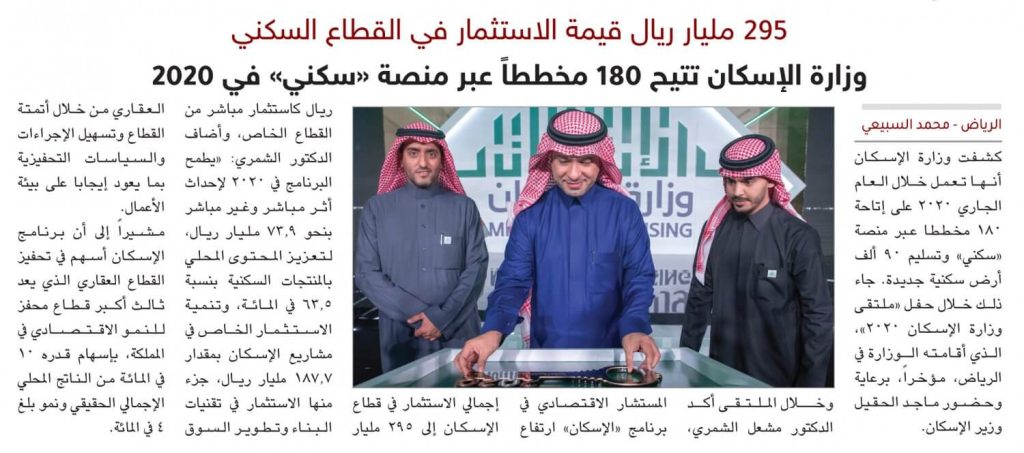

The Ministry of Housing seeks to enable citizens to build their own homes with high quality and at low cost, work toward creating a balanced housing market, and promote economic growth in various cities and provinces, thereby contributing to localization and increasing the contribution of the real estate sector and theconstruction sector to the gross domestic product, and to regulate the residential construction sector. This was explained by Minister of Housing Majed Al-Hogail during a recent meeting organized by the Eastern Province Chamber of Commerce at its headquarters in Dammam, during which he reviewed the Ministry of Housing’s strategy.
Unlimited support from the government
The Minister of Housing explained that the Ministry has received unlimited support from the Custodian of the Two Holy Mosques, the Crown Prince, and the Deputy Crown Prince. This is in an effort to serve citizens and achieve greater stability and economic and social well-being for them.He added that the Ministry has taken a number of urgent and carefully considered steps through a group of competent and experienced staff members, which contributed to the launch of a number of diverse programs, initiatives, and projects with a vision aimed at organizing and facilitating a balanced and sustainable housing environment, as well as creating and developing programs to stimulate the private and public sectors through cooperation and partnership in regulation, planning, and oversight to facilitate housing for all segments of society, noting that the Ministry of Housing has achieved a number of significant strides in implementation and planning within a short period of time. He explained that it is currently working to continue the allocation and delivery of the 100,000 housing units whose distribution began at the start of last Sha’ban.
Housing units
He explained that these housing units consist of ready-to-move-in residential units (villas and apartments), land plots, and financing solutions across all regions of the Kingdom. He noted that among these projects in the Eastern Province is the Hafar Al-Batin project, which has already been allocated and comprises 900 residential units, as well as other projects in Dammam, Al-Khobar, Al-Ahsa, and Al-Qatif, totaling over 10,000 housing units. This will be followed, God willing, by another package of housing units to meet the housing needs across the Kingdom.
The Minister of Housing stated that the Ministry has entered into a series of partnerships with a number of qualified and highly competent local and international real estate development companies in this sector to provide more housing units suitable for all segments, ensuring they are of high quality and reasonably priced. He added that the Ministry has signed agreements with more than 20 local real estate development companies, including two projects in Qatif Province comprising more than 16,000 housing units. Internationally, agreements have been signed with a Saudi-Korean consortium and a number of Egyptian companies, and an agreement was recently signed with Chinese companies to build 100,000 housing units in the Al-Asfar suburb of Al-Ahsa Governorate, and the Ministry is on the verge of signing agreements with more companies in various countries. He noted that the Ministry has launched a number of initiatives, including the White Land Fees Program, which aims to curb land hoarding and helps increase the rate of development within urban areas, thereby making land available at affordable prices and increasing the housing supply.
Land Tax Program
Al-Hogail explained that the program for fees on undeveloped land began in Riyadh, Jeddah, and Dammam, where more than 11 million square meters were identified within the targeted area, which covers 612 square kilometers—equivalent to 50% of theof the total urban area, which spans 1,181 square kilometers, as well as the «Itmam» Developer Services Center «Etmam,» which currently operates through its branches in Dammam, Jeddah, and Riyadh and helps expedite the approval of plans within a maximum of 120 days from the date of application, thereby facilitating the launch of more residential projects, as well as the «Owners Union» program, which aims to create a safe, organized, and sustainable environment for residential coexistence, and the "Ijar" program, which aims to restructure and regulate the rental market and organize the landlord-tenant relationship.
Off-plan sales
Al-Hogail added that among the initiatives is the "Wafi" off-plan sales program , which aims to reduce the costs of owning real estate units and protect buyers" rights through regulations and procedures that ensure this, as well as increase transparency in the real estate market and offer other benefits. This is in addition to the supporting programs provided by the Real Estate Development Fund, including the additional loan andadvance payments, in addition to continuing to disburse loans to citizens.
Stimulating real estate supply
Al-Hogail stated that the Ministry’s primary objective is to "stimulate real estate supply and increase productivity to provide housing products at appropriate prices and quality," through "forming partnerships with private-sector developers on Ministry-owned land to benefit citizens and participants in the housing support program specifically, developing informal settlements and city centers, regulating urban density, and utilizing public-sector land within the urban area through land swapsland swaps and activating the partnership program. He emphasized the Ministry’s focus on reducing construction costs and ensuring quality by promoting innovative industrial solutions, construction quality, and centralized procurement.
He noted that the Ministry is committed to "enabling citizens to access suitable housing finance, as the Ministry adopts several options in this regard, including mortgage guarantees, savings programs, and rent subsidies to facilitate savings and financial support for mortgage financing, as well as the development of eligibility programs and affordable and cooperative housing programs.
The Minister of Housing noted that one of the Ministry’s strategic objectives is to improve the Ministry’s own efficiency and performance from a financial standpoint and to ensure the sustainability of this resource. The Ministry has also established the National Housing Company and is working to develop human resources, internal audit programs,for electronic transactions, an information technology strategy, and the design of internal policies and procedures.
Housing and the Kingdom’s Vision 2030
For his part, Abdulrahman Al-Ateishan, Chairman of the Eastern Province Chamber of Commerce, said that the real estate sector has received growing attention from our wise government, which has directed various forms of support to bring about real development in the sector. This is clearly reflected in the size of the financial allocations for the housing sector in the National Transformation Program 2020, estimated at more than 59 billion riyals, as well as the significant developments in the regulatory environment of the real estate sector in the Kingdom, including the establishment of the National Real Estate Authority, the expansion of partnerships with real estate developers and owners’ councils, and other programs andinitiatives launched by the Ministry of Housing, all of which aim to reshape the real estate environment in terms of procedures and financing.