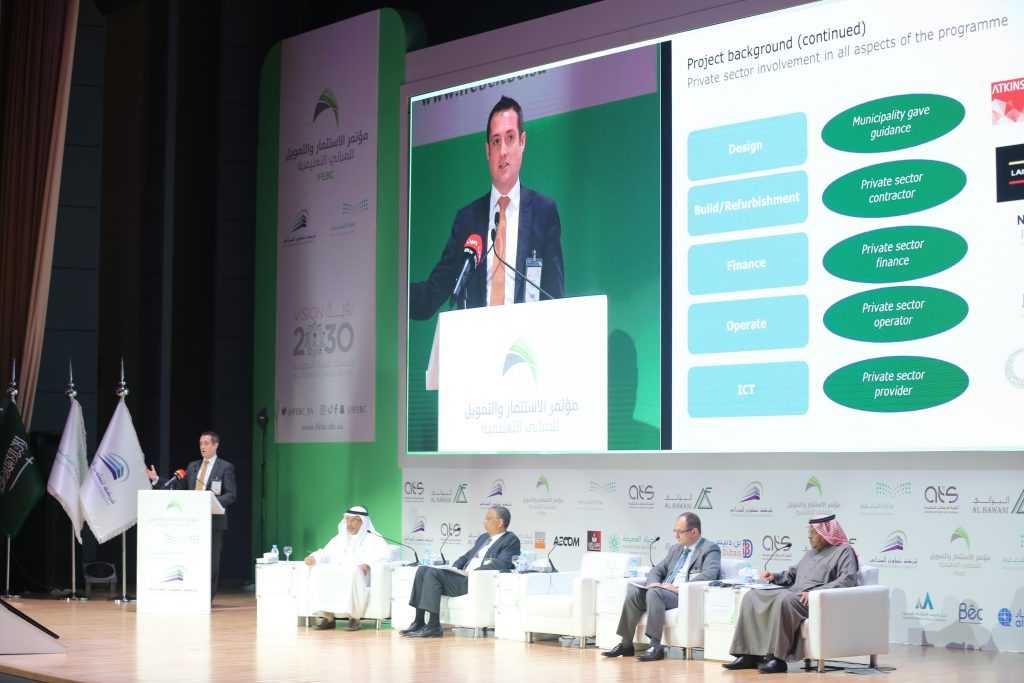

The conference on investment and financing for educational buildings, which concluded last Wednesday, highlighted a number of innovative solutions presented by several international experts participating in the conference during “Innovative Solutions for Investment and Financing in Educational Buildings.” These solutions included international models for achieving public-private partnerships in investing in government buildings. Hamed bin Mahmoud Zaghwa, CEO of Ecom Middle East, the American model, which has been applied for 20 years to establish partnerships with the private sector in the development of educational buildings. He noted that this system does not focus solely on the construction of educational buildings, but encompasses the entire life cycle of the educational building, from planning and architectural design to financing, furnishing, and even the management of educational buildings after completion.
CEO Zaghwa emphasized that among the benefits of implementing the public-private partnership model in investing in educational buildings are is reducing operational costs for the Ministry of Education, accessing the best expertise and practices in the construction of educational buildings, and implementing policies that facilitate access to the best innovative solutions.
For his part, Robin Peters, CEO of Deloitte Middle East, shed light on the British model for providing innovative solutions for investment and financing in educational buildings, noting that collaboration between local authorities in the United Kingdom and the private sector through an innovative financing system has resulted in the construction of 120 new schools.
In turn, Shadi Majas, a partner at McKinsey & Company, urged any investor intending to enter into a partnership with the government sector through a contract to ensure the presence of key elements, most importantly an understanding of the partner’s considerations and the economics of education, whether the project involves private education or public education represented by the Ministry of Education, ensuring the success factors and considerations of the partnership, and considering the benefits of such a partnership.
For his part, Director General of Private Education Mohammed bin Eid Al-Otaibi noted that the Ministry oversees 4,287 private schools, including 1,940 international schools, and 33 private universities and colleges, noting that the total number of students across all levels of private education stands at 1,153,983 according to statistics from 1437/1438 AH.
He explained that the number of students in private education currently stands at 15.5%, and the Ministry aims to increase this figure to 25.1%, noting that market growth in the private education sector rose from 12.51% in 1435 AH to 15.51% in 1437 AH, emphasizing that these figures demonstrate opportunities for partnership between the Ministry of Education and the private sector to further expand private education by building private schools, early childhood preschools, institutes, language centers, and supervision and training centers, which the Ministry supports through real estate grants and soft loans.