
A report released today, April 11, 2017, by “Orient Planet Research,” an independent unit of the “Orient Planet Group,” revealed that family-owned businesses in the Gulf Cooperation Council (GCC) countries continue to build a strong presence and make a significant impact on the global economic landscape, yet they simultaneously face numerous challenges within the current highly competitive business environment amid the rapid developments of the 21st century.
The “Orient Planet Research” report, titled “Family Businesses in the Arabian Gulf: Facing Challenges,” highlighted the main challenges affecting the family business sector in order to find effective solutions to address them optimally, with a particular focus on obstacles arising from corporate governance and the issue of generational leadership succession, which are among the oldest methodologies used in organizing family businesses and managing
business. The report attributed these challenges related to governance, finance, and leadership succession to a number of influencing factors, the most significant of which are the spread of globalization and the increase in the number of family members across generations, as well as the growth in the size of family businesses and the difficulties they face in planning leadership succession.
Nidal Abu Zaki, General Manager of “Orient Planet Group,” said: “Family businesses have proven to be active contributors and key drivers of comprehensive development in the Arab Gulf states, where they have made unprecedented social and economic contributions, particularly in terms of creating promising job opportunities for both citizens and residents, as they are a fundamental pillar of growth and development in any country. Looking at the regional economic landscape, we find that many of the leading companies in the Gulf are family-owned. Today, these companies continue to move forward to solidify their influential role in shaping the future, supported by numerous competitive advantages that reinforce their superiority over other types of companies, particularly in terms of commitment to quality and a strong focus on employee well-being. At the same time, however, they face significant management challenges due to family considerations and other factors. The “Orient Planet Research” report identifies the best long-term solutions to ensure continuity and high productivity in the face of key emerging trends that hinder family businesses.”
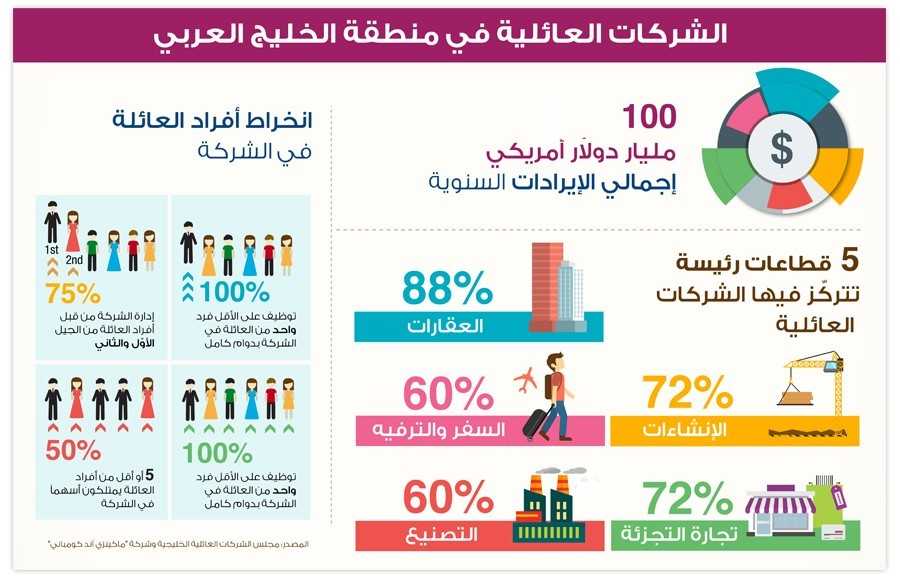
The report noted that a number of major international companies listed on stock markets are family businesses, including one-third of the companies selected for the “Fortune Global 500” list published by the American magazine Fortune. Specialized statistics indicate that family businesses account for between 70 and 80 percent of all private sector companies in the Gulf Cooperation Council (GCC) countries, underscoring the pivotal role of family businesses as the backbone of the region’s economies. According to the latest list of the 65 wealthiest families, the average net family wealth in Saudi Arabia reached $6 billion, followed by the United Arab Emirates and Kuwait, while the average net family wealth in the Middle East and North Africa region reached $4.5 billion. In contrast, the largest Gulf family businesses collectively generate annual revenues of US$100 billion, equivalent to 367.3 billion UAE dirhams, according to a recent study conducted by the Gulf Family Business Council (GFBC) and McKinsey & Company.
The report confirmed that family businesses, which are the second-largest contributor to national economies after the government sector, play a pivotal role in driving local economic growth in the Gulf Cooperation Council (GCC) countries and are a key element in the region’s development equation, explaining that a number of family businesses, which began as entrepreneurial ventures 50 to 60 years ago, have focused on diversifying their business portfolios and establishing numerous leading economic groups that currently support the region’s comprehensive development, as the vast majority of these family businesses are concentrated within five main sectors, foremost among which is the real estate sector.
Following a study of a number of major Gulf family businesses, the report’s findings revealed that adopting a structured approach to governance represents a crucial step, given expectations that leadership succession and the transfer of management from one generation to the next will continue over the next five to ten years, especially since more than half of Gulf family businesses are currently preparing to transfer management from the second to the third generation of the family, while many appear unprepared to implement a leadership succession policy. According to a study by McKinsey & Company, only 15 percent of family businesses undergoing a generational transition will be able to maintain their market presence, as only 17 percent of family businesses in the Arabian Gulf adopt effective assessment approaches to define the roles and responsibilities assigned to the next generation of the family.
In terms of corporate governance, the report emphasized the urgent need to apply higher standards that would enable family businesses to better access favorable financing opportunities and enhance their competitiveness in attracting foreign investment and top talent. Although business owners view corporate governance as a key factor in ensuring successful business management, the report indicates that most have yet to adopt the latest global corporate trends and cultures.
Conversely, the report “Family Businesses in the Arabian Gulf: Facing the Challenges” that succession planning enables companies to develop and facilitate the transfer of management from one generation to the next in a gradual and thoughtful manner that ensures continuity for shareholders, employees, customers, and stakeholders, while simultaneously enhancing the company’s reputation and brand value in the market, highlighting the importance of leadership succession planning in achieving a balance between skills and practical experience within the company.
Many regional companies have chosen to address the two main challenges of corporate governance and leadership succession planning, based on effective methodologies and policies designed to ensure long-term growth and success, as well as enhancing transparency, efficiency, and productivity, increasing the ability to attract capital and promising talent, streamlining management structures, and improving workflow. Given that focusing on these two areas will raise the level of professionalism and competitiveness of family businesses on the global stage, the report emphasized the need to implement a comprehensive approach to change management at both the theoretical and operational levels.
The report also highlighted strong cultural and family ties as key factors in family business management, noting that family businesses in the Arabian Gulf region, which tend to be larger than their counterparts in Europe and North America, place great emphasis on corporate governance and leadership succession as part of their relentless efforts to enhance their competitiveness on the global business landscape. Regarding addressing challenges related to leadership succession, the report recommended that family businesses offer their shares for public subscription to increase immediate cash flows that can later be used to develop the companies“ businesses. While Gulf governments
are focusing on promoting women’s participation in comprehensive economic and social development, the report emphasized the importance of involving female talent in family businesses to actively contribute to talent development, which would yield significant benefits on both the family and professional levels. In conclusion, the ”Orient Planet Research” report emphasized the need for family businesses to take proactive measures to address internal challenges and respond effectively to external issues in light of increasingly competitive business environments in the era of globalization.