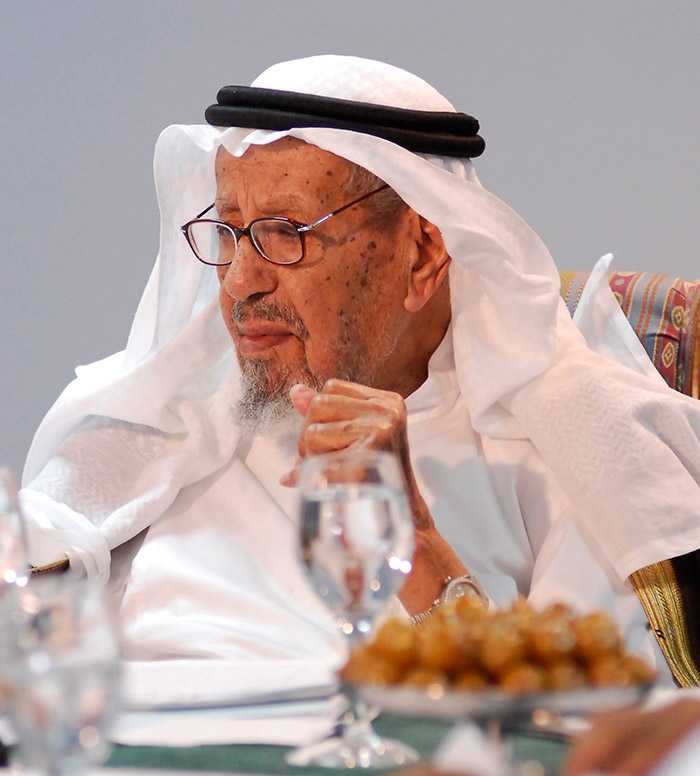

At the age of nearly 100, the renowned philanthropist and businessman Sheikh Muhammad Ibrahim Al-Subaie—may God have mercy on him—on Friday, August 18. He was considered one of the most prominent businessmen and founders of the nonprofit charitable sector in the Kingdom, and throughout his life, he set a wonderful example of selflessness, standing by those in need, supporting charitable projects and Quranic centers, and encouraging learning by establishing and organizing scientific competitions—including the Sheikh Mohammed and and Abdullah Al-Subaie Award for Excellence and Scientific Research.
The Birth of Sheikh Muhammad Al-Subaie
Sheikh Muhammad was born in Unaizah in 1333 AH, where he recited half of the Holy Quran under the guidance of Sheikh Abdulaziz Al-Damgh—may Allah have mercy on him—and was dedicated to his studies, continuing his education at Al-Falah School in Makkah Al-Mukarramah. He complied with his uncle’s wish to leave school and join the family business. His father, Ibrahim, passed away in Madinah in the month of Sha’ban of the year 1344 AH; he had been working with the most prominent commanders of King Abdulaziz, may Allah have mercy on him. As for their mother, she was ”Noura bint Nasser al-Amash“ from the Al-Bada’i Governorate in Al-Qassim, a member of a devout and educated family who passed away in 1404 AH.
The young boy Muhammad al-Sibai decided to travel to Makkah al-Mukarramah with his uncle ”Nasser,“ and this decision proved to be a source of blessing and sustenance for him; For at that time, Mecca was a gathering place for merchants from around the world; as is well known, pilgrims and Umrah performers flocked there, in addition to its proximity to the port of Jeddah.
Struggle and Diligence in the Early Years of Life
The early years of Sheikh Al-Sibai—may Allah have mercy on him—were marked by perseverance in seeking a livelihood and searching for even the smallest opportunities to rise from a state of poverty and deprivation to one of sufficiency, as he supported his small family after his father’s death, where he worked as a water carrier for his uncle in exchange for a meager wage so that the thirteen-year-old could help his family. After several months, he left this job and began searching for another, more lucrative one, so he turned to construction work for a few piastres until an acquaintance, Ibrahim Al-Fareeh—may God have mercy on him—interceded on his behalf to secure him a position at King Abdulaziz’s palace as a foreman, earning one Majidi riyal per day; (equivalent to 22 piastres). Muhammad al-Subaie worked in numerous professions, including as a cook for one year and 10 months, and he learned to drive and sew—though he was unable to purchase a sewing machine due to its high price. He also worked as a carpet peddler, walking the streets, until the year 1349 AH brought good news—a reward for his patience and self-reliance—when he secured a government job (road inspector) that paved the way for his success.
(Road Inspector)... Ambition and Business
Sheikh Muhammad Ibrahim Al-Subaie—may God have mercy on him—possessed a tenacious work ethic and ambition, which qualified him in the year 1349 AH to take a government position titled ”road inspector.“ The salary was attractive at the time, amounting to about thirty riyals, in addition to numerous benefits, including food, drink, and housing. At that time, Muhammad decided to bring his mother and his brother Abdullah to live with him, After four years in that position, his nostalgia and ambition for trade were rekindled, and he returned to Makkah al-Mukarramah, where he went into business with Sulayman bin Ghuneim, one of Makkah’s merchants, Since Ibn Ghuneim wished to visit his relatives and family in the Eastern Province, he agreed through his uncle Nasser to a partnership whereby the latter would accept the fabrics, headscarves, and turbans in Ibn Ghuneim’s shop in exchange for 950 riyals, Although these goods were worth no more than 500 riyals, Al-Subaie agreed because he was convinced of the importance of this partnership and determined that it would be his first step into the world of commerce. Ibn Ghneim decided to keep his partner ”Muhammad“ in Mecca while he himself moved to Riyadh; this led Muhammad to invite his brother Abdullah to join the partnership that had marked their beginning.
The Banking Profession and the Founding of Al-Bilad Bank
Al-Subaie’s partnership with Suleiman bin Ghuneim was imbued with a spirit of love and loyalty, and thus lasted 28 years, until it was dissolved with the utmost smoothness in 1382 AH, after which he began a successful business journey with his brother Abdullah in various fields, such as money changing and trade, conducted with integrity and honesty. During their stay in the Hejaz, the two brothers gained a broad perspective and deep insight into the cultures, characteristics, and many customs of various peoples. They worked in the money exchange business, and continued their work in this field until they went on to play an active role in establishing one of the most modern Saudi banks today, Al-Bilad Bank.
The Concept of Partnership in Charitable Work
The Mohammed and Abdullah Ibrahim Charitable Foundation is considered one of the most distinguished charitable institutions that funds and supports the development of projects. It is registered with the Ministry of Social Affairs under number (22), and is dedicated to social, health, relief, educational, cultural, and developmental services, as well as all forms of charity and benevolence within the Kingdom of Saudi Arabia, in accordance with priorities, within the framework of Sharia guidelines and applicable regulations, based on the conditions set by the founders: Sheikh Muhammad bin Ibrahim Al-Subaie and his brother Sheikh Abdullah bin Ibrahim Al-Subaie. Through institutional efforts and a qualified team, the foundation supports charitable institutions, associations, and offices operating in the field, thereby realizing the concept of partnership in charitable work.
The charitable foundation works with its affiliates in complete integration and harmony to support acts of charity, build individuals and society, advance charitable work, and achieve sustainable development through a motivating institutional environment and a qualified team.
Sheikh Al-Subaie’s Approach to Charitable Work
Sheikh Al-Subaie—may God have mercy on him—and his brother Abdullah established important principles to consolidate charitable work through institutional efforts and channels that ensure beneficiaries fully benefit from the programs and affirm their right to support and the completion of their projects. Among these principles are:
- Working in partnership with entities involved in developing and supporting charitable work without engaging in executive operations.
- Supporting projects that serve the charitable sector, taking into account the permanence and magnitude of the reward, the extent of benefit to the recipient, and the alignment of the projects with the foundation’s strategic plan.
- Supporting organizations that do not have any security, legal, administrative, or financial issues; this is done after investigating and verifying the organization’s eligibility and merit for support or partnership according to scientific criteria that ensure quality outcomes, while monitoring and evaluating their work.
- Ensuring the reliability of partner organizations, as well as their commitment to clarity, transparency, and institutional accountability.
- Disbursements for projects and programs shall be made in accordance with approved budgets.
- The charitable foundation engages in media outreach to showcase examples of charitable work.
- The foundation is committed to distributing zakat to its legitimate recipients in accordance with its approved fatwa.
Sons Following in Their Father’s Footsteps
Sheikh Muhammad Al-Subaie—may God have mercy on him—had three sons: Ibrahim, Nasser, and Abdulaziz, and they are following in their father’s footsteps. They have asked those who loved him and wish to publish obituary condolences in the newspapers to transfer the cost of the advertisement to the account of the Charitable Society for the Care of Orphans (Insan).