
News: Muhammad al-Amin Jamous
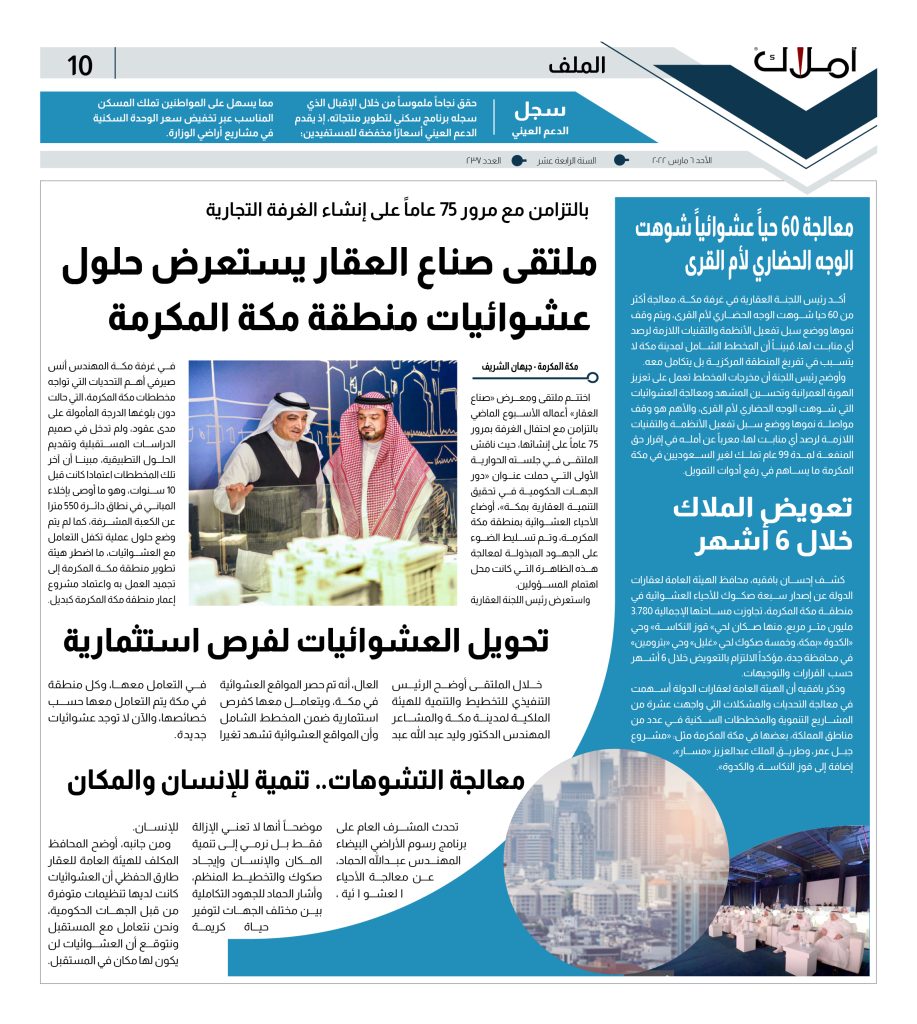
The «Real Estate Makers» concluded its proceedings last week in conjunction with the Chamber’s celebration of its 75th anniversary. During its first panel discussion, titled “The Role of Government Agencies in Achieving Real Estate Development in Mecca,” the conditions of informal settlements in the Mecca region, and highlighted the efforts being made to address this issue, which has been a focus of attention for officials.
In his opening remarks, Engineer Anas Sayrafi, Chairman of the Real Estate Committee at the Makkah Chamber of Commerce, reviewed the most significant challenges facing Makkah’s urban planning, which have prevented the city from reaching its desired level of development for decades, nor have they been central to future studies or the development of practical solutions. He noted that the most recent of these plans was approved 10 years ago, which recommended the evacuation of buildings within a 550-meter radius of the Kaaba, Furthermore, no practical solutions were developed to address informal settlements, forcing the Makkah Region Development Authority to suspend implementation of that plan and adopt the Makkah Region Reconstruction Project as an alternative.
====
Addressing 60 Informal Settlements That Have Marred the Urban Landscape of Umm al-Qura
The chairman of the Real Estate Committee at the Makkah Chamber of Commerce confirmed that more than 60 neighborhoods that have marred the cultural image of the Mother of Cities have been addressed, and that their growth is being halted while measures are being put in place to enforce the necessary regulations and technologies to monitor any new developments. He explained that the comprehensive plan for the city of Mecca does not depopulate the central area but rather complements it.
The committee chairman explained that the plan’s outcomes serve to strengthen the urban identity, improve the landscape, and address the informal settlements that have marred the cultural image of the Mother of Cities, and, most importantly, halt its continued growth and establish ways to implement the necessary regulations and technologies to monitor any new developments. He expressed his hope that a 99-year right of use would be granted to non-Saudis in Makkah, which would help increase financing options.
====
Compensation for Landowners Within 6 Months
Issuance of seven deeds covering an area of 3.780 million square meters
Ihsan Bafqih, Governor of the General Authority for State Real Estate, announced the issuance of seven deeds for informal settlements in the Makkah region, with a total area exceeding 3.780 million square meters, including two deeds for the ”Quz al-Nakasa” and “Al-Kadwa“ neighborhoods in Mecca, and five deeds for the “Ghalil” and “Petromin” neighborhoods in the Jeddah Governorate, affirming the commitment to provide compensation within six months in accordance with the relevant decisions and directives.
Bafqih noted that the General Authority for State Real Estate has helped address the challenges and issues faced by ten development projects and housing plans in several regions of the Kingdom, some of which are in Makkah, such as: “the Jabal Omar Project, King Abdulaziz Road (“Masar”), as well as Quz al-Nakasa and al-Kadwa.”
======
Turning Informal Settlements into Investment Opportunities
During the forum, the Chief Executive Officer of Planning and Development for the Royal Commission for Makkah and the Holy Sites, Engineer Dr. Walid Abdullah Abdul-Aal, explained that informal settlements in Makkah have been identified, and that they are being treated as investment opportunities within the comprehensive plan. He noted that the approach to dealing with informal settlements is changing, with each area in Mecca being addressed according to its specific characteristics, and that there are currently no new informal settlements.
======
Addressing Irregularities... Development for People and Places
Engineer Abdullah Al-Hammad, General Supervisor of the White Land Fees Program, spoke about addressing informal settlements, explaining that this does not mean mere demolition, but rather aims to develop both the area and its people, establish legal titles, and implement organized planning. Al-Hammad highlighted the collaborative efforts among various agencies to provide a dignified life for residents.
For his part, Tariq Al-Hafzi, Acting Governor of the General Real Estate Authority, explained that informal settlements had previously been regulated by government agencies, but we are looking toward the future and expect that informal settlements will have no place in it.
 العربية
  English