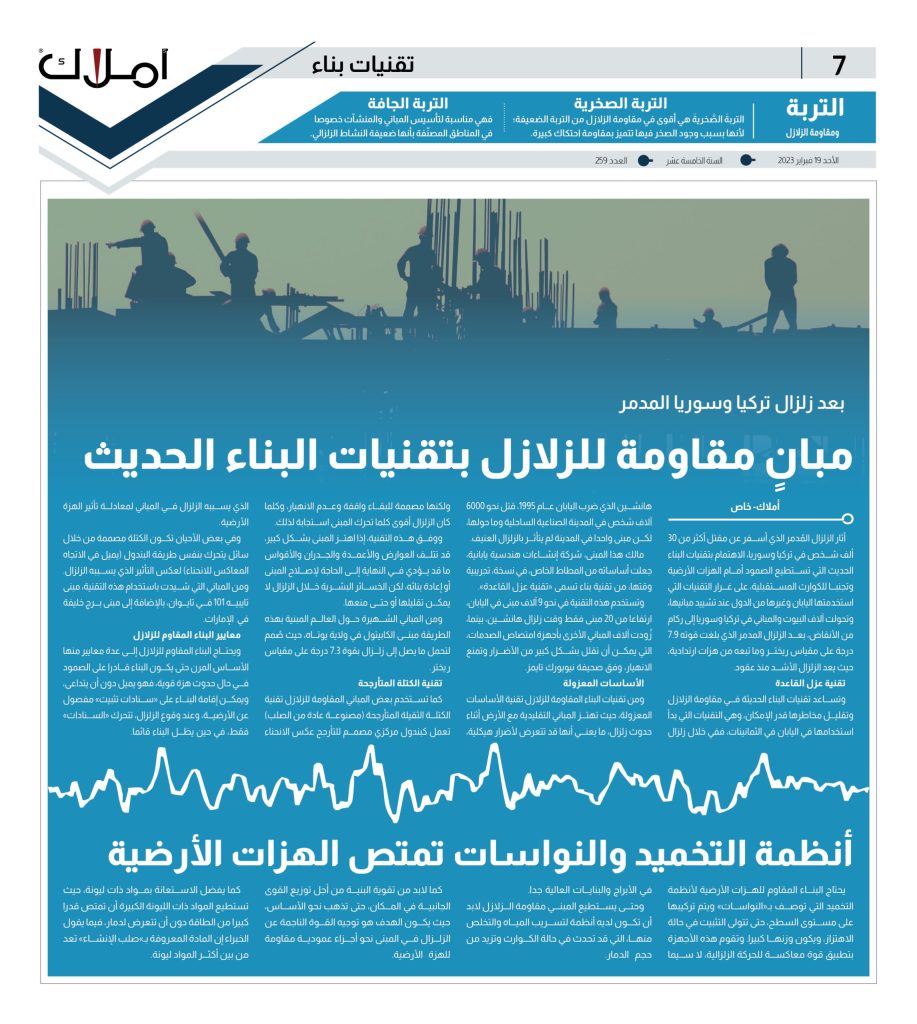

Private property: The The devastating earthquake in Turkey and Syria that killed more than 30,000 people in the two countries, attention to modern construction techniques that can withstand earthquakes and avoid future disasters, similar to the techniques used by Japan and other countries when constructing their buildings, and thousands of houses and buildings in Turkey and Syria turned into rubble, after the devastating earthquake, which reached a magnitude of 7.9 on the Richter scale and subsequent aftershocks, the most severe earthquake in decades.
Base isolation technology
Modern building techniques help resist earthquakes and minimize the risk of earthquakes, techniques that began to be used in Japan in the 1980s. During the 1995 Hanshin earthquake that hit Japan, about 6,000 people were killed in and around the coastal industrial city, but one building in the city was not affected by the violent earthquake.
Owner of this building. The owner of this building, a Japanese engineering construction company, made its foundations out of special rubber, in a then-experimental version of a construction technique called "base isolation technology."
Base isolation technology. <The technique is used in about 9,000 buildings in Japan, up from just 20 at the time of the Hanshin earthquake, while thousands more have been fitted with shock absorbers, which can significantly reduce damage and prevent collapse, according to the New York Times.
Insulated foundations
Traditional buildings shake with the ground during an earthquake, which means they may suffer structural damage, but are designed to remain standing and not collapse, and the stronger the earthquake, the more the building will move in response.According to this technique, the building is designed to remain standing and not collapse, and the stronger the earthquake, the more the building will move in response. According to this technique, if the building shakes too much, the beams, columns, walls and arches may be damaged, which may eventually lead to the need to repair or rebuild the building, but human losses during an earthquake cannot be minimized or even prevented.
Many of the world's most famous buildings are designed to remain standing and not collapse. Famous buildings around the world built in this way include the Utah State Capitol, which was designed to withstand up to a 7.3 magnitude earthquake.
Swing mass technology
Some earthquake-resistant buildings also use a heavy swinging mass technology (usually made of steel) that acts as a central pendulum designed to swing against the earthquake-induced bending of the buildings to offset the effect of the tremor.
Some earthquake-resistant buildings also use a heavy swinging mass technology. <Sometimes the block is designed with a fluid that moves in the same way as the pendulum (tilting in the opposite direction of the bending) to reverse the effect caused by the earthquake. Buildings constructed using this technique include the Taipei 101 building in Taiwan, as well as the Burj Khalifa in the UAE.
Standards for earthquake-resistant construction
Earthquake-resistant construction needs several criteria, including a flexible foundation so that the building is able to withstand in the event of a strong tremor, it leans without collapsing, and the building can be built on "anchors" separated from the floor, and when an earthquake occurs, only the ”anchors” move, while the building remains standing.
Resistant construction needs several criteria, including a flexible foundation so that the building can withstand a strong tremor.
=== ===
Damping systems and anchors absorb earthquakes
<Earthquake-resistant construction needs damping systems, described as "anchors," which are installed at roof level, to stabilize the structure in case of shaking, and have a large weight. These devices apply a counterforce to the seismic movement, especially in towers and very tall buildings. In order for a building to resist earthquakes, it must have water leakage and disposal systems, which may occur in the event of disasters and increase the size of the destruction.It is also necessary to strengthen the structure in order to distribute the lateral forces in the place, so that they go towards the foundation, where the goal is to direct the force caused by the earthquake in the building towards vertical parts that are resistant to the earthquake.
It is also preferable to use softer materials, as materials with great ductility can absorb a large amount of energy without being destroyed, and experts say that the material known as "structural steel" is among the most ductile materials.
Reinforcing the structure to distribute the lateral forces in the place, so that they go towards the foundation, as the goal is to direct the force caused by the earthquake in the building to vertical parts that resist the earthquake.