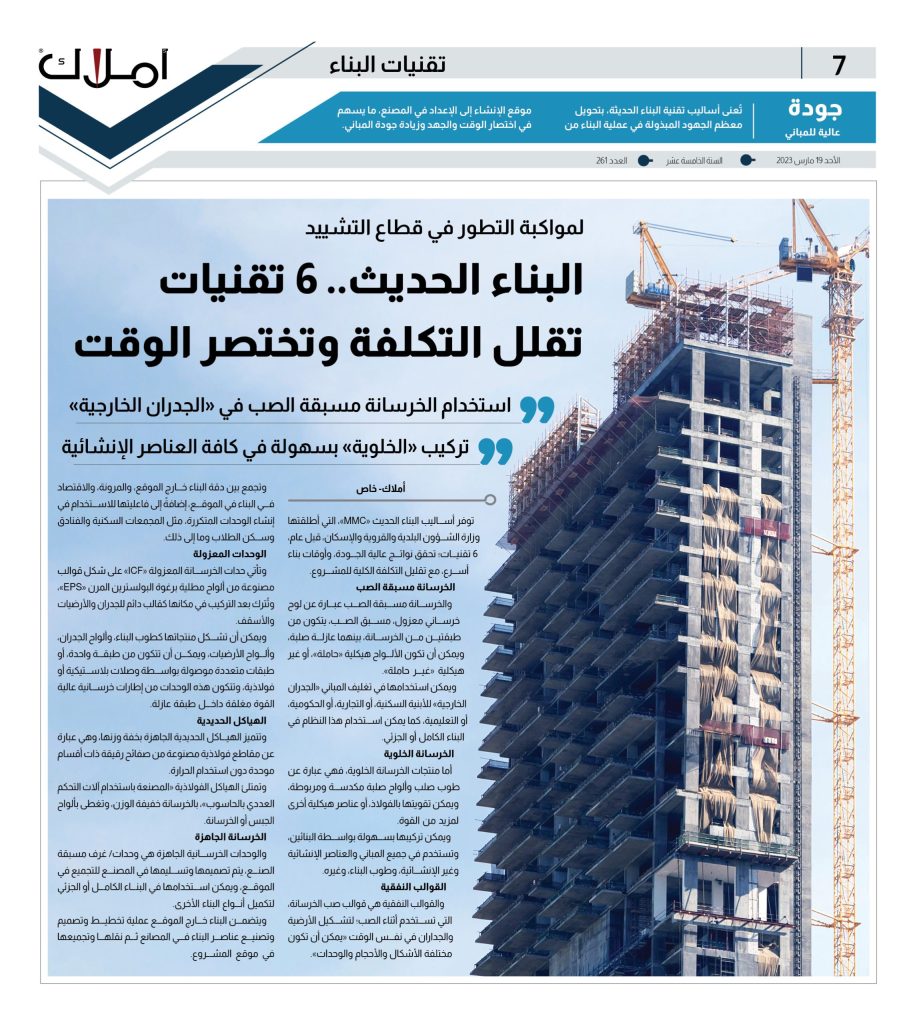

Modern Construction Methods
- The use of precast concrete in «exterior walls»
Easily install «cellular» in all structural elements
- Using «tunnel templates» to create repetitive modules
Modern Construction Methods (MMC), launched a year ago by the Ministry of Municipal and Rural Affairs and Housing, provides 6 techniques to achieve high-quality outputs, faster construction times, and reduced overall project cost.
The Ministry seeks to adopt and apply modern construction methods as part of the housing system to keep pace with the development of the construction sector, instead of relying on traditional construction methods.
Precast concrete is an insulated, precast concrete slab consisting of two layers of concrete, with rigid insulation in between, and the slabs can be structural "load-bearing", or non-structural «non-load-bearing». Precast concrete.
Can be used for building envelope "exterior walls" of residential, commercial, governmental, or educational buildings, and the system can be used for full or partial construction.
The prefabricated concrete panels are precast at the manufacturing facility, and the thickness can vary depending on the structural and architectural requirements of the project. Aerated concrete products are solid bricks and slabs that are stacked and bonded, and can be reinforced with steel or other structural elements for added strength.
Cellular concrete is lightweight because it is made from a material that contains air bubbles and produces a lightweight, low-density material when heat-treated in autoclave furnaces. Cellular concrete is lightweight.
Easily installed by masons, it is used in all buildings, structural and non-structural elements, masonry bricks, etc.
Tunnel formwork is a concrete formwork, which is used during pouring to form the floor and walls at the same time "can be of different shapes, sizes and units". it combines the accuracy of off-site construction, flexibility, and economy of on-site construction, as well as its effectiveness for use in the construction of repetitive units, such as apartment complexes, hotels, student housing, etc. Modular units can be made of steel, aluminum, plastic, or fiberglass and are used for modular construction. ICF units come in the form of molds made of EPS foam-coated panels that are left in place after installation as a permanent mold for walls, floors, and ceilings. They can be formed as building bricks, wall panels, and floor panels, and can consist of a single layer, or multiple layers connected by plastic or steel joints, and these units consist of high-strength concrete frames sealed inside an insulating layer. Prefabricated steel structures are lightweight, steel sections made from thin sheets with uniform sections without the use of heat.
The "CNC-machined" steel structures are filled with lightweight concrete and covered with gypsum board or concrete.
These structures can be used in whole or in part to complement other types of construction. The plates are usually very thin (1-8 mm) and the surface of the plate is covered with a zinc alloy that protects the entire surface of the steel from corrosion due to environmental conditions. The thickness of the zinc coating can be varied to suit the type of environment. Precast concrete units are prefabricated units/rooms, designed and delivered at the factory for on-site assembly, and can be used in full or partial construction to complement other types of construction. Offsite construction involves the process of planning, designing and manufacturing building elements in factories and then transporting and assembling them at the project site. In this technique, almost the entire building is constructed off-site in separate, box-like modules, complete with attached walls, floor, roof, wiring, plumbing, and interior fixtures, and this system saves 50% time compared to traditional construction. Precast concrete
Cellular Concrete
Tunnel Formwork
Insulated modules
Ferrous Structures
Ready Concrete