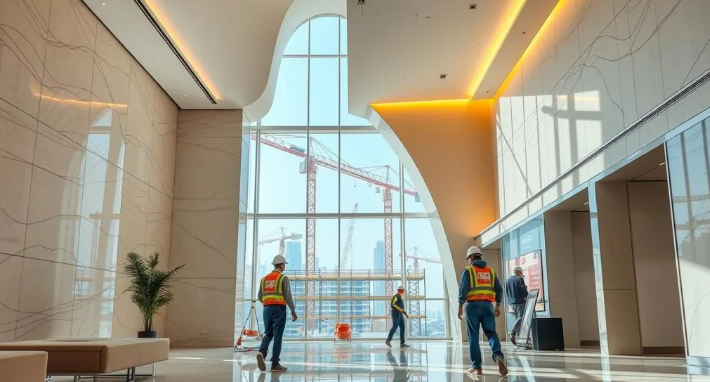

Renovation and adaptive reuse buildings has been at the forefront of architectural discourse in recent years, showing that the profession is becoming increasingly aware of its impact on the environment and the opportunities presented by reusing what has already been built.
Architecture 2030 recently launched CARE, a new digital tool that enables designers, owners and communities to quantify the carbon benefits of adaptive reuse by introducing
Architecture 2030 recently launched CARE «Retrofit for Estimated Carbon Avoidance,» a new digital tool that enables designers, owners and communities to quantify the carbon benefits of adaptive reuse. By entering a simplified set of project information, such as energy targets and potential building interventions, users can estimate the operational carbon emissions resulting from building use and the embodied carbon emissions associated with Construction used quickly.
Renovations are generally considered the most sustainable option due to their lower carbon footprint compared to new buildings, because renovations reuse the most carbon-intensive parts of the building, the foundation, structure and envelope.
Despite this intuitive conclusion, quantifiable data and information is hard to come by, and this gap is addressed by the CARE tool, which provides a comparison of the carbon footprint of existing reused buildings versus new construction.
The CARE tool takes the carbon footprint of existing reused buildings and compares it to that of new construction. The digital tool takes into account a series of variables such as interventions required to increase density or accommodate new uses, climate zone, grid density and existing building condition, the outputs are visualized as the total embodied and operational carbon over a specific time frame as well as the accumulated emissions over time.
Outputs are visualized as the total embodied and operational carbon over a specific time frame as well as the cumulative emissions over time. <Three scenarios are explored: Existing building, renovated building, and new construction, the results can be easily compared to aid in the decision-making process and determine the overall lower carbon approach and the timeframe in which this occurs.
Architect Hisham Al Qasim
@ArchHesham
Architect and faculty member at King Saud University