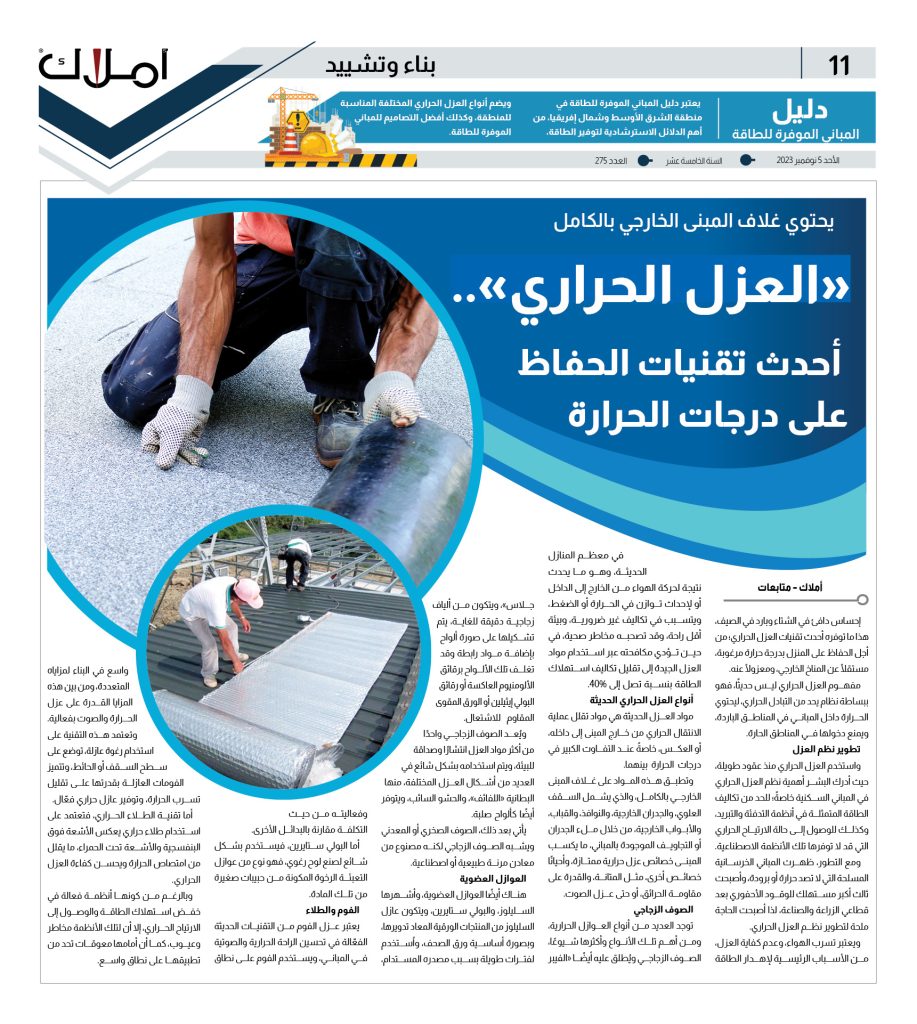

Thermal insulation...
The latest technologyTo completely enclose the building envelope
“Warm in winter, cool in summer”
This is what the latest thermal insulation technologies provide in order to keep the home at a desirable temperature, independent of and insulated from the outside climate.
The concept of thermal insulation is not new, it is simply a system that limits heat exchange, containing heat inside buildings in cold areas and preventing it from entering in hot areas.
Development of thermal insulation systems
Thermal insulation has been used for many decades, as humans realized the importance of thermal insulation systems in residential buildings in particular, to reduce the energy costs of heating and cooling systems, as well as to reach a state of thermal comfort that these artificial systems may not provide.
With the development, thermal insulation systems have emerged. With the development of reinforced concrete buildings that do not repel heat or cold, and have become the third largest consumer of fossil fuels after the agricultural and industrial sectors, so the need to develop thermal insulation systems has become urgent.
<Air leakage and inadequate insulation is one of the main causes of energy waste in most modern homes, which occurs as a result of air movement from outside to inside or to balance heat or pressure, and causes unnecessary costs, a less comfortable environment, and may be accompanied by health risks. Combating it with good insulation can reduce energy costs by up to 40%.
.
Modern thermal insulation types
Modern thermal insulation materials are applied. These materials are applied to the entire exterior building envelope, which includes the upper roof, exterior walls, windows, domes, and exterior doors by filling walls or cavities in buildings, giving the building excellent thermal insulation properties, and sometimes other properties such as durability, fire resistance, or even sound insulation.
Modern insulation materials are materials that reduce the process of heat transfer from the outside of a building to the inside, especially the difference in temperature between them.
Glass wool
There are many types of thermal insulators, one of the most important and most common types is glass wool, also called "fiberglass" and consists of very fine glass fibers, which are formed into panels by adding binders and these panels may be coated with reflective aluminum foil, polyethylene foil or flame retardant cardboard.
Glass wool is one of the most important and most common types of thermal insulators. <Glass wool is one of the most widespread and environmentally friendly insulation materials. It is commonly used in many different forms of insulation: blanket (rolls), loose fill, and is also available as rigid panels.
Next up is glass wool. Rock or mineral wool is similar to glass wool but is made from natural or synthetic flexible minerals.
Next comes rock or mineral wool and is similar to glass wool but is made from natural or synthetic flexible minerals.
Organic insulators
<Cellulose insulation is made from recycled paper products, mainly newsprint. Cellulose insulation is made from recycled paper products, mainly newsprint. It has been used for a long time due to its sustainable source and cost-effectiveness compared to other alternatives.Polystyrene is made from recycled paper products, mainly newsprint. <Polystyrene is commonly used to make foam board. It is a type of soft packaging insulation made up of small granules of the material.
Polystyrene is commonly used to make foam board.
Foam and paint
Foam insulation is a modern technology that is effective in improving thermal and acoustic comfort in buildings. Foam is widely used in construction for its many advantages, including the ability to effectively insulate heat and sound.
Foam insulation is based on a combination of foam and paint.
This technology is based on the use of insulating foam applied to the surface of a ceiling or wall. Insulating foams are able to minimize heat leakage and provide effective thermal insulation.
Foam insulation is characterized by its ability to minimize heat leakage and provide effective thermal insulation.
Thermal coating is a technique that uses a thermal coating that reflects ultraviolet and infrared rays, which reduces heat absorption and improves thermal insulation efficiency.
While thermal coating is not a new technology, it can be used to reduce heat leakage and provide effective thermal insulation. Although these systems are effective in reducing energy consumption and achieving thermal comfort, these systems have risks and drawbacks, and have barriers that limit their widespread application.