
Panorama about the Expo and the host country
Abdulrahman Al-Qut
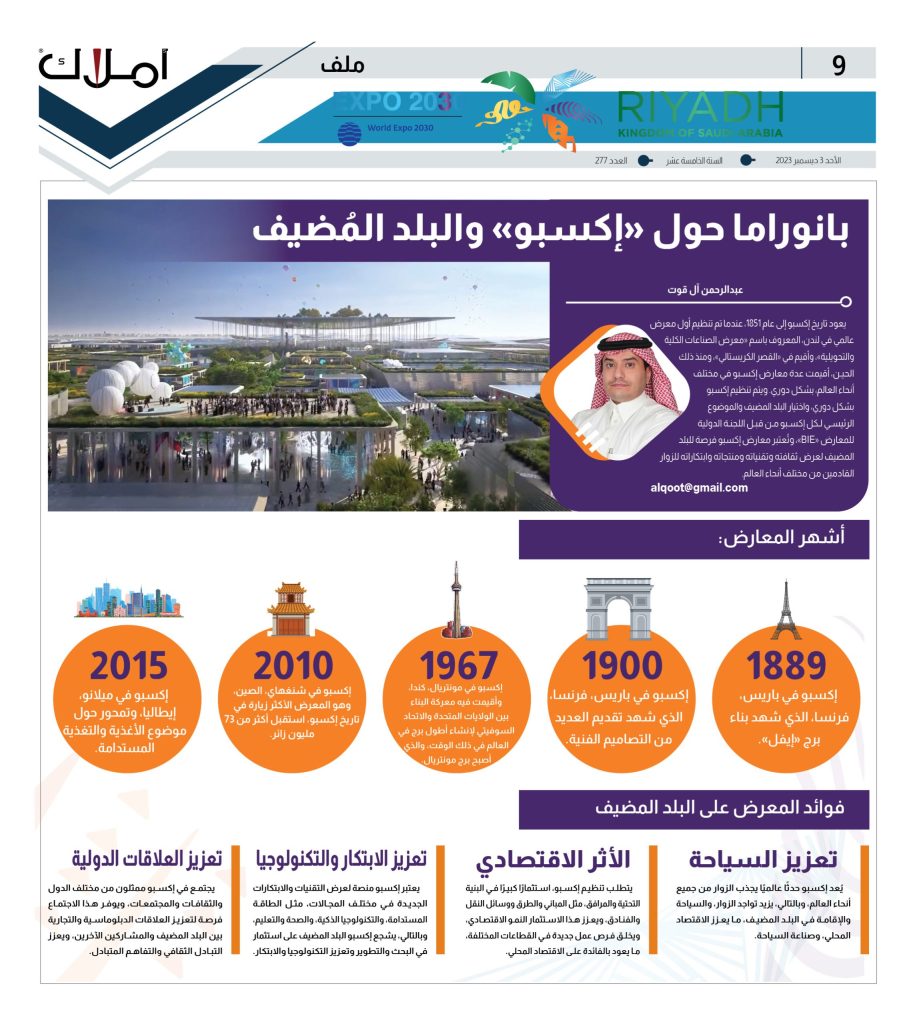
The history of Expo dates back to 1851, when the first World's Fair was organized in London, known as The Great Exhibition of the Works of Industry of All Nations, held at The Crystal Palace. Since then, several Expos have been held around the world periodically. Some of the famous Expos that have been organized include:
- Expo 1889 in Paris, France: the one where the Eiffel Tower was first built.
- Expo 1900 in Paris, France: The fair saw the introduction of many innovations and artistic designs.
- Expo 1900 in Paris, France: The fair saw the introduction of many innovations and artistic designs.
- Expo 1967 in Montreal, Canada: The construction battle between the United States and the Soviet Union for the tallest tower in the world at the time, which became the Montreal Tower.
- Expo 2010 in Shanghai, China: The most visited Expo in history, welcoming more than 73 million visitors.
- Expo 2015 in Milan, Italy: Centered around the theme of sustainable food and nutrition.
Benefits of the Expo for the host country.
Benefits to the host country:
▪️تعزيز Tourism: Expo is a global event that attracts visitors from all over the world. Consequently, the presence of visitors increases tourism and accommodation in the host country, boosting the local economy and tourism industry.
Economic impact: The Expo is a global event that attracts visitors from all over the world.
▪️ Economic impact: Organizing an Expo requires significant investment in infrastructure and facilities, such as buildings, roads, transportation, and hotels. This investment promotes economic growth and creates new job opportunities in different sectors, benefiting the local economy.
Economic Impact: Organizing an Expo requires significant investment in infrastructure and facilities, such as buildings, roads, transportation and hotels.
▪️تعزيز Innovation and technology: Expo is a platform to showcase new technologies and innovations in various fields, such as sustainable energy, smart technology, health and education. Thus, Expo encourages the host country to invest in research and development and promote technology and innovation in the country.
▪️تعزيز International Relations: Representatives from different countries, cultures and societies gather at Expo. This meeting provides an opportunity to strengthen diplomatic and commercial relations between the host country and other participants, and promotes cultural exchange and mutual understanding.
▪️ Promotion of cultural heritage: The Expo gives the host country an opportunity to showcase its cultural heritage, traditions and arts. Cultural events and performances are organized that highlight local culture and promote mutual understanding and respect for different cultures.
Sustainable: The Expo gives the host country an opportunity to showcase its cultural heritage, traditions and arts.
▪️التنمية Sustainable: The Expo focuses on issues of sustainable development and environmental challenges. Consequently, it urges the host country to apply sustainable practices in urban planning and environmental sustainability, contributing to the preservation of natural resources and the environment.
Sustainable: Expo focuses on sustainable development issues and environmental challenges.