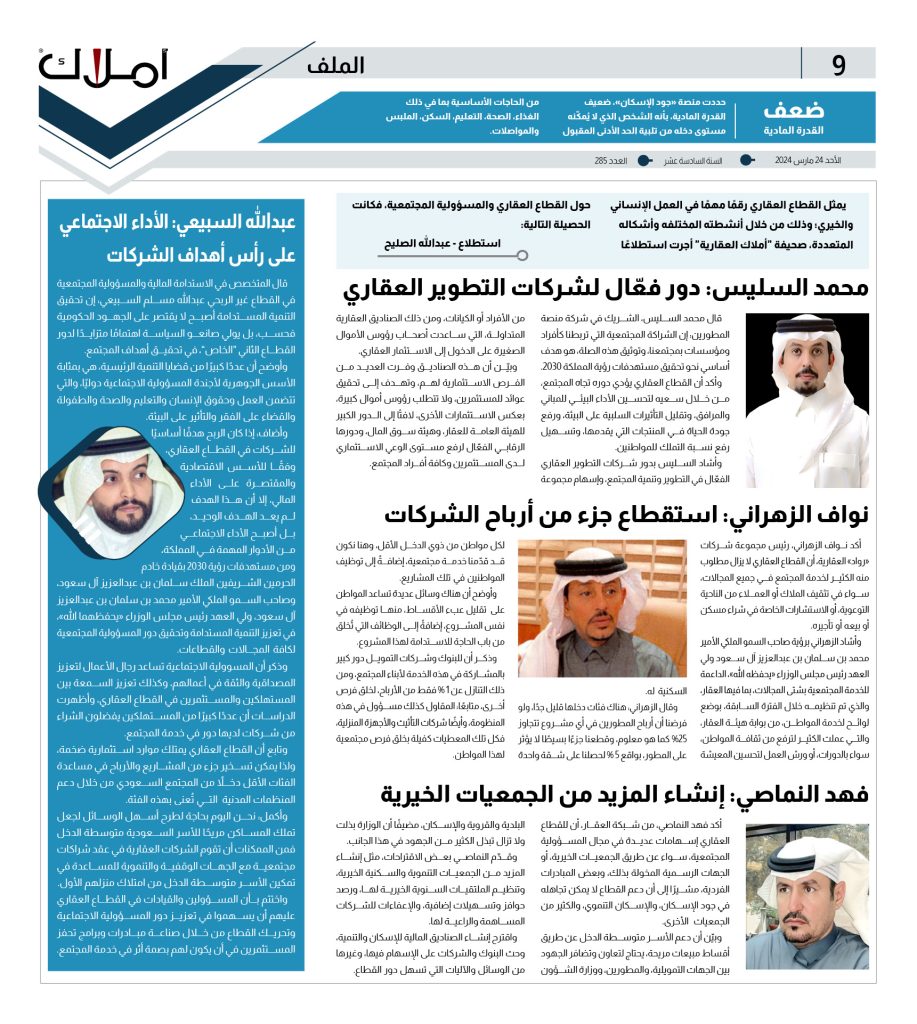

Survey: Abdullah Al-Salih: Represents real estate sector plays a significant role in humanitarian and charitable work through its various activities and forms. The “Amlak Real Estate” newspaper conducted a survey on the real estate sector and social responsibility, yielding the following results:
Mohammed Al-Salis: An Active Role for Real Estate Development Companies

Mohammed Al-Salis, a partner at Developers Platform, believes that the social partnership that connects us—as individuals and institutions—to our community, and the strengthening of this bond, is a fundamental goal toward achieving the objectives of the Kingdom’s Vision 2030, emphasizing that the real estate sector fulfills its role toward society by striving to improve the environmental performance of buildings and facilities, reduce negative impacts on the environment, enhance the quality of life in the products it offers, and facilitate an increase in homeownership rates among citizens.
Al-Salis praised the effective role of real estate development companies in community development, noting that a group of individuals and entities makes a significant contribution, including publicly traded real estate funds, which have helped small investors enter the real estate market and provided them with numerous investment opportunities. These funds aim to generate returns for investors, and do not require large amounts of capital, unlike other investments. He also highlighted the significant role of the General Real Estate Authority and the Capital Market Authority, as well as their effective regulatory oversight in raising investment awareness among investors and all members of society.
= =
Nawaf Al-Zahrani: Withholding a Portion of Corporate Profits

For his part, Nawaf Al-Zahrani, Chairman of the Rawad Real Estate Group, emphasized that the real estate sector still has much to contribute to serving society across all real estate sectors—whether through educating property owners and clients to raise awareness or providing specialized consultations on buying, selling, or renting a home.
Al-Zahrani praised the vision of His Royal Highness Crown Prince Mohammed bin Salman, may God protect him, which supports community service in various fields, including real estate. This vision was implemented during the previous period through the establishment of regulations to serve citizens via the Real Estate Authority portal, represented by the Ministry of Housing, which has worked extensively to enhance citizens“ knowledge—whether through courses or workshops—to improve their housing conditions.
Al-Zahrani said: ”Naturally, there are groups with very low incomes compared to employees in Grade 5 and above. If we assume, for the sake of argument, that developers" profits on any project exceed 25%, as is well known, and we allocate a small portion—5%—that does not affect the developer, we would be able to provide one apartment for every low-income citizen. This, for example, would constitute a service to the community. Likewise, by employing citizens in these projects within the homeowners" association, we would also create jobs."
Al-Zahrani explained that there are numerous ways to help citizens reduce the burden of their mortgage payments, such as employing them within the same project in the homeowners" association or creating jobs necessitated by the project’s sustainability, He noted that banks and finance companies play a major role in participating in this service for the community; Banks and finance companies generate profits; if they were to waive a portion not exceeding 1%, they would also create other opportunities. Similarly, if we consider the contractor, they are also responsible alongside us in this system and could set aside 1% of their profits, as well as furniture and home appliance companies. Al-Zahrani believes, from his perspective, that all these factors are sufficient to create community opportunities for citizens.
= =
Fahd Al-Namasi: Establishing more charitable organizations

On the same topic, Fahad Al-Namasi of Al-Aqar Network emphasized that the real estate sector makes numerous contributions to social responsibility, whether through charitable organizations, authorized government agencies, or individual initiatives, noting that the sector’s support cannot be overlooked in the areas of affordable housing, development-oriented housing, and many other initiatives.
Al-Namasi noted that supporting middle-income families through affordable housing installment plans requires cooperation and joint efforts between financing institutions, developers, and the Ministry of Housing, adding: "The Ministry has made and continues to make significant efforts in this regard.
In conclusion, Al-Namasi offered several suggestions, such as establishing more charitable housing and development associations, organizing annual charity fundraisers for them, and providing additional incentives, facilities, and tax exemptions for companies that contribute to and sponsor them, as well asestablishing financial funds for housing and development and urging banks and companies to contribute to them, along with other means and mechanisms that facilitate the sector’s role.
= =
Abdullah Al-Subaie: Social Performance Tops Companies" Priorities

Abdullah Muslim Al-Subaie, a specialist in financial sustainability and social responsibility in the nonprofit sector, said: Achieving sustainable development is no longer limited to government efforts alone; rather, policymakers are paying increasing attention to the role of the "private« sector in achieving societal goals.
He explained that a large number of key development issues serve as the fundamental pillars of the international social responsibility agenda, which includes labor, human rights, education, health, children’s welfare, poverty eradication, and environmental impact.
He added: "While profit is a fundamental goal for companies in the real estate sector—in accordance with economic principles and limited to financial performance—this goal is no longer the sole objective. Rather, social performance has become one of the key roles in the Kingdom, and is one of the objectives of Vision 2030, led by the Custodian of the Two Holy Mosques, King Salman bin Abdulaziz Al Saud, and His Royal Highness Prince Mohammed bin Salman bin Abdulaziz Al Saud, Crown Prince and Prime Minister—may God protect them both— in promoting sustainable development and fulfilling the role of social responsibility across all fields and sectors.
He noted that social responsibility helps businesspeople enhance credibility and trust in their businesses, as well as strengthen their reputation among consumers and investors in the real estate sector. Studies have shown that a large number of consumers prefer to purchase from companies that play a role in serving the community.
He went on to say that the real estate sector possesses vast investment resources, and therefore a portion of projects and profits can be channeled toward assisting lower-income segments of Saudi society by supporting civil society organizations that serve this demographic.
He continued: Today, we need to introduce the easiest ways to make homeownership affordable for middle-income Saudi families. It is possible for real estate companies to form community partnerships with endowment and development agencies to help enable middle-income families to own their
He concluded by stating that officials and leaders in the real estate sector must contribute to strengthening the role of social responsibility and driving the sector forward by creating initiatives and programs that encourage investors to make a meaningful impact in serving the community.