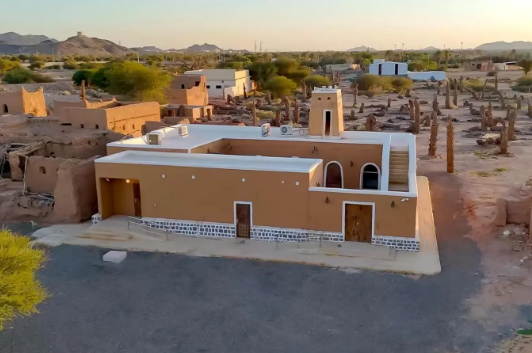

Proceeds Prince Mohammed bin Salman’s project to develop historic mosques is now in its second phase, presenting a unique model for preserving the Kingdom’s architectural heritage. It includes the Al-Abbasa Mosque in Abu Arish Governorate in the Jazan region, one of the oldest historic mosques in the region and one of its most prominent heritage landmarks.
The project aims to restore the mosque in accordance with its distinctive architectural style, using original natural materials, while preserving its three domes, which are a unique architectural feature.
The Al-Abbasa Mosque dates back to 1262 AH, and its architectural design reflects the traditional style of the region, having been constructed with stone and fired brick. The mosque is distinguished by its mihrab, which is adorned with a panel engraved with verses from the Quran and inscribed with the date of its construction, making it a testament to the site’s rich history. Following its renovation, its area will reach 435.38 m², accommodating approximately 165 worshippers, while preserving its intricate heritage details.
Al-Abbasah Mosque is part of the second phase of the project, which includes 30 historic mosques spread across 13 regions in the Kingdom, including 6 mosques in Riyadh, 5 in Makkah, 4 in Madinah, 3 in Asir, 2 each in the Eastern Province, Al-Jawf, and Jazan, and 1 each in the Northern Border, Tabuk, Al-Baha, Najran, Hail, and Al-Qassim.
The project is based on four main objectives:
- Rehabilitating historic mosques for worship and prayer.
- Restoring their architectural authenticity and heritage.
- Highlighting the cultural dimension of the Kingdom of Saudi Arabia.
- Enhancing the religious and cultural significance of these mosques.
The project aligns with Saudi Vision 2030, which focuses on highlighting and leveraging authentic architectural identity in the development of modern mosque designs, thereby strengthening the connection between the present and the past and affirming the vital role of these religious and historical landmarks.