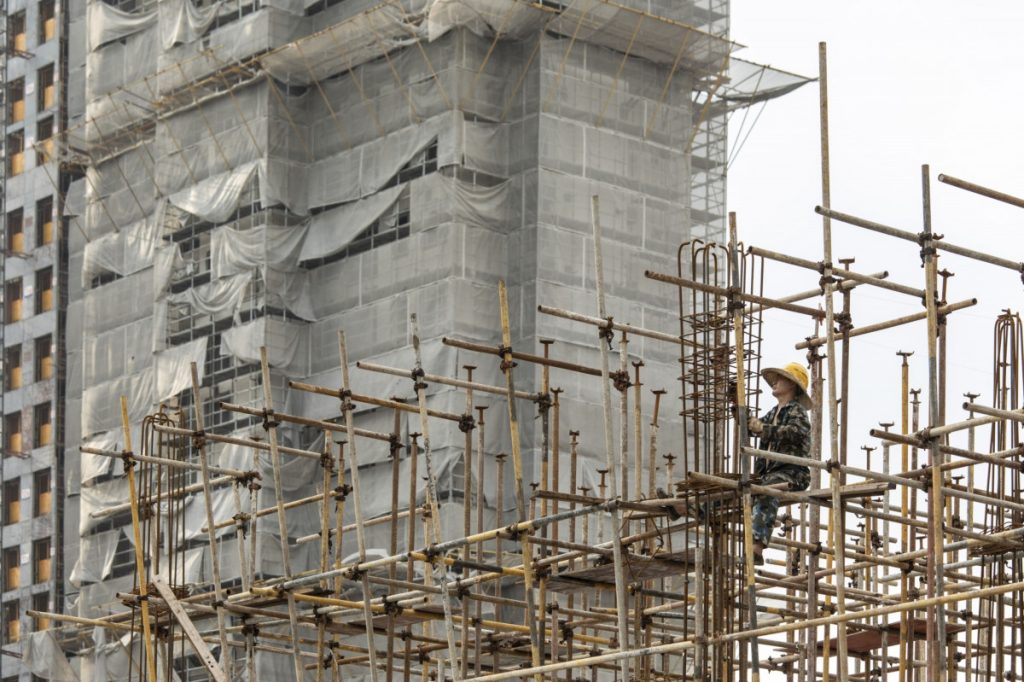

New home prices in China posted their biggest monthly drop in seven months in May, a fresh sign of the depth of the crisis facing the world's second-largest economy and further motivation behind the Chinese government's repeated pledges to revive the ailing real estate market.
Data from China's National Bureau of Statistics (NBS) showed on Monday that new home prices in 70 Chinese cities - excluding state-subsidized housing - fell in May.
<Data from China's National Bureau of Statistics showed on Monday that new home prices in 70 Chinese cities - excluding state-subsidized housing - fell 0.22% from April, which saw a smaller decline of 0.12%. Existing home prices fell at a sharper pace of 0.5%, the biggest decline in eight months.
The data comes amid clear signs that the impact of the stimulus measures launched in September 2024, which were intended to support the real estate market by easing lending restrictions and providing incentives to developers and buyers, is fading. However, the continued decline in prices reflects the weak response, at a time when investor and consumer confidence is still hesitant.
<“We expect the downturn in China's real estate market to continue through 2025, but at a slower pace than in 2024,” UBS analysts wrote in a recent research note.
An April UBS survey of 2,500 respondents indicated that the majority of respondents expect prices to continue to fall in the coming period, which could exacerbate buying hesitation and further stagnate the market. UBS analysts wrote in a recent research note.
Stimulus erodes, confidence wanes
Growing pressure on government policies
<Against this backdrop, the Chinese government is being forced to step up interventions. At a State Council meeting on Friday, Premier Li Keqiang pledged to take new measures to halt the deteriorating real estate market, the official CCTV network reported.
Premier Li vowed to take new measures to halt the deterioration of the real estate market, according to the official CCTV network.
Chinese leaders announced this policy direction in September 2024, followed by a package of stimulus measures, but these steps do not appear to have stabilized the market so far.
China's leaders announced this policy direction in September 2024, followed by a package of stimulus measures, but these steps do not appear to have succeeded in achieving the desired stabilization so far. <The central government will continue to coordinate existing and new fiscal and monetary policies in an effort to strengthen their impact and stimulate demand, especially as corporate profits and household incomes come under pressure from the ongoing real estate downturn, state media reported on Monday.
Fears extend to 2025
The outlook for China's real estate market remains negative, albeit to a lesser extent. Analysts expect the sector to remain in decline over the next year, unless deeper and more comprehensive measures are taken.
The outlook for China's real estate market remains negative, albeit less severe. Once a key driver of economic growth, China's real estate market is now a major source of concern, with growing concerns about its impact on the broader financial system and stagnant domestic demand.
The outlook for China's real estate market remains negative, albeit sharply so, as analysts expect the sector to remain in a downturn next year, unless deeper and more comprehensive measures are taken.