White land... between the right to sell and the duty to develop
Dr. Abdulhakim bin Abdullah Al-Kharji
<White land is not a silent space waiting to be traded, but a real test moment for the city's relationship with planning, and the market's ability to distinguish between an inherent right to act and a fair condition for its exercise. A sale, however legitimate in itself, does not have its full effect unless it is practiced at the right time, within a context that makes the land viable before it is tradable.<The transition of land from «whiteness» to urban viability is not achieved by paperwork alone, nor by completing formalities, but when the basic elements that give housing a sense of stability are completed. The road that leads to the place, streets, water and sewage networks, electricity, telecommunications, and flood drainage are not details that are added to the scene later, but its deep structure. When the sale opens before these elements are completed, the need for them does not disappear, but is postponed, and turns from a clear prior obligation into a subsequent burden that is silently distributed.
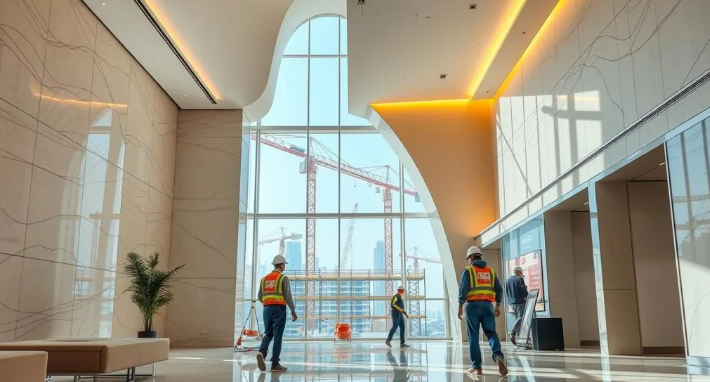
In the northern extensions. <In the northern stretches of Riyadh, on Sulbukh Road, this imbalance is evident. Buildings have risen, villas have been completed, and residential life is beginning to take shape, while streets have not yet been completed, and services have not stabilized to match this acceleration. Construction is present in abundance, but infrastructure is still in a catch-up position, as if the reality was imposed on it to meet its requirements later, not to lead it from the beginning.
The project may materialize. <Legitimacy may be achieved in terms of form, with land meeting accreditation requirements and licenses being issued according to legal frameworks, but this does not mean that the conditions of urban justice are complete. Selling land that has not yet been prepared does not remove the obligation to prepare, but rather redistributes its cost temporally and financially, moving it from a specific responsibility to an ambiguous obligation shared by the parties, with the city bearing an undisclosed portion of the consequences.
While this path may be legitimized in form, the land meets the requirements for approval and licenses are issued in accordance with legal frameworks, this does not mean that the conditions of urban justice are met. <While this path may appear to be market-inducing and quick payback, experience shows that what is initially short-circuited is later paid for twice over. Implementing infrastructure after neighborhoods have formed is more expensive, less efficient, and more complicated to regulate. As these cases accumulate, they do not remain isolated exceptions but become a pattern that pressures urban planning, drains public resources, and weakens the quality of urban growth in the long run.
Human impact. <The human impact goes beyond the lack of service to a prolonged state of waiting. Waiting for a safer road, a more regular service, and an environment that feels complete. This waiting, when prolonged, affects confidence in the market, the relationship to the place, and the very meaning of stability. <It is rumored, but not confirmed, that there was a regulatory trend in previous years that required the completion of infrastructure before authorizing the sale of white land. If this trend is true or has been established in a binding form, it reflects an advanced legislative awareness that regulating the market is not by restricting ownership, but by controlling the timing of its exercise, in order to protect the city before the cost of neglect becomes an irreparable reality. While such an obligation does not exist today in its explicit form, it is still needed from the perspective of balanced planning and the public interest. <In the end, the debate is not about preventing sales or stopping development, but about a fair order of phases. Land that is sold before it is ready may be transferred, but it does not fulfill its urban function. A city that is built in haste pays for it quietly and over a longer period of time. Rational development is the one that starts with prepared land and ends with a city that is less expensive, more stable, and more clearly defined for the future.
Dr.
@Dr_alkharji