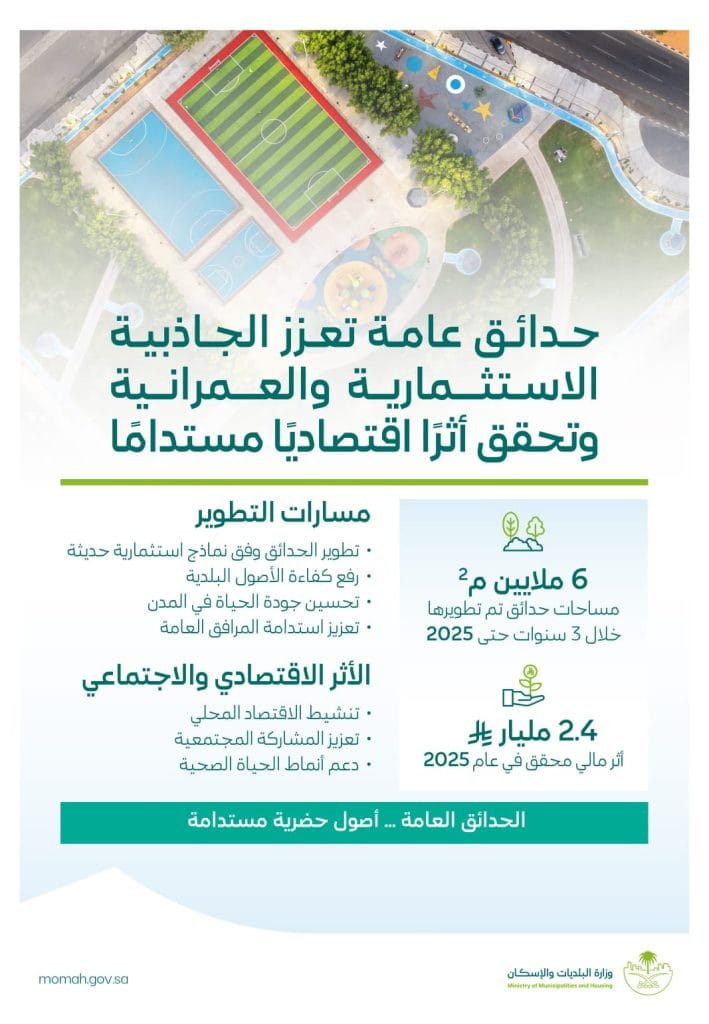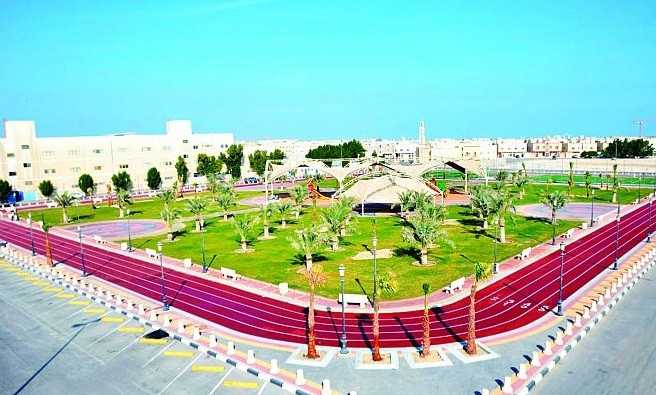

The Ministry of Municipalities and Housing revealed the development of approximately 6 million m² of public gardens in various regions of the Kingdom over the past three years until the end of 2025, through investment models in partnership with the private sector, which contributed to achieving a financial impact estimated at 2.4 billion riyals during 2025.
The official spokesperson for the Ministry of Municipalities and Housing, Mohammed bin Abdullah Al Rassama, explained that this expansion is a continuation of the ministry’s approach to maximizing the efficiency of municipal assets and transforming them into effective development elements, with a focus on improving the quality of life in cities through the development and operation of public gardens in accordance with modern models that enhance operational efficiency, improve the visitor experience, and ensure the sustainability of these vital facilities.
He pointed out that the ministry works in collaboration with the secretariats to develop sustainable models of partnership with the private sector that achieve financial sustainability and preserve the environmental and social identity of the parks, as open facilities that serve various segments of society while maintaining their general character and community role.
He pointed out that the scope of activities within the parks is undergoing a qualitative development, as they are no longer limited to traditional services; rather, they now encompass an integrated system of recreational, sports, and cultural activities, alongside commercial services designed to harmonize with the surrounding environment, thereby enhancing the attractiveness of the parks and transforming them into vibrant urban destinations.
He added that this diversity reflects the ministry's approach to developing gardens as integrated urban platforms that contribute to revitalizing the local economy and enhancing community participation, while maintaining their primary function as open facilities that support healthy lifestyles and enhance the quality of life.
He emphasized that the investment models adopted by the ministry contribute to covering part of the operating and maintenance costs, in addition to achieving capital savings through the private sector's implementation of construction, development, and operational activities, which enhances the efficiency of municipal spending and alleviates the burden on the public purse.
He also explained that the introduction of modern operational concepts and quality services contributed to improving the level of services within the parks, increasing their attractiveness, and increasing the rates of attendance, thereby solidifying their position as one of the most prominent elements of the urban landscape.
The Rasamsa statement pointed out that these efforts come within the framework of expanding municipal investments through the “Opportunities” portal for investment in Saudi cities, which continues to offer quality opportunities to support cities’ efforts to improve the efficiency of the use of urban assets and transform them into potential for local economic activity.
He added: “The investment ratio was determined based on meticulous technical studies that ensure balance between the economic dimension and the community role of the gardens, while being adaptable to project needs and feasibility studies, without affecting the green spaces or the quality of the visitor experience.”
It is reported that the Ministry of Municipalities and Housing continues to work on expanding the scope of these development models, thereby enhancing the role of public gardens as sustainable urban assets that effectively contribute to supporting the local economy and improving the quality of life.